


Through an expansive digital magazine and a discipline-focused social network, Chilean architect Mariela Pimentel Valdivia is building something larger than a professional platform: an open territory where architecture, photography, design and art can meet on more equal ground.
There is a quiet form of inequality in the creative world.
It does not always appear in laws, contracts or institutional declarations. It appears in distance: between the artist working in a peripheral city and the cultural centres where recognition is concentrated; between an emerging architect’s first sketch and the international publications capable of making it visible; between those who create and those who control the spaces in which creation is validated.
Talent may exist everywhere, but access rarely does.
From Santiago, Chile, Estudio Arquitectos is attempting to redraw that map. Led by architect and founder Mariela Pimentel Valdivia, the project brings together two interconnected digital spaces: EstudioArquitectos.cl, an architectural practice and vast editorial platform, and Red.EstudioArquitectos.cl, a specialised social network created for architects, designers, photographers, artists, landscape professionals and other makers of the inhabited world.
Together, they form an unusual cultural proposition: a place where the finished building and the unfinished thought are given equal dignity.
Architecture Beyond Property
Architecture is often discussed through ownership: who commissioned a building, who financed it, who inhabits it and whose name appears on the project.
Yet architecture is also a shared cultural condition.
A wall changes the light received by others. A tower modifies a skyline that belongs to an entire city. A public bench can produce companionship or exclusion. A garden can become refuge, memory or border. Even the most private building participates in a collective territory.
This understanding is present throughout Estudio Arquitectos. The practice works across exterior architecture, interiors, conceptual exploration and Kinda Line, its experimental approach to outdoor furniture and play environments. Its stated philosophy places the user, the surrounding landscape and the possibilities of space at the centre of each project. About Estudio Arquitectos
The result is not a fixed visual signature imposed on every site. It is a way of listening.
Materials are treated as forms of language. Light is allowed to reveal time. Structure is not hidden behind decoration but invited to participate in the emotional character of a place. Architecture becomes less concerned with producing an isolated object and more interested in creating a relationship between bodies, materials, climate and memory.
Under Pimentel’s direction, the practice proposes that good architecture should not merely be observed. It should create conditions in which life can unfold with greater meaning.
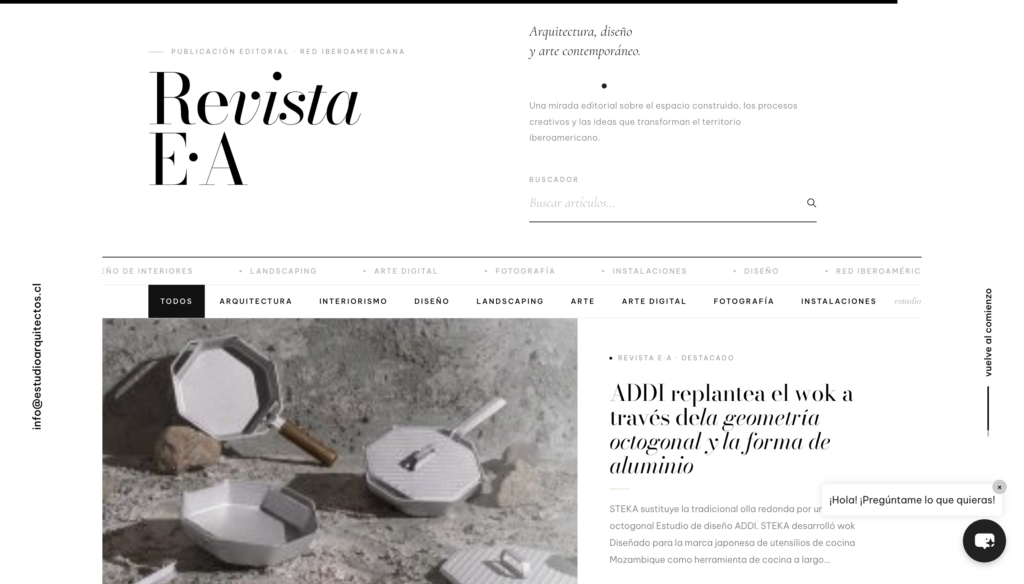
A Magazine Without Narrow Borders
The editorial world of EstudioArquitectos.cl extends far beyond the conventional boundaries of an architectural publication.
Its magazine moves through architecture, interior design, photography, visual art, landscape, installations, digital art, materials, technology and international culture. It treats these subjects not as separate industries but as neighbouring territories.
That distinction matters.
When architecture is separated from art, it risks becoming merely technical. When art is separated from territory, it can lose contact with the social realities that give it urgency. When photography is treated only as decoration, its power as evidence and memory is diminished.
Estudio Arquitectos creates room for these disciplines to coexist.
According to figures displayed by its own digital ecosystem, the platform contains more than 100,000 published articles, giving it an exceptionally extensive Spanish-language editorial archive devoted to architecture and the wider creative world. Platform information
Scale, however, is only part of its significance.
The deeper value lies in the removal of artificial hierarchies. A major international building can exist beside a study of local materials. An emerging photographer’s way of seeing can enter the same cultural conversation as an established designer. Landscape is not treated as background, nor interior design as ornament. Each discipline is recognised as part of the larger question of how human beings occupy the Earth.
The magazine therefore functions as more than a stream of information. It is a constantly expanding atlas of creative thought.
Visibility as a Form of Justice
In the arts, visibility is not a superficial concern. It determines who is remembered, who is commissioned, who receives opportunities and whose ideas become part of the historical record.
Traditional media structures have often depended on limited pages, metropolitan networks and institutional gatekeepers. Digital publishing promised to change that reality, but many general-interest platforms reproduced the same inequalities through algorithms that reward spectacle, repetition and existing popularity.
Estudio Arquitectos approaches visibility differently.
Its editorial territory is defined by disciplines rather than celebrity. Architecture, photography, art and design are not interruptions within an endless entertainment feed; they are the reason the platform exists.
This creates the possibility of a more equitable cultural space—one where recognition can emerge from the substance of the work, the clarity of an idea or the honesty of a documented process.
Equality does not mean pretending that every work is identical. It means ensuring that different voices can reach the field under fairer conditions.
It means allowing a student in southern Chile, a photographer in Colombia, a designer in Mexico and an architect in Spain to enter the same conversation without first asking permission from the geographic centres that have historically defined cultural relevance.
The Social Network as a Creative Commons
If the magazine is an atlas, Red.EstudioArquitectos.cl is the public square drawn within it.
The network was designed specifically for architects, designers, photographers, artists, urbanists, landscape professionals and creators working across the spatial disciplines. Its central statement—“The process is the work”—challenges the polished perfection that dominates conventional social media.
Here, a project does not need to be complete to deserve attention.
A sketch can be published before it becomes a structure. A construction photograph can reveal the intelligence hidden beneath a finished surface. A failed material test may be as valuable as the final solution. A reflection written during uncertainty can help another creator understand their own practice.
The network gives its members the ability to create profiles, document projects, publish work in progress, enter thematic groups, access technical resources and participate in conversations with peers. The platform reports more than 1,200 registered members and communities organised around residential architecture, photography, urban design, interior design, landscape, art, BIM and technology. Explore the creative network
Unlike general platforms, its purpose is not to make every form of human attention compete inside the same feed. It creates a defined cultural environment where creative work can be encountered by people capable of understanding its questions.
That focus gives the network its distinctive value.
The Right to Participate in Culture
The separation between creator and audience is becoming increasingly unstable. A photographer can also be a researcher. An architect may publish criticism. An artist can document territorial change. A landscape designer can become an environmental historian through the careful recording of a single site.
Red Estudio Arquitectos embraces these overlapping identities.
Its members are not asked to remain inside rigid professional categories. They can share technical documents, photographs, ideas, unfinished experiments and personal observations. A profile becomes a living portfolio, evolving alongside the person rather than freezing them into a single professional image.
The network’s free registration model also carries a symbolic importance. It recognises that participation in a creative community should not be reserved only for those with institutional support or the ability to purchase visibility.
Access alone cannot eliminate every inequality in architecture or the arts. But it can create the first condition for change: a shared space in which people are able to appear, speak, observe and be discovered.
A more equal creative field begins when presence is no longer a privilege.
Photography and the Democracy of Memory
Photography plays a particularly important role across both platforms because it stands at the threshold between art and evidence.
An architectural photograph can preserve a building, but it can also preserve a way of living. It records how light entered a room, how people occupied a square, how a wall aged, how vegetation reclaimed an abandoned structure or how a neighbourhood looked before development altered its scale.
Estudio Arquitectos treats this practice as a cultural act rather than a purely commercial service.
Its editorial work explores architectural photography as a dialogue between geometry, time, atmosphere and collective memory. In the Chilean context—where earthquakes, urban transformation and environmental conditions constantly reshape the built landscape—the photographic image becomes a form of protection against disappearance. Architectural photography as urban memory
A photograph cannot prevent the physical loss of a place. It can, however, resist its complete erasure.
By giving photography equal standing alongside architecture, design and art, the platform recognises that creating space and remembering space are inseparable cultural responsibilities.
Territory Is More Than Land
Territory is often described through maps, property lines and administrative borders. But territory is also made of stories, rituals, materials, migrations and images.
A territory exists in the timber chosen for a southern home. It exists in the shadow cast across a city pavement. It exists in the colour of a market, the rhythm of a façade and the memory of a building that no longer stands.
The two Estudio Arquitectos platforms approach Ibero-America as a living cultural geography rather than a fixed region.
Santiago, Buenos Aires, Lima, Bogotá, Mexico City, São Paulo, Madrid and Lisbon appear not as distant creative capitals competing for attention, but as points in an interconnected field. Between them are smaller cities, rural landscapes, coastal settlements and individual studios whose work may now enter a broader conversation.
This is one of the project’s most poetic possibilities: the construction of a territory that is not conquered, owned or divided, but shared through knowledge.
Mariela Pimentel and the Architecture of Connection
Mariela Pimentel’s most ambitious project may ultimately be neither a house nor an interior.
It may be the invisible architecture connecting these people, disciplines and territories.
Through the professional work of Estudio Arquitectos, she explores how physical environments can carry identity. Through the magazine, she expands the language used to understand them. Through the social network, she opens that conversation to a wider community.
These are different forms of the same architectural act.
One builds with materials. Another builds with information. The third builds with relationships.
Together, they suggest that architecture’s future will depend not only on what professionals design, but also on the conditions under which knowledge is shared, talent is recognised and cultural participation becomes possible.
A Space Where More Voices Can Exist
The creative world does not suffer from a shortage of talent. It suffers from unequal distribution of attention.
Some works are illuminated immediately. Others remain beyond the visible horizon—not because they lack value, but because they were created far from the institutions, publications and networks that decide what deserves to be seen.
Estudio Arquitectos is attempting to widen that horizon.
Its magazine offers an immense editorial landscape where architecture can coexist with art, photography, design and technological exploration. Its social network gives creators a specialised environment in which the process matters as much as the result and participation is not defined solely by geography, prestige or professional status.
This is not equality as uniformity. It is equality as spatial generosity.
It is the creation of enough room for different disciplines, origins and stages of experience to exist without cancelling one another.
Architecture has always been the art of organising space. In this project, that space is also cultural, digital and human.
And perhaps that is the most important structure Mariela Pimentel and Estudio Arquitectos are building: not a monument standing above the territory, but a common ground upon which more people can create, speak and be seen.
Discover the editorial platform: EstudioArquitectos.cl
Join the specialised creative network: Red.EstudioArquitectos.cl
