

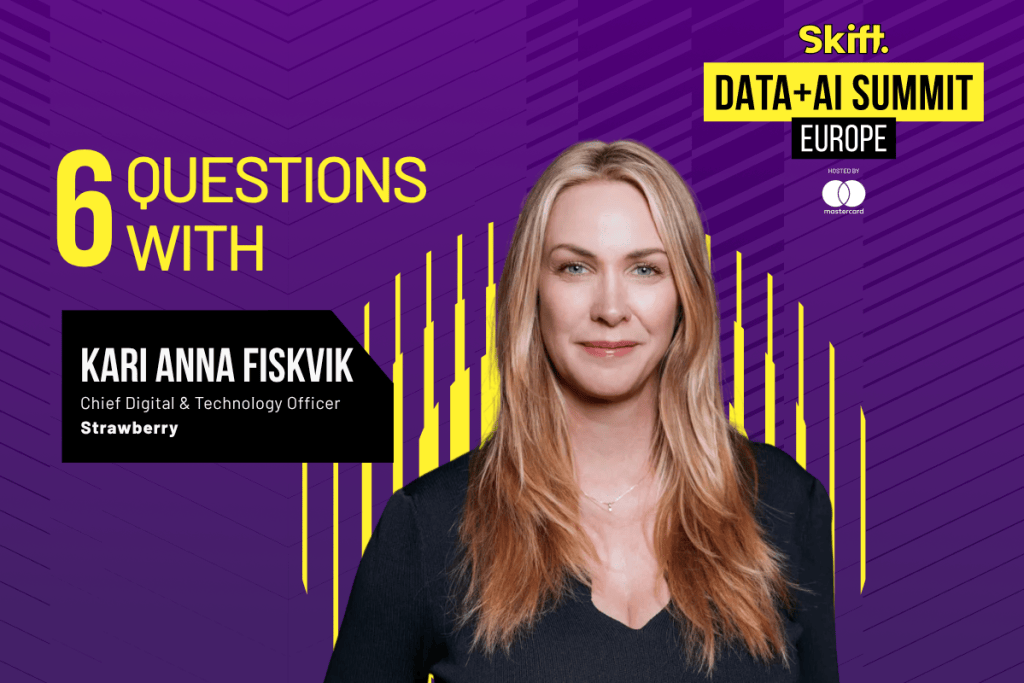
In 2021, mid-pandemic, a ransomware attack took down most of Strawberry’s systems, and the Nordic hotel group was back online within four days. Kari Anna Fiskvik, its Chief Digital and Technology Officer, credits people who knew exactly what mattered. She joins Skift Data + AI Summit Europe, October 6, 2026, at Mastercard London. Ahead of the Summit, she shared why data architecture outranks the model and where she expects AI to earn its keep first.
Data Underneath the Model
Skift: What is the single most important factor for successfully scaling AI in travel operations across European markets?
Kari Anna: If I have to pick one: unified, clean data and the architecture that lets it move freely between systems. Curiosity, time, the willingness to experiment — all of that matters, but none of it compounds into anything if the underlying data is fragmented across a dozen disconnected systems.
AI is a force multiplier: multiply clean, structured, real-time guest data and you get faster, better decisions. Multiply chaos — inconsistent records, systems that don’t talk to each other, three departments each holding a different piece of the guest’s history — and you just get faster chaos. It’s also why the “we’ll build our own AI and beat the platforms” framing is a bit naive right now: even where Google is piping hotel options straight into AI Mode, the properties that get represented well are the ones with clean, structured, complete data feeding it. The model is rapidly becoming a commodity. Your data, and the plumbing underneath it, are not. AI is a force multiplier, and if what you are multiplying is chaos, you simply get faster chaos.
It does not matter how capable the model is if the data pipes, integrations, and identity systems underneath cannot carry the traffic. A broken guest journey is almost always an architecture, data & infrastructure problem wearing a costume.
Skift: Are there common misconceptions about AI in travel operations that you would like to address?
Kari Anna: The most common one: more AI automatically means more efficiency or a better guest experience. It doesn’t. We constantly ask ourselves when we build something whether it actually gives our guest or employees more, or whether we are doing it simply because we can — two very different projects wearing the same jacket.
The discoverability and booking side of a hotel stay can go fully digital, the physical check in and stay can go fully digital – and for some of our properties it largely has, for guests who prefer that. But the stay itself remains a physical experience that somebody has to deliver and stand behind, and hospitality for most is largely a people business before it is a technology business. Just because we can build a model capable of replacing a person doesn’t mean we should.
It is also worth saying plainly: a good number of the AI vendors approaching hotels right now are not primarily in the business of fixing you guest journey. They are in the business of raising their next funding round.
People Behind the Policies
Skift: In your view, is European regulatory complexity a barrier to AI adoption or an opportunity to build something more defensible?
Kari Anna: Both, and I would be lying if I said the paperwork never stings. But new technology needs rules, because how we use it ultimately affects people’s lives and decisions, not just our roadmap. Labelling AI-generated content and carrying out proper risk assessments to protect us all from prompt injections and hackers are reasonable requirements.
Where I would maybe push back a little, though, is on the assumption that more paperwork automatically means more safety. It doesn’t. Policies don’t change behaviour, and they certainly don’t stop hackers — we learned that directly in 2021, mid-pandemic, when a ransomware group (Conti, for the record) took down the majority of our systems. What got us back online within four days wasn’t a compliance binder; it was people who understood exactly what mattered and acted on it. I would like to see regulators spend as much energy on whether a rule actually works as they currently spend on whether it is documented. We are not there yet — understandably, this is new for everyone — but that is the balance worth working toward.
Skift: What is one piece of advice you would give travel leaders about balancing AI and human judgment?
Kari Anna: Look into your people-strategy as well as your AI-strategy.
AI can scrape, read huge amounts of information and structure and write and act on that.
But only with the right context. Humans, on the other hand, have spent their entire lives building context that affects their judgement. They can’t process the same amount of information, but they have experience in real life.
Race for the Booking
Skift: Where do you see the biggest opportunities for AI to impact business outcomes in travel?
Kari Anna: Conversion, primarily. The real opportunity is closing the gap between a guest asking a question and receiving a real answer with a real price attached – and to be able to book instantly. We already do this: on Villa Copenhagen’s website, our AI concierge, Vivi, can be asked for a double room in October and will return actual current pricing and packages within seconds — not “contact us for availability,” but a bookable answer with a link to confirm the booking.
That is the opportunity: turning every guest question into a bookable moment. As always, it’s about removing friction in the booking process.
Obviously, it will also largely affect how we work, as all technology and industrial revolutions have. We will automate more work and gain more insights with the help of AI.
The biggest threat is what it does to us as employers, a very important role we have in society. We are a people, planet, profit company. We don’t want AI to replace all juniors – young people deserve to work and they have to start and learn somewhere. We’re working very actively on this: how to secure jobs and still gain efficiency from AI. It is every company’s responsibility to take care of people in this transformation as well.
Skift: Which AI trend do you think will most reshape European travel operations in the next two years?
Kari Anna: Conversion, again. Agents handling parts of the booking process on a traveler’s behalf. Google has now launched agentic hotel booking inside AI Mode, starting in the US. Notably, hotel brands are on that list alongside the OTAs, and loyalty programs are already part of it — the tool can compare cash rates against points. The traveler still selects the room and approves payment, so “AI books for you” overstates today’s reality, but AI is already doing the searching, comparing, and assembling behind that decision.
It is a game changer for many around digital discoverability and booking. I think this time it will also affect MICE and groups more than we’ve seen before as well. It’s becoming even harder for stand-alone hotels and smaller hotel groups to be digitally discoverable. And it changes the ad models. Meta has launched their travel app, which will also be interesting to follow.
What Operators Have to Decide
- Data before models: Kari Anna ranks unified, structured data and the architecture that moves it above model capability. For operators setting AI budgets, that puts integration and identity systems ahead of model selection.
- Compliance and resilience: Her ransomware recovery came from people who understood what mattered. European operators have to weigh how much of their compliance effort also buys them the ability to recover.
- Discoverability: Kari Anna points to Google’s agentic hotel booking in AI Mode, which lists hotel brands alongside OTAs. She expects stand-alone hotels and smaller groups to find it harder to be discovered, and she ties representation to the quality of the data feeding these systems.
- Workforce: Strawberry wants efficiency from AI while protecting the entry-level jobs where young people start and learn. Operators planning automation need a junior talent plan running alongside it.
Hear Kari Anna Fiskvik live at Skift Data + AI Summit Europe, October 6 in London, where the day’s lineup also includes Bryan Batista of Skyscanner and Benjamin Cany of Amadeus, among other travel leaders.