



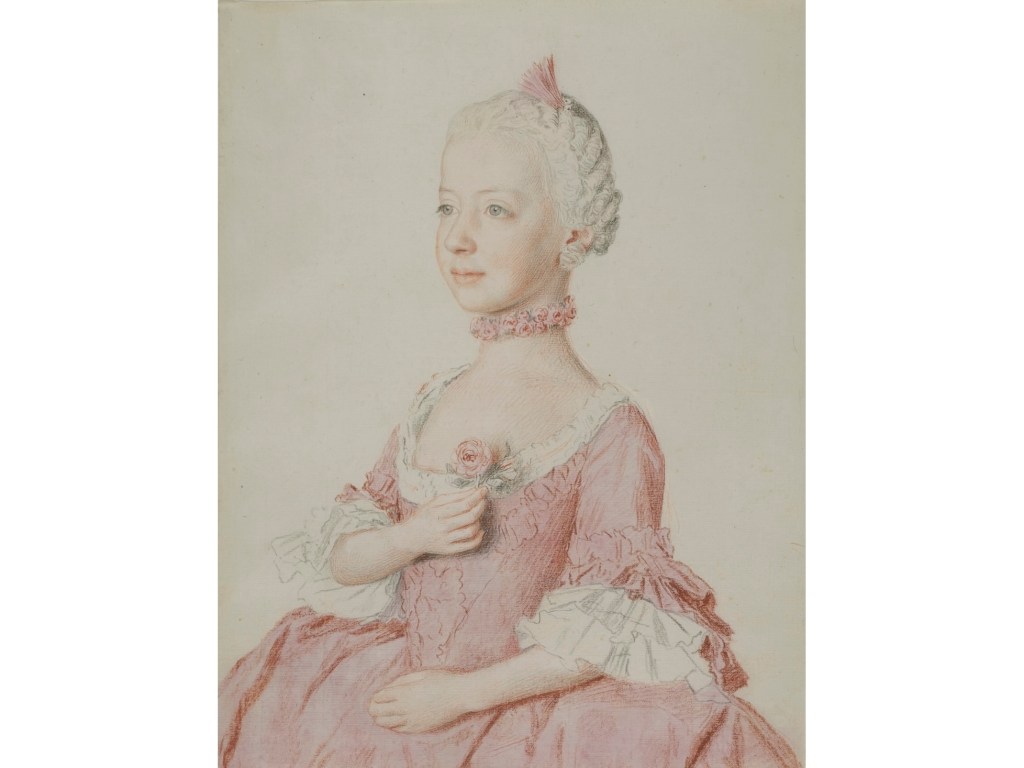
Can AI help identify the sitters in historical portraits? This is the question pondered by an interdisciplinary project as well as an exhibition that opened this month at Geneva’s Musée d’art et d’histoire (MAH), showcasing a dozen 1762 chalk drawings of the family of Austria’s Empress Maria Theresa by the 18th-century artist Jean-Étienne Liotard.
Twenty years ago, when Catriona Seth was preparing to publish a book about Marie-Antoinette, she chose a beloved childhood portrait of the storied French queen by the 18th-century artist Jean-Étienne Liotard as the book’s cover illustration. Only years later, while researching the early life of this infamously decapitated royal, did she realize something wasn’t quite right. The young lady depicted in that chalk drawing has the chivalric medal of the Order of the Starry Cross pinned to her ruffled pink dress; Marie-Antoinette too received that medal but hadn’t yet in 1762 when Liotard (1702–1789) was in Vienna producing a series of portraits of the many children of Empress Maria Theresa of Austria.
As it turned out, the portrait that Seth used to illustrate the cover of her book wasn’t of Marie-Antoinette at all, as had long been believed, but rather of her sister Marie-Caroline.
“I love being able to say that to people, because it just shows that research is a continuous process and that we also learn by our mistakes,” says Seth, a French literature professor at All Souls College, University of Oxford. “There are things that can be discovered, even about great portraits, great texts. We have to think about them and question things.”
Seth had historical proof that the portrait formerly identified as Marie-Antoinette was of Marie-Caroline, but it was a trickier matter to claim the opposite: that the portrait once thought to be Marie-Caroline was actually of Marie-Antoinette. Remembering popular filters she’d seen online, Seth wondered what would happen if she uploaded the portrait into an app that ages faces by 10 or 20 years. She did so, and then compared the result to an adult portrait of the French reine. “It wasn’t very useful,” admits Seth. “But I thought: There’s an idea here.”
Seth mentioned this to Marie-Eve Celio-Scheurer, senior curator and head of the graphic arts department at Geneva’s Musée d’art et d’histoire (MAH), which holds the largest collection of Liotard portraits in the world (including the two in question). Celio-Scheurer in turn reached out to David-Olivier Jacquet-Chiffelle, a professor of forensic science and identification at the University of Lausanne, home to the world’s oldest school of forensic science. He connected with Sébastien Marcel, an expert in biometrics and face recognition.
Together, the team posed the question: Can modern AI and biometric technologies be used to identify people in centuries-old artistic portraits?
They’re attempting to answer this question through a joint experimental project, INTERART, which is a collaboration among the MAH, the University of Oxford, Idiap Research Institute, and the University of Lausanne’s School of Criminal Justice. Identifying a sitter in a portrait is a tricky art-historical task that involves a study of provenance, inscriptions, archival documentation, iconographic juxtaposition, collection history, and costume and jewelry. Could present-day technologies be another item in the researcher’s tool kit?
Results of the project, at this early stage, are part of an exhibition that opened this month at MAH titled Liotard & Marie-Antoinette: Faces Under Investigation, and an accompanying catalog. The show, on view through February 7, 2027, presents all 11 drawings of Marie-Therese’s children, plus one portrait of their father, François-Étienne de Lorraine, that recently entered the museum’s collection. In the exhibition, Liotard’s portraits of Marie-Antoinette and Marie Caroline have been newly titled to reflect the true identities of the sitters.
Current facial recognition systems, originally developed for photographs, can compare faces despite differences in pose, lighting, expression, age, and image quality. They were never intended to be used on paintings, where two portraits of the same sitter may have major differences in style and technique. The challenge, then, is to create models that can recognize facial constants regardless of changes introduced through artistic practice. One caveat: For a painting to be effectively analyzed through biometrics and AI, it needs to have been created directly before the sitter, and therefore truest to the person’s likeness (rather than a copy of an existing portrait, for example).
The potential of such a model would be to generate thresholds of probability, not provide conclusive answers. “There is never a 100 percent correct answer, and this is what also keeps the project interesting,” says Celio-Scheurer. “It gives you a potential.”
This path holds promise, but it needs refining. The algorithm can suggest associations that wouldn’t naturally occur to scholars and may help in the identification of people in portraits. “We all know museums are full of portraits of an unknown woman or an unknown man, that sort of thing, and if we can have databases of portraits where we know exactly who a sitter is, where we know exactly what their age was, we know they sat for the portrait, et cetera, then by putting an unidentified portrait into the mix, the algorithm can probably suggest things to us,” Seth explains. “It might give us leads.” In this sense, it would be a bit like a database of criminals, where you provide a suspect’s fingerprints and hope for a match.
Seth and Celio-Scheurer are careful to warn that these tools won’t replace the human eye or traditional research. Rather, they could be additional aids. “Art historians [are] quite curious about this approach. It’s not that AI will replace research in art history; it’s more of a support or tool that can give indications,” notes Celio-Scheurer. “At the moment it’s a support, but who knows how far this tool can be developed?”


