



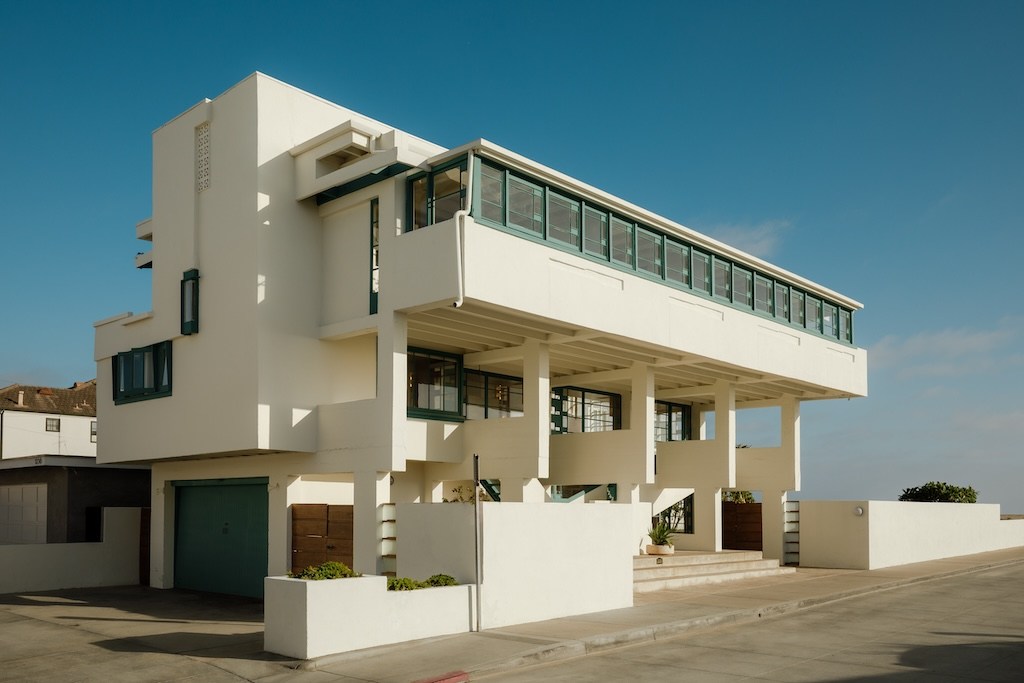
A century ago, California health fanatic Philip Lovell had some unusual ideas about how people ought to live. He believed in vegetarianism, plenty of exercise, fresh air, and nude sunbathing. All good there. He also thought sleeping outdoors was good for you, which is why, when he commissioned architect Rudolph Schindler to build a beach house in Newport Beach in 1926, he insisted on open-air sleeping porches instead of bedrooms.
That particular experiment lasted about two years. It turns out the California coast gets pretty chilly at night.
The house, however, has fared considerably better. Now, after 100 years in the same family, the Lovell Beach House, one of the most celebrated examples of early California Modernism, is on the market for $18.8 million.

Schindler designed the house for health enthusiast Philip Lovell and his wife, Leah, incorporating plenty of natural light and space for outdoor living.
STERLING REED
Located on Newport Beach’s Balboa Peninsula, the four-bedroom, four-bathroom house is a remarkable piece of architecture. Schindler, an Austrian-born architect who had worked for Frank Lloyd Wright, raised the living quarters above the beach on five enormous concrete frames that resemble squared-off figure eights. The unusual arrangement gave the family privacy from beachgoers below, along with sweeping views of the Pacific.
Inside, there’s a double-height living room, a balcony overlooking the main floor, and built-in furniture designed by Schindler himself. The house measures just 2,741 square feet, which isn’t much by the standards of today’s $18.8 million beachfront properties. But then, buyers aren’t exactly paying for the square footage.

The view from the Lovell Beach House, where Philip Lovell’s enthusiasm for fresh air and outdoor living met the occasional reality of chilly coastal weather.
STERLING REED
Lovell, a naturopath who wrote a health column called Care of the Body for the Los Angeles Times, believed a house should do more than provide shelter. It should make its people healthier. Along with the sleeping porches, Schindler designed a rooftop sunbathing terrace and a bathroom equipped with an extraordinary shower featuring roughly five shower heads, allowing bathers to lie down beneath the running water.
Unfortunately, Newport Beach’s nighttime fog wasn’t particularly interested in Lovell’s theories about fresh air. In 1928, Schindler returned to enclose the sleeping porches and turn them into conventional bedrooms.
The house also has a connection to another giant of modern architecture. Richard Neutra, who would become one of Schindler’s great professional rivals, designed the landscaping. The two architects had once been friends and collaborators, but their relationship eventually crumbled like so many brittle bricks.

The house’s double-height living room features a towering wall of glass overlooking the Pacific Ocean. Not a bad place to get some fresh air.
STERLING REED
The Lovells played a part in that story, too. After commissioning Schindler’s beach house, they hired Neutra to design their Los Angeles residence, the equally famous Lovell Health House, completed in 1929. The decision helped establish Neutra’s reputation and contributed to the falling-out between the two architects.
For all its architectural importance, the beach house was never just a showpiece. Philip and his wife, Leah, eventually made it their permanent home, entertaining an assortment of artists and intellectuals. Photographer Edward Weston visited and, according to the family, singer and actor Paul Robeson once performed in the living room.
The house passed through several generations of Lovells. In the early 1970s, the couple’s youngest son, Gary, acquired it from his father and brother for about $50,000. He and his wife, Barbara, made a few changes, including opening up the kitchen and dividing the enormous original bathroom into two. Barbara continued living there until her death in 2025.

Schindler used built-in shelving and furniture to separate the dining and living areas without closing off the house’s airy interior.
STERLING REED
Through it all, the family kept much of Schindler’s original design intact, including the built-in furniture. The house was added to the National Register of Historic Places in 1974 and has become a destination for architecture enthusiasts, who, according to the Lovell grandchildren, regularly arrive by the busload to photograph and sketch it.
For the family, though, its appeal was simpler. Speaking to architectural historian Esther McCoy in 1958, Leah Lovell explained why she preferred Schindler’s beach house to Neutra’s more famous Los Angeles residence.
“It just fitted us,” she said.
A hundred years later, the house is looking for someone else it fits. Preferably someone with $18.8 million to spare and an appreciation for concrete, architectural history, and the occasional chilly ocean breeze.