



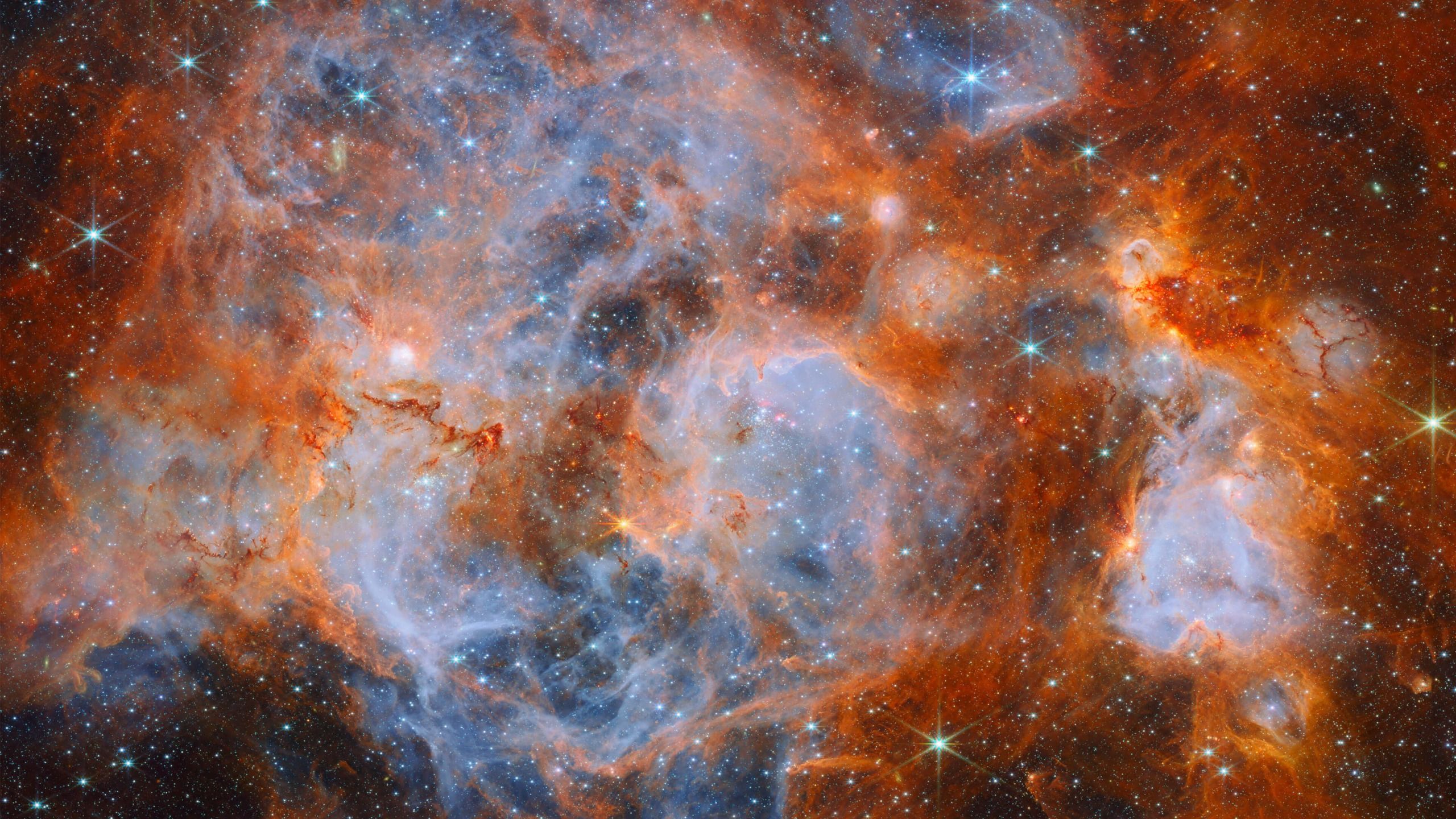
NASA and the ESA (European Space Agency) have announced the latest James Webb Space Telescope (Webb) picture of the month, with this new frame depicting what the agencies have described as a “turbulent” stellar nursery.
Every month, NASA and the ESA choose their favorite image captured by the Webb telescope over the past four weeks, publishing it on the ESA Webb telescope site.
According to the ESA, October’s image shows a star-forming region of space named LHA 120-N 159, or simply N159, located 161,000 light-years away from Earth in the Large Magellanic Cloud (LMC), a satellite galaxy orbiting the Milky Way.
Latest Videos FromDigital Camera World
N159 is what’s called an H II region: an area of space filled with ionized hydrogen gas. According to the ESA, in these regions, giant molecular clouds of cold hydrogen gas collapse under gravity, forming new stars, many of which are extremely massive and hot.
The ESA explained that the stellar nursery is shrouded by the thick orange clouds spread across the center of the image, with the orange color signifying light emitted by polycyclic aromatic hydrocarbons, a carbon-based molecule.
According to the agency, the pale blue clouds swirling within are made of H II gas, which has been ionized by “intense” ultraviolet light emitted from massive stars. And the dark red filaments across the center of the image are formed of cooler molecular hydrogen. The ESA said that these filaments are the densest part of the nebula and shield young stars from harsh radiation and stellar winds.
To capture the 230-light-year-wide image, astonomers used Webb’s Near-Infrared Camera (NIRCam).
The primary imaging instrument aboard Webb, NIRCam is capable of capturing light ranging from 0.6 micrometers (visible red light) to 5 micrometers (near-infrared). Because infrared light passes through dense cosmic dust clouds that block normal visible light, NIRCam enabled the astronomers to see deep into N159.
The astronomers have since published a paper on the recent observation, highlighting how the conditions of N159, thought to be akin to those of the early universe, have helped to further our understanding of star formation during that time.
You might also like…
Here’s our astrophotography expert Jamie Carter’s pick of the best cameras for astrophotography.