

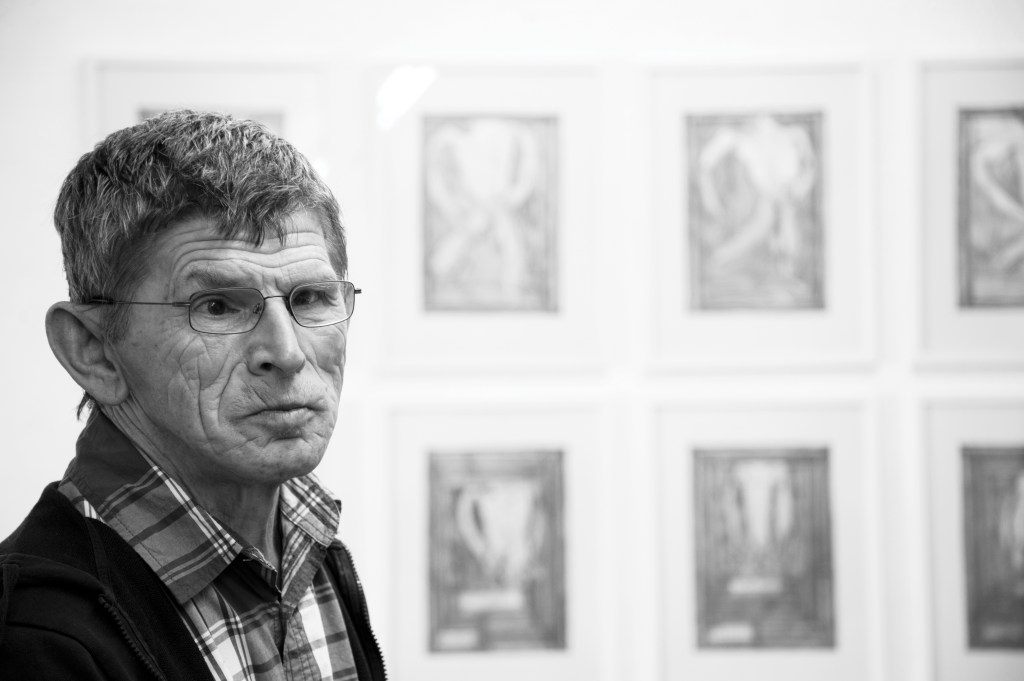
Outsider Austrian artist Josef Hofer, who was hidden as a child from Nazi forces by his parents due to a speech and developmental disability, has died at 80, reports Le Quotidien de l’Art. Gallery Christian Berst in Paris, where the artist had his last show this fall, said he passed away in the western Upper Austrian town of Ried im Innkreis on Friday, October 23, shortly after he was hospitalized for complications related to a pulmonary infection.
Hofer, who signed his works “Pepi,” rarely spoke and was hard of hearing, instead expressing himself through raw, figurative drawings that reflected his own life and observations. These included depictions of erotic nudes within a signature frame drawn in reds, yellows, and oranges, as though enclosed or trapped.
“He was one of those artists for whom creating was not a choice but a vital necessity,” Christian Berst told ARTnews via email. “Drawing, for him, was a way of inhabiting the world, of making a mark in it and, perhaps, of inventing a place for himself there. His work, of rare intensity and humanity, will long continue to move us deeply,” he added.
In 1997, Hofer was discovered by art historian Elisabeth Telsnig at a drawing class in Austria, which he attended. Telsnig later helped connect him to institutions, and several exhibitions followed in Europe, including one at the Collection de l’art brut in Lausanne in 2003; a 2010 retrospective at the Austrian Cultural Forum in Prague; and a major 2022 show at the Kunstmuseum Thurgau/Ittinger Museum in Warth, Switzerland. The Centre Pompidou, as well as top collectors such as Antoine de Galbert, Bruno Decharme, and Arnulf Rainer, now own his work. Meanwhile, Montpellier’s contemporary art center Mo.Co is mounting an art brut exhibit featuring Hofer’s works, titled “I Am the Phantom of My Own Opera,” on view from December 5th to May 2, 2027.

Untitled (2010) by Joseph Hofer. Photo courtesy christian berst art brut
Hofer was born on March 17, 1945, in Upper Austria, and was raised in rural isolation alongside his brother, who was born with similar mental and physical disabilities. Their isolation continued after the decline of the Nazi party, as the Hofer parents feared any contact with the invading Soviet army.
The family moved to Kirschlag after the father’s death in 1977. There, Josef Hofer began interacting with other people and was admitted as an inpatient at a psychiatric clinic in Ried. He discovered his love for drawing in 1985, and went on to make thousands of artworks on paper with colored pencil. These evolved from subjects such as life on the farm to raw and erotic nudes, inspired in part by the works of Egon Schiele.
His drawings “represented a total break from anything I had been given to see until then,” Telsnig wrote in a catalog published alongside his last exhibition.