


Over the last few years, leading documentary festival IDFA has become a crucial stop on the awards season trail, with major streamers and key studios courting voters in Amsterdam’s imposing 17th-century canalside houses and theaters. One of the key titles in this year’s best documentary race, however, has foregone glitzy cocktails and receptions in favor of a lengthy on-stage conversation, with the team behind “NAZA” filling the DeLaMar theater on a rainy Monday night to discuss how the film “broke the mold” in terms of finding audiences.
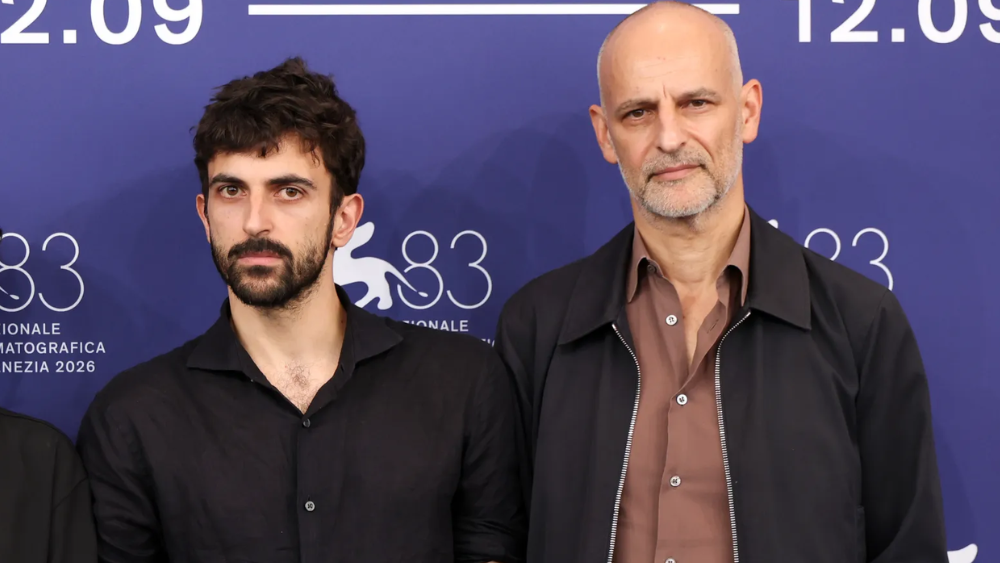
The panel saw a rare public appearance by director Yuval Abraham, who connected via Zoom from London, where he continues to tackle his journalism work for “NAZA” producer The Guardian, represented on the IDFA stage by editorial director, film and TV and head of documentaries Lindsay Poulton. Abraham and Poulton were joined by the film’s producer James Wilson (“The Zone of Interest”) and Fionnuala Jamison, managing director of major sales agent MK2. Rachel Szor, who directed the film alongside Abraham, was not present.
Asked about how it feels to tackle the overwhelming calendar of a high-profile awards campaign for a film as sensitive and somber as “NAZA,” Abraham said the thought is not at the forefront of his mind. “We have so much to do with the film and also with the journalism. We’re working on the investigative journalism, and I really want to focus on that.”
Abraham has very recent experience with the frenzy of the awards race, having won the best documentary Oscar two years ago for “No Other Land,” co-directed with Szor and Palestinian directors and activists Basel Adra and Hamdan Ballal. “The awards are important in a sense because they do give more visibility, and of course, that’s what we want,” he said. “But on the other hand, my experience with ‘No Other Land’ has been that voters are also smart. They know the film is out there and they can watch it and make up their own mind.”
“I prefer to focus on doing conversations with audiences when we feel it’s meaningful,” added the director. “We’re planning to be physically present to meet audiences. We hope to screen the film in front of politicians all over the world, to leverage this streaming moment when it comes out on The Guardian, when Israelis and Palestinians are able to watch it online and access it, to get people to write about it and talk about it. For me, that’s the focus.”
Wilson echoed that thought, noting how Yuval and Szor could not be physically present in Amsterdam for the talk—or to meet with voters in the Amsterdam awards stop—because “the journalism is ongoing and they are deep in that. The killing is ongoing.”
The veteran producer, who has a career spanning over three decades, noted how he has only recently been involved in films that have received awards attention: Jonathan Glazer’s Oscar-winning “The Zone of Interest” and Kaouther Ben Hania’s Oscar-nominated “The Voice of Hind Rajab.”
“For me, it’s a very simple contract in a way,” he said, adding that “awards are a form of a light being shone on your film. It’s a form of marketing.” The producer then noted that awards also bring to attention films in “an era and an age where there is so much competition for attention and cinema is no longer the kind of jewel at the top of the cake, the summit of moving pictures.”
‘NAZA’ team at IDFA
When prodded about the lesson behind the success of “NAZA”—which has topped 1.5 million admissions worldwide and reached a $14 million box office so far—Wilson said it is “a clarion call to distributors to not be afraid of the subject matter and to open doors to it. Because when the doors are open, people come into the cinemas to see it. People who are trying to stymie that, like the people who didn’t want to release ‘No Other Land,’ should be ignored.”
The producer was referring to how “No Other Land” struggled to get distribution in the U.S., with the filmmaking team eventually self-distributing. That experience, Abraham noted, taught him and Szor “how long it can take for a film to be accessible to wide audiences,” something they thought about at length when discussing the release strategy for their follow-up.
“NAZA” was a complete mystery until it was announced as a late addition to the Venice Film Festival competition on Aug. 24. Mere days later, it played to massive acclaim at the festival, landing a record-breaking 25-minute standing ovation and winning the Special Jury Prize. During the talk, Jamison revealed the filmmakers originally intended for the film to be made available online on The Guardian the day after the festival premiere, a strategy they eventually changed after lengthy conversations with Wilson and the MK2 team.
While the film is still scheduled to be made available online for free at The Guardian sometime in December, MK2 has secured deals for theatrical exhibition in 56 territories. In the U.S., Neon acquired it following an initial rollout by the British news company and the French sales agent.
“Our north star with ‘NAZA’ has always been about impact. It’s how you reach people, move people, and get them talking and to be in dialogue with really important matters that are at the core of this subject. Sitting in a cinema has been an important part of that,” added Poulton of the strategy, with Abraham adding that he learned from his team that “the film being immediately accessible doesn’t necessarily translate to maximum impact.”

‘NAZA’
Courtesy MK2
Releasing “NAZA” has been a particularly challenging process given the secrecy and sensitivity surrounding the project. Because the filmmakers could “only approach people [they] trusted,” that narrowed financing avenues and possible creative partners. But Wilson is quick to add that the team’s decision not to show the film to industry peers before Venice was strictly tied to security. “There was no sort of sleight-of-hand mystery to the late announcement, and I’ve heard chatter about that.”
As for the real-life impact of the film, Abraham spoke about the “violent” reaction to the film in his home country of Israel, which did not come as a shock. One of the hardest parts, however, was dealing with the effect it had on the directors’ families. “Rachel’s parents had these right-wing protests or mobs outside her house.”
When asked if “NAZA” had changed the way the world is dealing with the ongoing “genocide” in Gaza, Wilson said he sees cinema as “an antidote to fear and the antidote to complicity in the crime,” but that he could “make no claims” for the film singlehandedly being responsible for any responses to the conflict, but that the film spoke to people’s moral and ethical compasses.
“It’s sort of interesting to look at the midterm elections in the U.S. and these swathes of candidates being successful who have come out against the mass killing, the ethnic cleansing, the genocide, but also on other issues and [mobilizing] against other forms of authoritarian hegemony, mergers, and things like that,” he said. “I like to think ‘NAZA’ is a small cog in a machine of resistance.”