



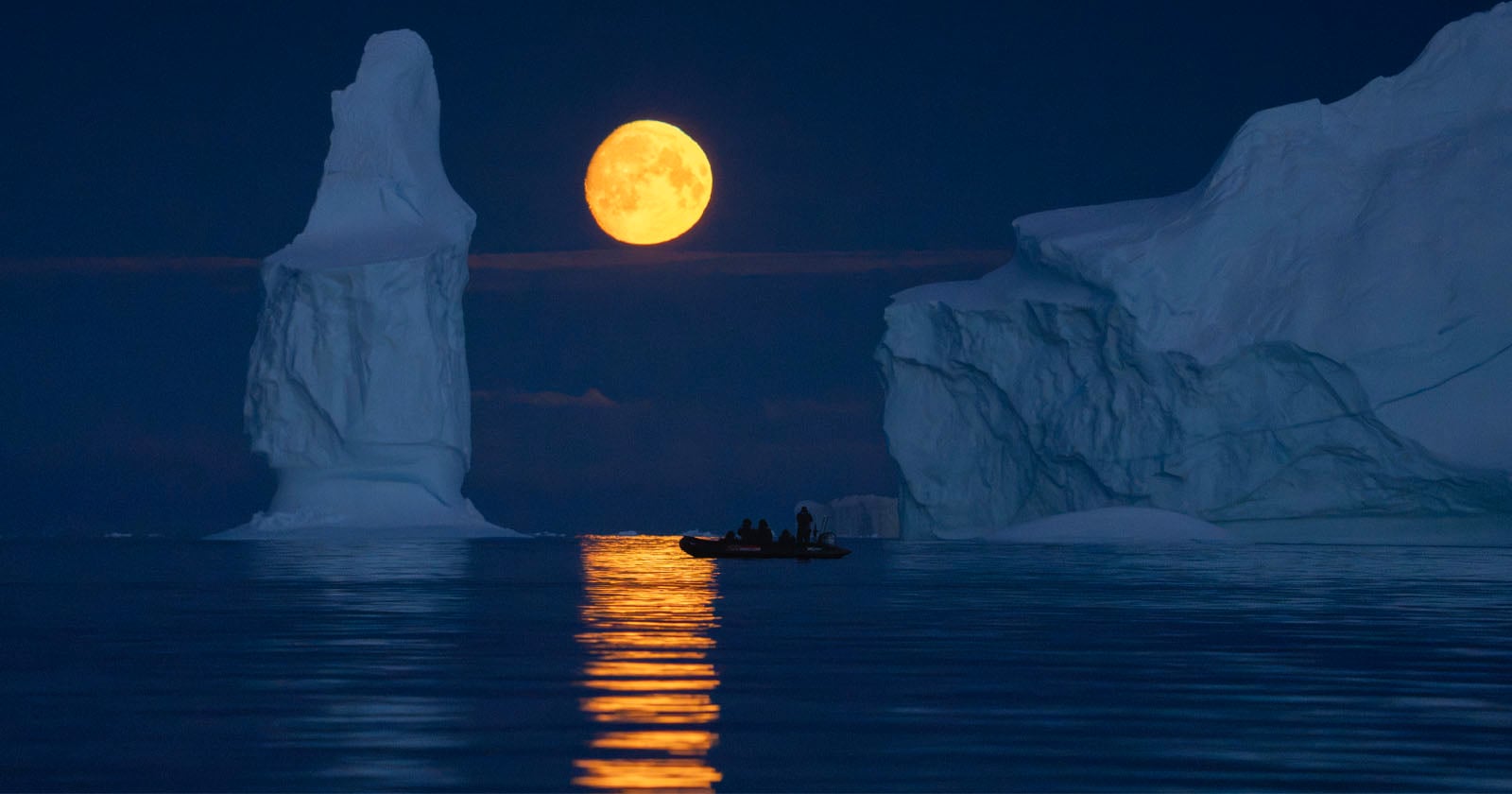
Photographing East Greenland at night is an exercise in preparation, observation, and adaptation. The landscape is immense, the conditions can be demanding, and the opportunities to make a particular image may be limited to a few minutes. Towering icebergs, drifting sea ice, fog, low clouds, and the changing Arctic sky create an environment in which light can completely transform the way a scene is perceived. Yet having spectacular scenery in front of you does not necessarily mean you will come away with a strong photograph. The challenge is to recognize what makes a moment worth capturing, understand how the available light interacts with the landscape, and make the right decisions before that moment disappears.
During a recent photography expedition in East Greenland, hosted by Secret Atlas this last October 2026, I spent several evenings leading the photographic project targeting enormous icebergs illuminated by the rising moon, alongside the Northern Lights appearing above the surrounding fjords and ice. These two subjects offered very different photographic challenges and a particular one-of-a-kind night operation.
Photographing Icebergs by Moonlight
Four Days of Anticipation
Some photographs begin long before the camera is taken out of the bag. The moonrise series was one of those projects. Across four days, I followed the changing opportunities to photograph the rising moon among the enormous icebergs of East Greenland. The objective was not simply to record the moon above the horizon, but to find a relationship between the moonlight, the architecture of the icebergs, the sense of exploration, and the surrounding landscape.
The first opportunity to photograph the sequence came around 8 p.m. on day three of our expedition, when the timing and the available light finally began to align. In the Arctic, twilight can retain considerable ambient light even as the moon rises. This transition creates an interesting balance: the landscape may still hold detail, while the moon begins illuminating the ice from a different angle.
A rising moon and a monumental iceberg are impressive subjects individually, but putting them together is not enough. Their positions, relative sizes, illumination, and separation from the background all influence how the image is read. Anticipating these relationships is essential, particularly when the window for making the photograph is short.
Working From a Zodiac
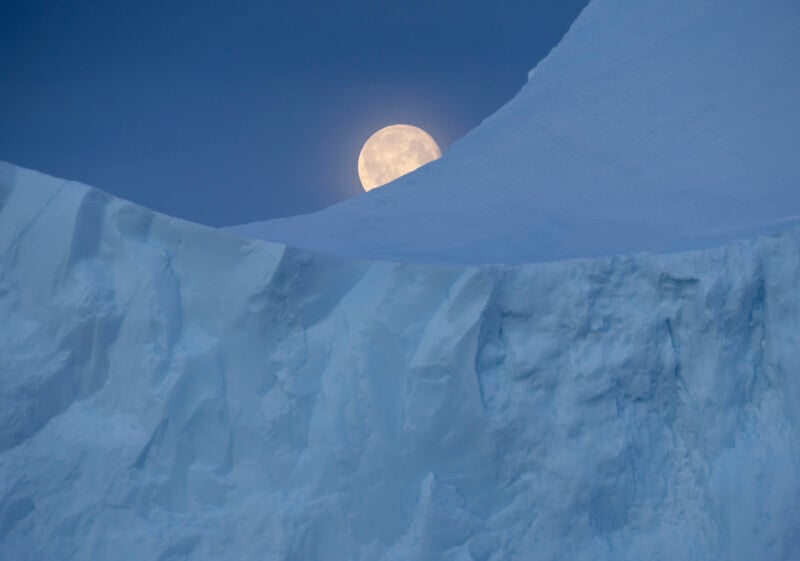
Photographing from a Zodiac adds another dimension to the process. Polar bear presence in East Greenland limits our possibility to operate on land during low-light conditions. Unlike working from stable ground, the shooting position is not necessarily fixed, and even small movements can affect the framing, particularly when using a long focal length.
The objective was to find a viewpoint from which the iceberg formations could be separated visually and the rising moon incorporated without losing the sense of scale. Icebergs are difficult subjects to photograph because their dimensions can be hard to communicate.
Choosing a Focal Length and Reading the Light
Focal length plays an important role in communicating scale. A wide-angle lens can emphasize the surrounding environment, while a longer lens can compress the scene and bring distant formations visually closer together.
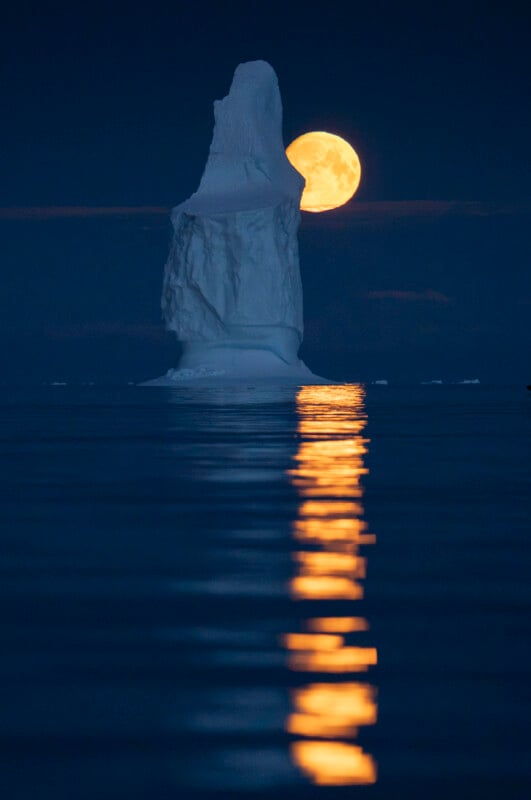
Exposure requires similar care. A gradually brightening moon against a dark sky can make it difficult to preserve highlights without losing detail in the shadows. Rather than trying to make every part of the photograph equally bright, I aim to retain the texture of the illuminated surfaces while allowing darkness to remain part of the image, preserving my highlight and shadow information.
Photographing the Northern Lights: Our One-of-a-Kind Night Operation
A Different Kind of Light
The Northern Lights create a very different set of challenges. The moon’s position can be anticipated, allowing me to plan around a relatively predictable source of illumination. This is great for subject illumination, though distracting when the moon appears in the frame. The aurora, by contrast, can change rapidly in brightness, shape, color, and movement.
From our main vessel, we navigate through the fjord in search of a good-looking iceberg to frame our shot. We carefully position the ship to achieve the greatest possible stability while maintaining the flexibility to adjust our orientation depending on where the aurora is expected to appear. The moment the Northern Lights emerge, close coordination via VHF radio with the bridge team becomes essential. As we prepare to photograph from the ship’s outer deck, the vessel is brought to a complete standstill, reaching zero speed over ground. This allows us to capture the scene with maximum stability, even using exposures of around half a second, while the iceberg and the dancing aurora create the perfect natural composition.
Composition Before Spectacle
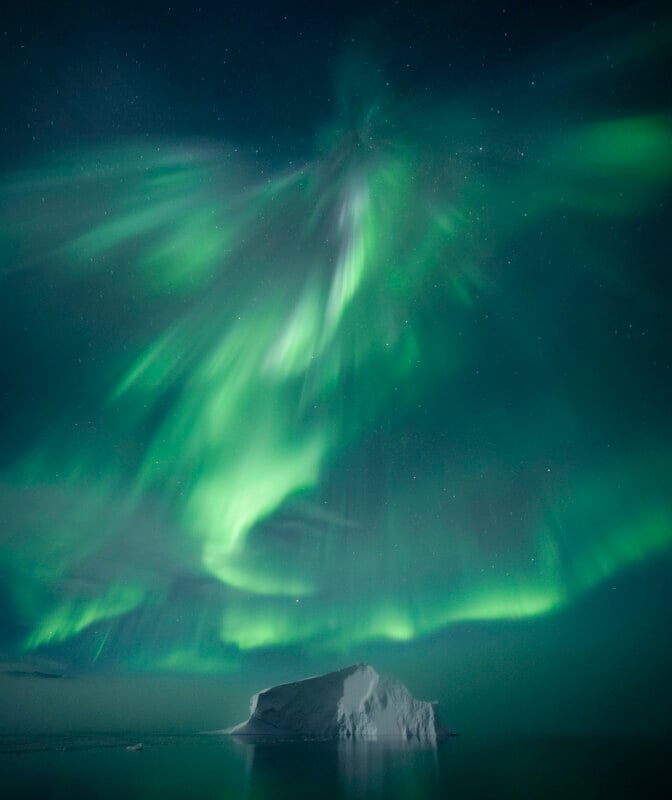
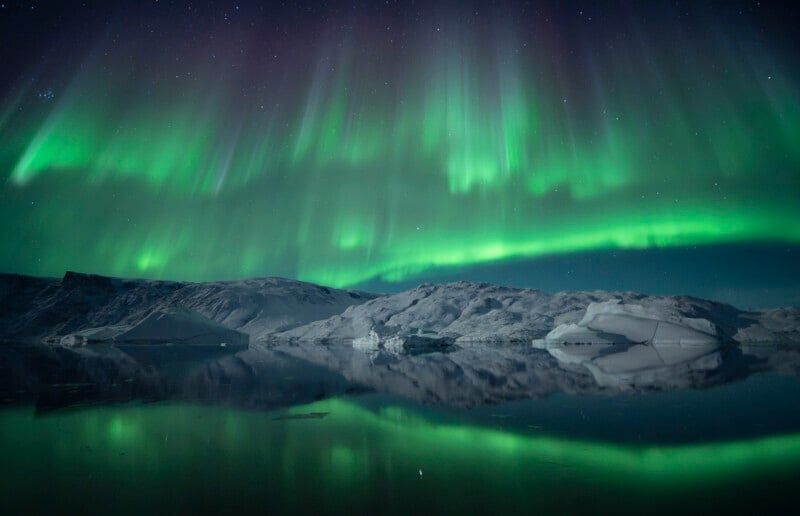
Aurora photography involves a series of compromises between shutter speed, aperture, and ISO. A longer exposure collects more light, which can help when the display is faint, but it can also blur the finer structures of a rapidly moving aurora. A shorter exposure preserves more detail in the curtains and patterns but requires enough light to produce a usable image. There is no universal exposure for the Northern Lights. The right settings depend on the brightness and speed of the display, the available ambient light, the lens, and the amount of detail I want to retain. I adjust according to the behavior of the sky rather than relying on a fixed recipe, as shown below with this powerful curtain of light.
Our Zodiac Operation to Reach the Special Image
As the sun began to set, we left the comfort of our main vessel and ventured out aboard our Zodiacs for a reconnaissance ride through the surrounding waters. Our mission was to explore the landscape, identify one or two particularly striking icebergs, and select the perfect setting for what we hoped would become an unforgettable night of aurora photography. Capturing the Northern Lights is as much about patience and preparation as it is about being in the right place at the right time. With exposures ranging from half a second to four, five, or even six seconds, stability becomes essential. Even the slightest movement can compromise an image. Out here, surrounded by the vastness of the polar landscape, finding a way to create a stable photographic platform would be one of the greatest challenges of the night.
Our idea was to return after dark, launching the Zodiacs from the main vessel and navigating through the freezing waters in search of newly formed sea ice near one of the selected icebergs. This young ice, approximately one centimeter thick, offered the possibility of carefully positioning the bow of a Zodiac against its edge, allowing us to wedge ourselves into place and create the stability required for long exposures. Finding a sufficiently wide area of newly formed ice would also give us the freedom to reposition ourselves as the auroras shifted and danced across different parts of the sky. But this was about more than simply finding a stable platform. It was about finding the right perspective, in pitch darkness surrounded by the freezing Greenlandic waters.
When planning an operation like this, I always look for ways to approach an iceberg while maintaining a safe distance and shooting from as low an angle as possible. I want the iceberg to become a powerful element in the composition, rising beneath the aurora and giving the image a strong sense of scale and depth. The newly formed sea ice often adds another dimension to the scene. Its delicate patterns, textures, and natural leading lines can guide the viewer’s eye toward the main subject, transforming an already extraordinary landscape into a compelling photographic composition.
By 11 p.m., it was time. We left the main vessel and began our night mission. Alongside my teammates Signe-Maria and Myriam, I led our group of photographers toward the giant icebergs and the newly formed sea ice. Behind us, the ship’s powerful searchlight illuminated our chosen iceberg, providing a guiding beacon across the darkness as we made our way toward our destination. Once we reached the area, we carefully positioned the Zodiacs against the edge of the newly formed ice. Every movement had to be deliberate. We wanted to achieve the stability needed for photography while maintaining a safe distance from the iceberg and the surrounding ice.
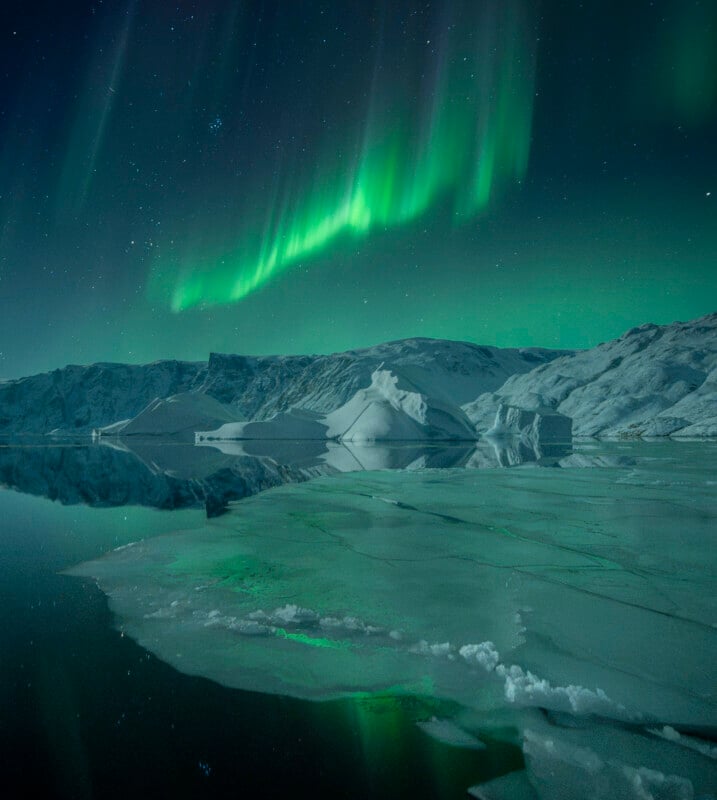
Fortunately, we had prepared for this moment long before leaving the ship. During the day, we had already assembled, adjusted, and practiced our photographic setups, making sure everyone knew exactly what to do. Now, under the darkness of the polar night, there was no time to waste. We secured our tripods against the Zodiac’s pontoon and tilted them forward, carefully adjusting their position to keep every part of the Zodiac out of the frame. One by one, our photographers settled into their compositions, pointing their cameras toward the magnificent icebergs.
Everything was ready. I picked up the radio and called the ship’s bridge team, asking them to switch off all the lights. And suddenly, everything changed. The powerful beam that had guided us across the darkness disappeared. We were now completely immersed in the polar night, resting on the newly formed sea ice, facing a gigantic iceberg beneath an extraordinary celestial spectacle. Above us, twenty billion stars seemed to fill the sky. A half-moon gently illuminated the frozen landscape, revealing the magnificent shapes and textures of the iceberg, while the auroras began dancing overhead, bringing movement and color to an otherwise silent world.
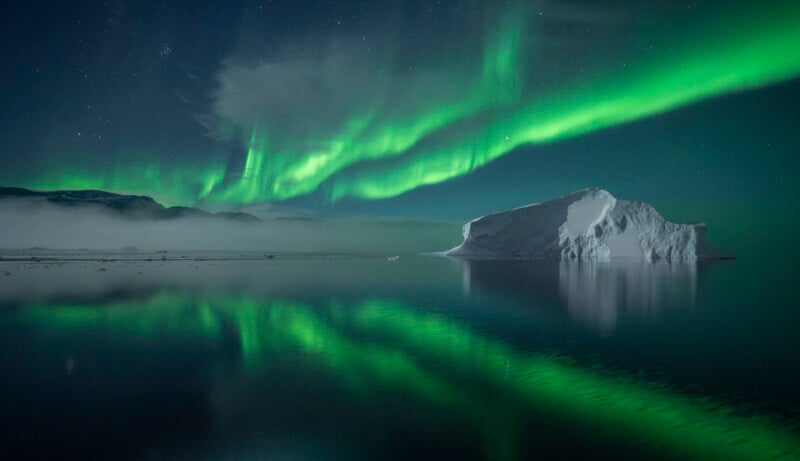
For a moment, everything seemed to stand still. There we were, floating between the ocean and the ice, surrounded by one of the most extraordinary landscapes on Earth. Cameras were clicking, shutters were opening and closing, and each long exposure was capturing a fleeting moment of this ever-changing spectacle. It is difficult to describe the feeling of witnessing such a scene. You can plan every detail, prepare your equipment, study the conditions, and carefully orchestrate the entire operation, but nature always has the final word. And when everything finally comes together, the experience goes far beyond photography. That night, we were fortunate enough to experience something truly exceptional. A moment in which preparation, teamwork, adventure, and nature converged beneath the dancing auroras. The photographs will remain on our SD cards, but the feeling of being there, surrounded by the icebergs, the stars, and the silence of the polar night, will remain with us forever.
Preparation Creates Possibility
There is a tendency to describe photographs of the Arctic as the result of being in the right place at the right time. Luck certainly plays a role. The moon must rise in a favorable position, the weather must allow the landscape to be seen, and the aurora must develop in a way that creates an interesting composition. None of these conditions can be guaranteed. But being present when a spectacle occurs is only part of the process. The photographer must recognize the potential of the scene, decide where to position the camera, choose a focal length, balance the exposure, and determine which elements belong in the frame. Preparation does not control nature; it makes it possible to respond when an opportunity appears.


