

Shooting portraits on location means you rarely get to pick your light, and a dim tunnel, an industrial corner in full sun, and a patch of open shade can all show up within the same hour. Bringing Westcott’s FJ strobes in three sizes is one way to handle that range, and seeing which one gets pulled out for which problem tells you a lot about how much power you actually need.
Steve Sanders, director of photography for the Kansas City Chiefs, loads a wagon with a Westcott FJ100, a Westcott FJ400 II, and a Westcott FJ800 and walks Arrowhead Stadium looking for difficult light. His first stop is a tunnel with a red brick wall and daylight spilling in from the far end. His base exposure there is ISO 100, 1/250 s at f/4.5, and the FJ100 in a softbox handles fill with no strain. Once he wants to match the bright stadium behind the model, the FJ100 runs out of room, so he steps up to the FJ400 II and switches to high-speed sync at 1/1000 s and f/5. That frame keeps the stadium readable, but it throws a hard shadow onto the wall behind her. Moving to the FJ800 with a modifier at a little over half power softens the shadow and leaves enough headroom to push to 1/1600 s for a darker, moodier background.
The tunnel also shows a habit that runs through the whole shoot. Sanders sets the light once and then moves himself. He turns to shoot back toward the bricks, where the daylight from behind becomes a hair light, and then walks around to the other side for a more dramatic frame against the red wall. Nothing about the strobe changes between those shots. Three distinct images come out of one setup, and the only variable is where the camera stands relative to the light.
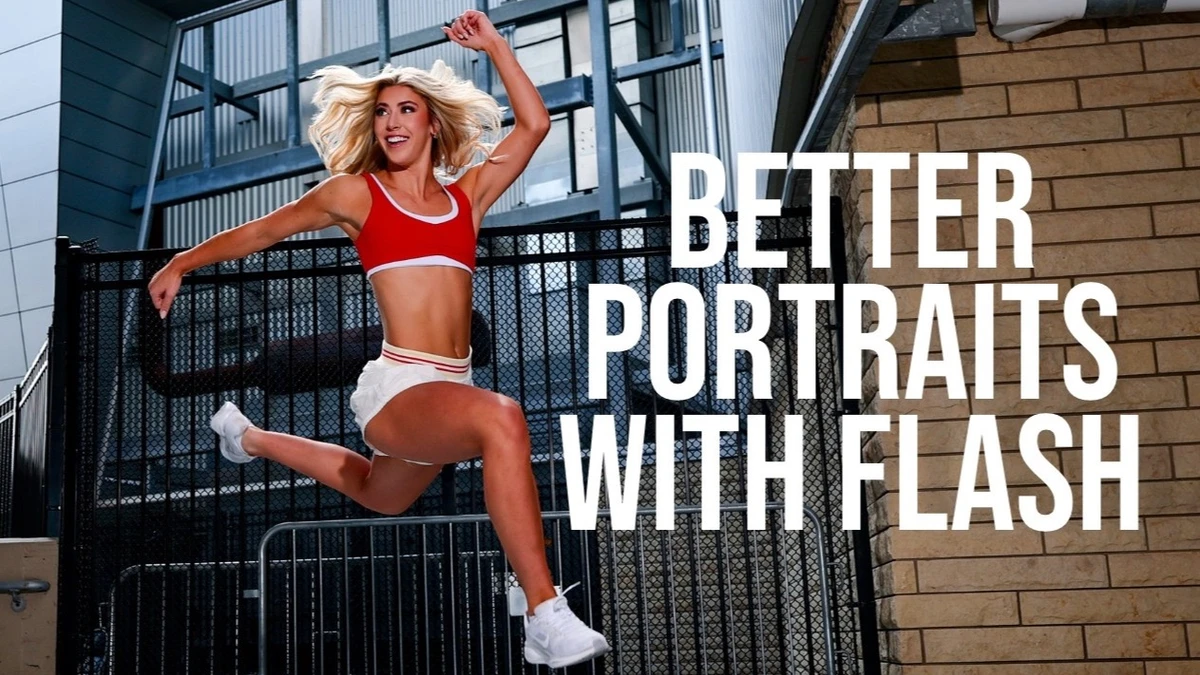
For an ad-style action set in an industrial corner of the stadium, he goes the other way: a bare FJ800 with no modifier, for harder, more contrasty light in strong sun, at 1/800 s, f/2.8, and ISO 100, with a faster frame rate to catch several frames per jump. On a count of three, the model jumps while he shoots from low, looking for the shot and its shadow together. He usually frames exactly how he wants the final image so he doesn’t have to edit much, but here he leaves room to crop. One jump throws a shadow that looks like a hurdler’s, and a few frames get some added atmosphere and sun flare for a more advertorial feel.
In a stretch of open shade with soft grass and a natural leading line, the approach flips. Sanders goes back to the FJ100, this time in a small octa, with an ambient exposure of ISO 100, 1/400 s at f/3.5. He starts the flash at roughly 35 to 40% and nudges it toward half power. He calls this “a kiss of light”: enough to brighten the eyes and the area under the chin and recover detail the shadows were swallowing. He’d always rather light a scene a little than try to fix it afterward. He also raises his white balance to about 6,000 K to offset the blue cast of shade. Because of its size, the FJ100 is joining the Chiefs’ travel kit, where it can be handheld or mounted on a monopod for the player arrival galleries the team shoots every week.
Then he walks about 20 feet into direct midday sun, where the model squints and the contrast is brutal. An assistant holds a reflector to block the sun instead of bouncing it, so she’s in shade, and the FJ400 II goes up in a 3-foot octa on a monopod that the loaded wagon counterbalances in the wind, so no sandbags are needed. It’s still only a kiss of light, at 1/500 s and f/3.5, with the white balance readjusted for open sun. High noon is the time photographers try hardest to avoid, but with a reflector, a softbox, and a little fill, he says you can own the lighting instead of letting it own you.
Sanders shows the jump frames with and without the flash in the video, which makes the strobe’s job in harsh sun easy to see.