

Italy continues to strengthen its position on the global tourism stage, combining an extraordinary cultural and historical heritage with a forward-looking vision for sustainable tourism, international investment and destination development. At the heart of this ambition is ENIT, Italy’s national tourism agency, which plays a pivotal role in promoting the country’s appeal across international markets and supporting the evolution of its tourism industry.
In this Breaking Travel News Q&A, Ms Nembrini, General Director of ENIT, joins Mr Cisotta, General Manager of Italiacamp EMEA, to discuss Italy’s tourism priorities, the opportunities emerging across the international travel landscape and the importance of collaboration in driving innovation, investment and sustainable growth. Together, they explore how Italy is positioning itself for the future, strengthening its global competitiveness and creating new opportunities for the tourism sector.
Questions for ENIT – Italian National Tourist Board
1. Italy’s tourism outlook
Italy remains one of the world’s most desirable destinations. What is your assessment of the tourism industry’s performance in 2026, and where do you see the greatest opportunities for growth in 2027?
Italy’s tourism performance in 2026 has remained positive. Provisional indicate approximately 408 million overnight stays in the first eight months of the year, up 2.9% on the same period in 2025. This follows a strong 2025, when overnight stays reached 535.5 million, including almost 302 million by international visitors.
The opportunity for 2027 is to build on this demand while making growth more balanced. Italy’s appeal lies in the breadth of its offer: cultural destinations, coastal and mountain areas, and places connected with nature and local traditions. Promoting a wider range of destinations and experiences, and encouraging travel throughout the year, can help strengthen Italy’s competitiveness and spread the benefits of tourism more widely.
2. The Middle East opportunity
How important are the UAE and wider GCC markets to Italy’s tourism strategy, and what changes are you seeing in travel demand from the region?
The UAE and the wider Gulf region are important markets for Italy, both for the volume of travel and the economic value of visitors’ stays. The 2025 figures supplied for this interview record approximately 771,000 travellers from the markets covered, around 4.5 million overnight stays and nearly €1.2 billion in tourism spending.
Holiday travel is a major reason for visiting Italy. In 2025, it accounted for 41.8% of travellers, 40.7% of nights and 57.6% of total spending in the markets covered by these figures. Cultural holidays are particularly significant, generating around 1.4 million overnight stays and €510 million in spending. Visitors also travel to see family, study and celebrate special occasions.
Interest in Italy often extends beyond its major cultural attractions. Shopping and Italian cuisine can form part of a broader journey that brings visitors closer to the country’s lifestyle and regional identities. ENIT’s role is to present those connections to travellers and the trade, highlighting the breadth of Italy’s offer.

3. Beyond the iconic destinations
Rome, Venice, Florence and Milan attract enormous international attention. How are you encouraging travellers to discover Italy’s lesser-known regions, and which destinations deserve greater recognition?
Italy’s best-known cities can serve as starting points for broader itineraries. Across the country, smaller towns, inland areas and places shaped by local culinary traditions offer visitors the chance to discover the landscapes, culture and everyday life of Italy’s regions.
In this context, walking routes are a practical way to highlight Italy’s dispersed heritage and encourage a more balanced distribution of visitor flows. The Ministry of Tourism identifies slow tourism including walking routes, regional gastronomy, art and cultural heritage as a key area for promotion. It also names the distribution of visitors towards new destinations as an objective of tourism initiatives. Measures supporting religious routes include improvements to safety, accessibility, wayfinding and digital services, alongside promotion through digital channels.
One practical example is Antichi Cammini d’Italia, a project implemented by ENIT under Caput Mundi and the National Recovery and Resilience Plan. In Lazio, it promotes five routes of national and international significance: the Via Francigena, Romea Strata, Via Romea Germanica, Way of St Francis and Way of St Benedict. Complementary to the best-known itineraries, these routes bring together spirituality, culture, landscape and hospitality, while helping to ease pressure on traditional routes and extend the tourism season. The project combines promotion with digital tools and information available through Italia.it.
Regional cuisine offers another way to tell the stories of lesser-known destinations.In 2025, more than 517,000 international visitors chose Italy for a holiday focused on tastings and food products, generating around two million overnight stays and €342 million in tourism spending. Local produce and traditional recipes also enrich many other types of holiday.
Rather than single out one destination, ENIT encourages travellers to look beyond the best-known itineraries: to explore walking routes, olive-growing areas, smaller historic centres and inland landscapes across Italy’s regions. Promoting a wider range of places and routes can help distribute visits across more destinations and throughout the year, creating opportunities for local communities and businesses.
4. The power of destination storytelling
The Wonderful Italy: Made to Be Seen exhibition showcases tourism posters spanning different eras. What can today’s destination marketers learn from this extraordinary visual heritage, and how has the way Italy promotes itself evolved?
The exhibition shows how images can make people curious about a place before they have visited it. ENIT’s cultural collection brings together works that have represented Italy across different periods, turning its cities, landscapes and regional identities into an invitation to travel.
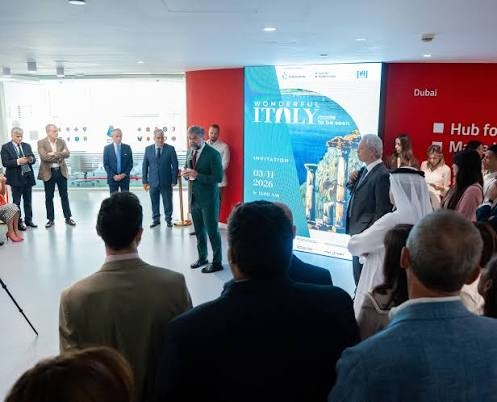
For today’s destination marketers, one lesson is that a strong visual story needs to be distinctive and rooted in the character of a place. Another is that heritage can remain relevant when it is presented in a way that speaks to contemporary audiences. Wonderful Italy: Made to Be Seen brought historical posters, an illustration and contemporary works together at Dubai’s Hub for Made in Italy during Dubai Design Week, creating a conversation between Italy’s visual past and present. The selection represented all 20 Italian regions.
Promotion has expanded from posters and printed campaigns to digital platforms and a much wider range of formats. The central task remains the same: to communicate what makes a destination meaningful and turn interest into a reason to experience it. The exhibition also offered audiences in the UAE a way to encounter Italy through its cultural heritage and creative identity, alongside its tourism offer.

5. Culture as a competitive advantage
Italy has an exceptional combination of art, architecture, gastronomy, fashion and history. How are you bringing these strengths together to attract new audiences and encourage visitors to explore beyond traditional tourism experiences?
Italy’s cultural strengths are most compelling when visitors can experience them together. A trip can connect art and architecture with regional cuisine, design, fashion, craftsmanship and local traditions. These are not separate attractions: together, they express the identity of a place and create opportunities for visitors to meet the people who live there.
The concept of “flourishing destinations” reflects this approach: destinations where tourism contributes to the well-being of local communities and the environment, while enhancing local resources and identities. Tourism development involves residents, businesses and local authorities working together to create shared benefits that respect the pace and character of each place. The quality of life of local communities, their traditions and their intangible cultural heritage—from festivals and craftsmanship to oral storytelling and social practices—become an integral part of the visitor experience.
Italy’s tangible and intangible heritage can generate broad economic and social benefits. In 2025, live entertainment, leisure and sports events attracted around 253 million spectators and generated €4.3 billion in spending, up 7% on the previous year. Cultural tourism also generates an estimated €56.6 billion in economic impact, equivalent to around 52% of the overall tourism-related impact. These figures show that culture not only attracts visitors, but also supports local businesses and services.
Roots tourism is another example of travel built around people’s connections with places. Many visitors of Italian heritage, including third- or fourth-generation descendants of Italian emigrants, return to discover the areas their families came from. A cultural event can give them a reason to combine attending a performance or exhibition with a visit to their family’s place of origin. According to the figures provided for this interview, in 2025, 7.7 million international travellers visited family and relatives in Italy, accounting for 59.1 million overnight stays and more than €5.2 billion in tourism spending.
The British market also demonstrates the appeal of Italy’s cultural offer. In 2025, cultural destinations welcomed 2.9 million visitors from the United Kingdom, generating 13 million overnight stays and €2.1 billion in spending.
ENIT’s promotional approach presents Italy as a country rich in experiences and encourages visitors to look beyond a single monument or city: to discover regional culinary traditions along a cultural itinerary, visit smaller towns alongside major destinations, and take part in the life of local communities. Projects such as Wonderful Italy: Made to Be Seen help bring this broader vision to international audiences. The challenge is to promote authentic experiences, close to nature and local communities, where travel contributes to the well-being of both visitors and the places that welcome them.
6. Sustainable tourism growth
With some Italian destinations facing overtourism while others seek more visitors, how can Italy achieve a better balance between economic growth, environmental protection and the needs of local communities?
A more balanced tourism model requires attention to both where people travel and when they travel. Encouraging visits to a wider range of destinations and across more seasons can create opportunities in places that receive less international attention, while helping to ease pressure on the most heavily visited itineraries.
In this context, promoting walking routes offers a practical way to highlight Italy’s dispersed heritage and encourage a more balanced distribution of visitor flows. These routes connect landscapes, villages, cultural heritage and local services, offering alternatives to the most popular itineraries and supporting year-round travel. The Ministry of Tourism identifies slow tourism, including walking routes, as an area for promotion. ENIT’s Antichi Cammini d’Italia project promotes five routes in Lazio, including the Via Francigena and the Ways of St Francis and St Benedict.
This goal must go hand in hand with respect for the environment, local services and residents’ needs. ENIT’s role is to promote a diverse national tourism offer and work with regions, destinations and tourism operators. Decisions on managing visitor flows should reflect the characteristics of each place and involve the communities who live there.
7. AI and the future of destination marketing
AI is transforming how travellers discover and choose destinations. How is ENIT adapting its marketing and distribution strategy, and what opportunities does this create for Italy’s tourism industry?
Digital tools are changing the way people find inspiration, compare options and plan their trips. Artificial intelligence is playing an increasingly prominent role in these stages and can help tourism organisations better understand their audiences, personalise information and bring destinations and experiences to light that might otherwise receive less visibility.
ENIT must approach this transformation with expertise, recognising AI’s growing influence on travel choices and planning. To do so, it is important to maintain a strong presence in the information environment where these tools generate their responses, by providing reliable, up-to-date and well-contextualised content. Authoritative sources and specific guidance can help shape the way Italy is presented and ensure its diversity is accurately represented, in the interests of the country and its regions.
Technology should contribute to the quality of the visitor experience by providing accurate information, presenting destinations clearly and giving visibility to the people and places that bring them to life. Artificial intelligence can support this work, while the knowledge and judgement of tourism professionals remain essential to overseeing its use and providing clear direction when shaping a national strategy.

8. Looking ahead
What are ENIT’s biggest priorities for 2027, and what would you most like international travellers and the travel trade to understand about the future of Italian tourism?
For 2027, ENIT’s priorities are to strengthen Italy’s position in international markets, promote the diversity of its destinations, encourage travel throughout the year and support the visibility and commercialisation of the country’s tourism offer. Digital communication and cooperation with regions, destinations and private-sector partners will remain important to this work.
The message for travellers and the trade is that Italy offers far more than its best-known places. Its strength lies in the variety of its regions, cultures and experiences. Discovering more of that variety can make a trip richer and help tourism contribute to communities across the country.
Questions for Leo Cisotta – Italiacamp EMEA
1. The story behind Wonderful Italy
What inspired Wonderful Italy: Made to Be Seen, and why was Dubai the right place to showcase Italy’s tourism heritage through this collection of historical and contemporary posters?
For more than a century, Italy told its story to the world before most people ever set foot there. It did so through images. Travel posters turned a coastline, a mountain village or a city of art into something people wanted to experience. When we explored the Italian Tourist Board’s (ENIT) digital heritage collection, we saw more than archive material. We saw a communication tool that is still impactful today.
That’s how Wonderful Italy started. Twenty historical posters, one illustration and two contemporary pieces. Together, they span all twenty Italian regions. Side by side, they show that Italy is not a single image but a mosaic of facets, each with its own colours, symbols and identity. The contemporary works show that this way of telling Italy’s story is still evolving.
Dubai was the natural place to showcase it. The UAE is one of the world’s most dynamic crossroads, where cultures, travellers and businesses meet every day. Launching during Dubai Design Week, inside our Hub for Made in Italy at the Dubai World Trade Centre, put Italy’s visual heritage in front of exactly the audience we wanted: culturally curious local and international residents of the UAE. For us, it’s not just an exhibition, but a new, interactive way of telling Italy’s story.

2. The Italy-UAE relationship
The relationship between Italy and the UAE extends well beyond tourism. How is Italiacamp helping to strengthen commercial, cultural and creative connections between the two countries?
Since 2023, Italiacamp EMEA has run the Hub for Made in Italy in Dubai, and since 2025 a second Hub in Abu Dhabi.
On the commercial side, we help Italian companies set up, find partners and meet the right counterparts, from first market entry to cross-border M&A and joint ventures. On the cultural side, we bring Italy into everyday life in the Emirates. Examples include the Made in Italy Week, held across three Emirates under the auspices of the Italian Embassy, and Crossroads, our podcast on Italy-UAE relations with Manara, which brings Italian and Emirati voices together. On education, we run programmes with Luiss Business School, plus Italian and Arabic language courses. The common thread is people. Lasting partnerships between countries are built by individuals who know and trust each other. Our Hubs exist to create those encounters.
3. The power of Made in Italy
Made in Italy is one of the world’s most recognisable expressions of quality, creativity and craftsmanship. What makes it so powerful internationally, and how can that reputation create new opportunities for Italian businesses in the Middle East?
Made in Italy is powerful because it is never just a product. It carries a territory, a know-how handed down through generations, and a way of living. When someone buys an Italian chair or a suit, they’re buying into a story about beauty, care and authenticity. That story is the result of centuries of craftsmanship, and it can’t be copied.
In the Gulf, that reputation opens doors, but it isn’t enough on its own. The region is sophisticated, fast-moving and highly competitive. Italian companies, most of them small and medium-sized, need to pair their brand with a local presence, the right partners and a real understanding of the market. That’s the gap our Hubs for Made in Italy are designed to close.
Made in Italy gets the first meeting, but a solid local strategy turns it into a long-term business opportunity.
4. The evolution of destination marketing
The ENIT archive demonstrates how Italy has inspired travellers for generations. What has changed most fundamentally about how destinations tell their stories, and what remains timeless?
The biggest change is who tells the story. A century ago, a destination spoke through a single poster with one image, one message, one direction. Today the story is told by millions of travellers, creators and communities at the same time, across every screen. Destinations no longer control their image, but they have to earn it, and keep earning it, through authentic experiences that people want to share.
The pace has changed too. Content now lives for hours, not years. The audience has also become much more global and diverse. A campaign has to speak to a traveller in Dubai as naturally as to one in Milan or Mumbai.
What remains timeless is the power of a single strong image to create desire. If you take a look at ENIT’s posters you will see a few colours, a strong composition and a name that makes you want to visit that place. Effective destination marketing doesn’t sell a place, it invites you to imagine yourself in it. That’s why we see the ENIT archive as a living tool, not a museum piece. It reminds us that the best stories are simple, rooted in a real place, and made to be seen.
5. Beyond the exhibition
What role does the Hub for Made in Italy play in supporting Italian businesses, entrepreneurs and creative industries in the UAE, and what practical opportunities does it provide?
The Hubs for Made in Italy are where Italian companies land, grow and connect. In Dubai we have 2,000 square metres in the Convention Tower at Dubai World Trade Centre, a venue that welcomes millions of visitors every year. In Abu Dhabi we have 600 square metres in Sky Tower, in the heart of ADGM. Both offer offices, coworking, meeting rooms and event spaces, but the real value is in the services and the community around them.
We work across five core business lines:
-Market Entry Pack: company set-up and licensing, domiciliation, legal, tax and accounting support, and offices or virtual offices, delivered directly and through qualified partners.
-Events, missions and delegations: complete programmes for Italian delegations, with institutional agendas, targeted B2B meetings, visits and logistics.
-Education and training: programmes with Luiss and Luiss Business School, executive courses on the UAE market, and Italian and Arabic language classes.
-Advisory: cross-border M&A, strategic joint ventures and financial advisory between Italy, the GCC, India and East Africa.
-Special initiatives: our own cultural and content formats, such as Wonderful Italy, the Made in Italy Week and the Crossroads podcast.
For a creative studio, a designer or a young entrepreneur, this means they don’t arrive alone. They join a community that spans industry, tech, finance, fashion, health, sport and the creative industries, with institutions on both sides. We’re not a business centre, but rather a place built to make Italian businesses and talent enter and scale in this market.
6. Tourism, culture and commerce
How can initiatives such as Wonderful Italy translate cultural engagement into measurable tourism demand, investment and business opportunities?
An initiative on its own creates emotion and curiosity, while an exhibition that sits inside a wider system creates results. That’s why, together with ENIT, we designed Wonderful Italy in the UAE as a permanent platform rather than a one-off event. The opening and the talks around it brought together institutions, tourism operators, Made in Italy brands and cultural figures in the same room. Those are relationships that continue long after the posters come down.
On measurement, we look at what can be counted: visitors and event participants, the institutional and business partners involved and the meetings and follow-ups that come out of each activation. Over time, the indicators that matter most are the partnerships signed, the delegations organised and the companies that set up in the UAE through the Hubs for Made in Italy. Tourism demand itself is measured by our institutional partners, such as ENIT. Our role is to make sure that cultural engagement keeps leading somewhere concrete: a trip, a meeting, a partnership.
7. The next generation of collaboration
Where do you see the most exciting opportunities for collaboration between Italy and the Gulf, particularly across tourism, hospitality, design, innovation and the creative industries?
The most exciting opportunities sit where these sectors meet.
In tourism and hospitality, Gulf travellers are looking for experiences, not just destinations. Italy can offer an extraordinary range beyond the classic routes: smaller regions, wine and food territories, wellness and slow travel, in every season. At the same time, Italian hospitality know-how, from service culture to design to food, has a lot to offer the region’s growing hotel and leisure sector.
In design and architecture, the Gulf is building at a scale and ambition few places can match. Italian architects, designers and manufacturers bring quality, materials and a sense of beauty that projects here increasingly look for. Our presence at Dubai Design Week with Wonderful Italy is a sign of how closely these worlds are connected.
In innovation, I see strong potential in partnerships between Italian SMEs and start-ups and Emirati innovation ecosystems. That’s the spirit of our agreements with the Sharjah Research, Technology and Innovation Park and with Dubai SME. Sport, entertainment and the creative industries complete the picture, as areas where both countries invest heavily and share a passion for excellence.
The next generation of collaboration will be about co-creating: joint ventures, shared projects and talent moving in both directions.
8. Looking ahead
What are Italiacamp’s ambitions for the region in 2027, and what other initiatives or partnerships should we be watching?
Our ambition for 2027 is to make the Hubs for Made in Italy the reference point for anyone who wants to build something concrete and long-lasting between Italy, the UAE and the wider Gulf region.
First, Wonderful Italy continues. A selection of the works will travel to our Abu Dhabi Hub, and we expect the project will grow into a year-long platform of talks, content and activations. Wonderful Italy is designed as an umbrella brand for initiatives on Italian history, art and culture.
Second, we’ll strengthen Abu Dhabi as our institutional and financial base, alongside Dubai as our commercial and community engine. We also want to deepen our work in Sharjah with SRTIP.
Third, we’ll keep growing our own formats: the Made in Italy Week around Made in Italy National Day in April, new seasons of Crossroads, and more education programmes with Luiss and Luiss Business School.
Finally, we want to grow our advisory work on cross-border investment, connecting Italian companies with partners and capital across the GCC.