



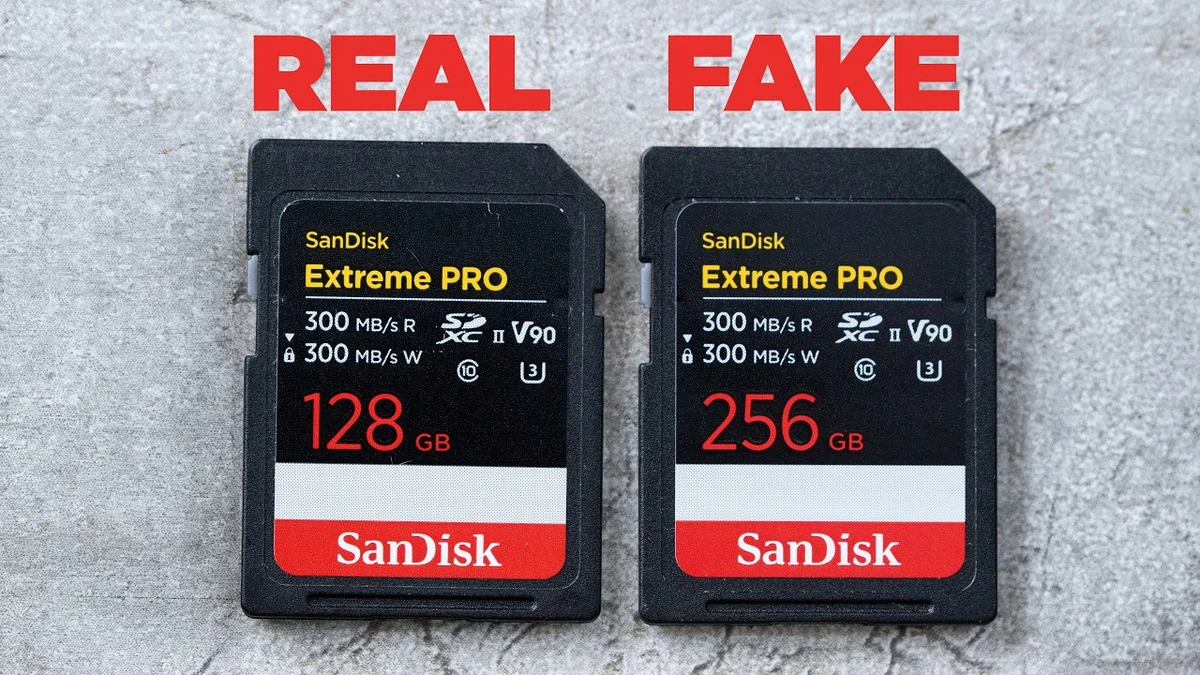
There’s a good chance you own a fake hard drive, SSD, or memory card right now. You might even be using it today and think it’s working fine. It isn’t. I recently bought six SanDisk memory cards from Amazon and eBay, and every one of them was fake.
Fake external drives have been around for a while. You think you’re buying a brand-name drive, it arrives looking right, you plug it in, and it works, so it must be real. Then you open it and find a cheap USB stick inside with some metal glued in to make it feel heavy. What fewer people know is that camera memory cards are being faked too, they’re everywhere, and they look identical to the real thing.
My second attempt was a set of supposedly refurbished high-speed SanDisk cards. They even had the second row of pins you’d expect on a UHS-II card. They looked real. They were fake.
Where Fake Cards Come From
I assumed there were factories somewhere making cheap SD cards and slapping a brand-name sticker on them. What I’ve learned since is that only a handful of companies on earth can make the internal components of an SD card, and they’re all legitimate companies that would never make fakes. SanDisk is one of the few card brands that makes its own chips. Many other well-known brands, including some that sell faster and pricier cards than SanDisk, buy pre-made chips and put their own label on them, and those are still legitimate products.
The problem starts with chips that fail quality control. George Pavel of SalvageData explained that at the chip fab level, manufacturers produce smaller, lower-grade chips meant for other uses, and scammers adapt them to look like higher-grade parts and sell them at retail prices. They likely buy huge quantities of these defective chips for less than a dollar each. The easy part is printing a sticker that makes it look like a real brand, and the packaging from the different sellers I bought from looked almost identical.
You Can’t Tell From the Outside or the Inside
For the first time, I cut one of these cards open. I don’t know what I expected, but it wasn’t this: about 75% of an SD card is empty space. The only working part is at the very top, and that’s exactly what a genuine SD card looks like inside too. There’s no visible difference.
The outside isn’t much help either. In one lineup of four cards, the one I bought from eBay looked a little different, and it was fake. But another card that also looked different was real. SanDisk changes the design of its cards and boxes regularly, so even a card I got directly from SanDisk had a logo I’d have sworn was a fake.
The Scariest Part: They Work
Fake cards have to work. If a card arrived and failed in your camera right away, you’d leave a bad review and ask for a refund. Years ago, a SanDisk card I’d used to shoot weddings professionally failed on me. Thankfully there wasn’t a wedding on it at the time. I called SanDisk furious, and after we went through all the checks, it turned out to be a fake. I’d been shooting weddings on a fake card for years.
Scammers fake two things to make as much money as possible:
- Capacity: the card says 512GB or 1TB when the real capacity is far smaller.
- Speed: you pay extra for a high-speed card that can’t come close to those speeds.
Faking capacity is easy, because your computer or camera doesn’t actually measure the storage. It reads a number stored in the card’s firmware. You might think you can just fill the card and see whether it fills up, but that doesn’t always work. Your camera or computer can think it’s writing files successfully, with no error at all, and the files simply aren’t there when you go to open them. George told me about a wedding photographer whose card showed JPEG thumbnails while she thought she was shooting raw. When she went to open the files later, there were no raw files at all.
How to Test Your Cards
On a Mac, one of the only reliable ways I know to check capacity is the free app F3XSwift. It fills the entire card with data, then reads every bit of it back to make sure it’s all there. Checking a 512GB card took me about an hour and a half.
That only covers capacity. For speed, use Blackmagic Disk Speed Test. It measures read and write speeds and shows which video formats the card can handle, with green checks and red Xs that make the results easy to read.
Speed matters most for video. Some of the formats my Sony cameras shoot can only be recorded to V90 cards, which are guaranteed never to drop below 90 MB/s. Put a fake card in with one of those settings and the camera tells you immediately that it won’t work. My real card worked. The refurbished ones that looked exactly the same didn’t.
eBay and Amazon
Anyone can make an eBay account, but every fake card I got from eBay came from a seller with years of history and over 95% positive feedback, and many of those positive reviews were for the fake cards. My guess is that scammers buy established eBay accounts. Their older sales are ordinary items, and their recent listings are all counterfeits.
Amazon is more complicated. On my own hot sauce brand’s Amazon page, the seller is my company, which is actually rare. Most big brands sell through distributors, who either sell in bulk to Amazon or run their own Amazon storefronts. On one SanDisk V90 card’s page, the top says “Visit the SanDisk Store,” but the seller is Amazon.com, not SanDisk. That’s probably fine, assuming Amazon buys from SanDisk or an official distributor. On a SanDisk SSD I own, though, the seller was a company I’d never heard of, and there were about 20 other sellers of the same listing. Refresh the page and the seller can change without you noticing. One nearly $500 card was sold by another company I’d never heard of.
This isn’t a SanDisk problem. I focused on SanDisk because it’s the brand I use and trust most. According to SalvageData‘s George Pavel, the most counterfeited cards he sees are actually Lexar and Samsung, often bought on eBay.
How I Buy Cards Now
George’s advice was simple: the safest way is to buy from a brand-name retailer, because on marketplaces like eBay and Amazon, even a legitimate listing can be swapped between sellers. I’m going to buy every card and drive like this from B&H from now on. It’s not worth the risk when you’re using these tiny cards to make money. I can’t imagine losing an entire wedding to a fake card.
If a card or drive has already failed on you, there’s still hope. SalvageData has saved me twice. It recovered a Synology NAS where several drives failed at the same time, and an old Drobo full of my old weddings that I didn’t have backed up anywhere else, after it had sat broken for 10 years.


