



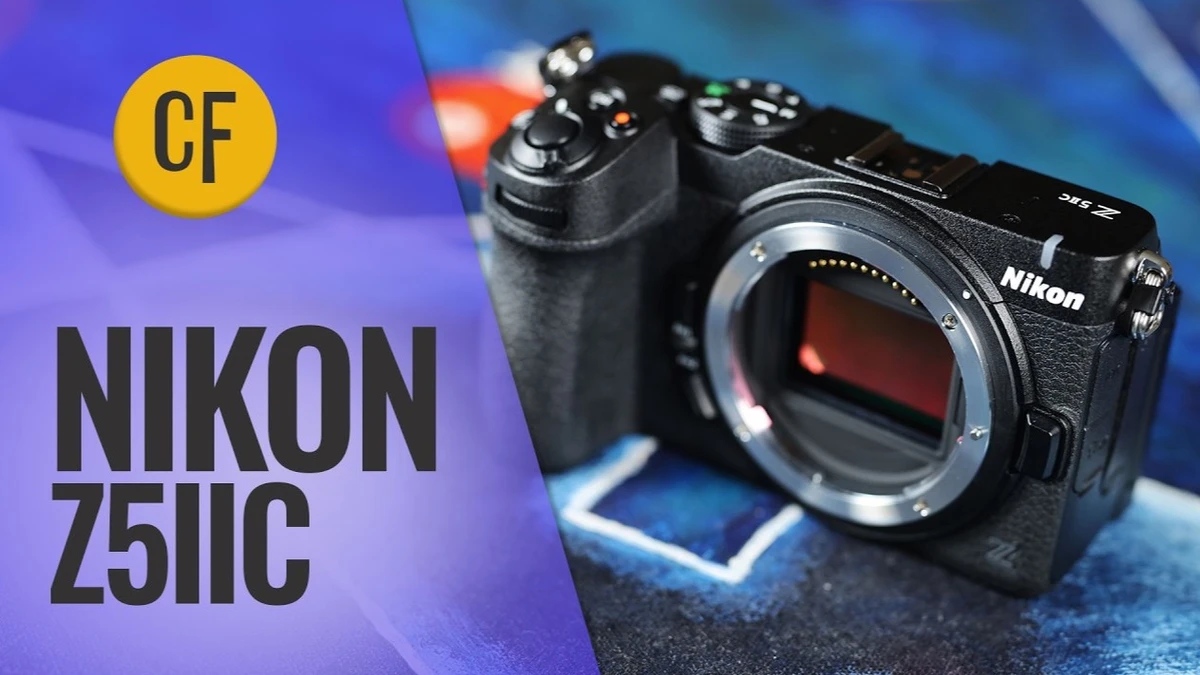
Nikon’s Z5IIC takes most of the Z5II, removes the electronic viewfinder, and sells what’s left for $1,396. If you’ve been saving for an affordable full frame body, you now have to decide whether composing on a rear screen alone is a fair trade for a smaller camera and a few hundred dollars back in your pocket.
The missing viewfinder has stirred up more argument online than you might expect, and Christopher Frost spent about a week with the Nikon Z5IIC, on loan from Nikon UK, to see how much of the $1,847 Nikon Z5II survived the cut. Most of it did. The 24-megapixel backside-illuminated sensor carries over, along with in-body image stabilization rated up to 7.5 stops, a top mechanical shutter speed of 1/8,000 s, and burst rates of 11 fps with the mechanical shutter or 30 fps with the electronic one, though only in JPEG. Frost got roughly 400 shots from the same large battery, a solid number from a body this compact. Pre-release capture is still here, and so are the astrophotography modes from the Z5II.
The cuts are specific, and you can judge each one against how you shoot. The screen is fully articulated, touch sensitive, and bright enough for sunny days, though it has a lower resolution than the one on the Z5II. It still has over a million dots, and Frost found it perfectly sharp in use. You drop to a single SD card slot, and the autofocus joystick is gone, so you’ll move your focus point with the D-pad or by tapping the screen. The dedicated AF-ON button is also missing, but the AE-L button can be reassigned to do the same job. The autofocus assist lamp is gone too. Oddly, the cheaper camera gains something: subject detection for fish, a mode the Z5II doesn’t have.
A few smaller details came up in testing. The older sensor reads out a little slowly in silent electronic shutter mode, so Frost suggests keeping the camera still when you use it. The microphone, headphone, mini HDMI, and USB-C ports sit under rubber flaps, and the USB-C port charges the battery, though even with a 65 W charger, a full charge seemed to take about an hour and a half. The camera comes in black or with a silver top plate, which Frost thinks looks a little better.
Handling holds up better than the small size suggests. A deep rubberized grip makes the body feel a little chunky in the hand, and it’s solidly built, with plenty of customizable buttons and front and rear dials. One of the three custom slots on the mode dial has been replaced with a scene setting, where picking dusk or sports sets exposure, white balance, and shutter speed accordingly. A dedicated button next to the mode dial brings up the picture styles, and Frost found some of the more unusual ones genuinely inspiring. The menus take some getting used to. Silent shooting now lives in the setup menu rather than the photo shooting menu, which tripped Frost up for a while.
Image quality matches the Z5II exactly. Raw files hold excellent detail for a 24-megapixel sensor, while JPEG colors and contrast look great, even if the sharpening runs a bit heavier than Frost prefers. ISO 100 through 800 are clean, the finest details start slipping at 1,600, and 3,200 still looks quite good. ISO 6,400 shows more smearing, and 12,800 is usable in a pinch. On the video side, you get 4K at 60 fps with a 1.5x crop, internal 12-bit raw recording, 16-bit log, and 1080p at 120 fps. A 96-megapixel pixel shift mode is included as well, and Frost had the most success with the 32-shot setting on a very sturdy tripod.
Video quality matches the Z5II as well. In 4K 60p, detail is average, noise starts creeping in at ISO 1,600, and he wouldn’t use 6,400 or 12,800. 4K 25p is a touch cleaner and slightly more detailed. The 1080p 120 fps footage looks gorgeous for HD, but rolling shutter is pretty bad in 4K at both frame rates, so Frost switches to 1080p for action, where it’s minimized at any frame rate. A raw file pulled up from -7 EV with the mechanical shutter showed decent dynamic range for a full frame sensor, though some more expensive cameras do better.
Frost doesn’t see why the camera should be controversial. He calls it a great choice if you want the most value from a full frame purchase, an okay one if you’re still learning, and a good fit if you’d rather not carry a camera that looks big and expensive. Photographers who want a viewfinder and dual card slots should get the Z5II, which is sometimes on sale and can narrow the price gap, but at its price, he recommends the Z5IIC completely.
Frost’s sample images, ISO comparisons, and rolling shutter tests are all in the video.


