



A heavy camera bag quietly costs you frames, because every stop means unbuckling, swinging it off your back, and digging through it, and after a few hours you start walking past scenes instead of shooting them. A small Micro Four Thirds kit with two zooms changes that math, especially in winter, when the sun stays low enough that good light can stretch from midday into the afternoon.
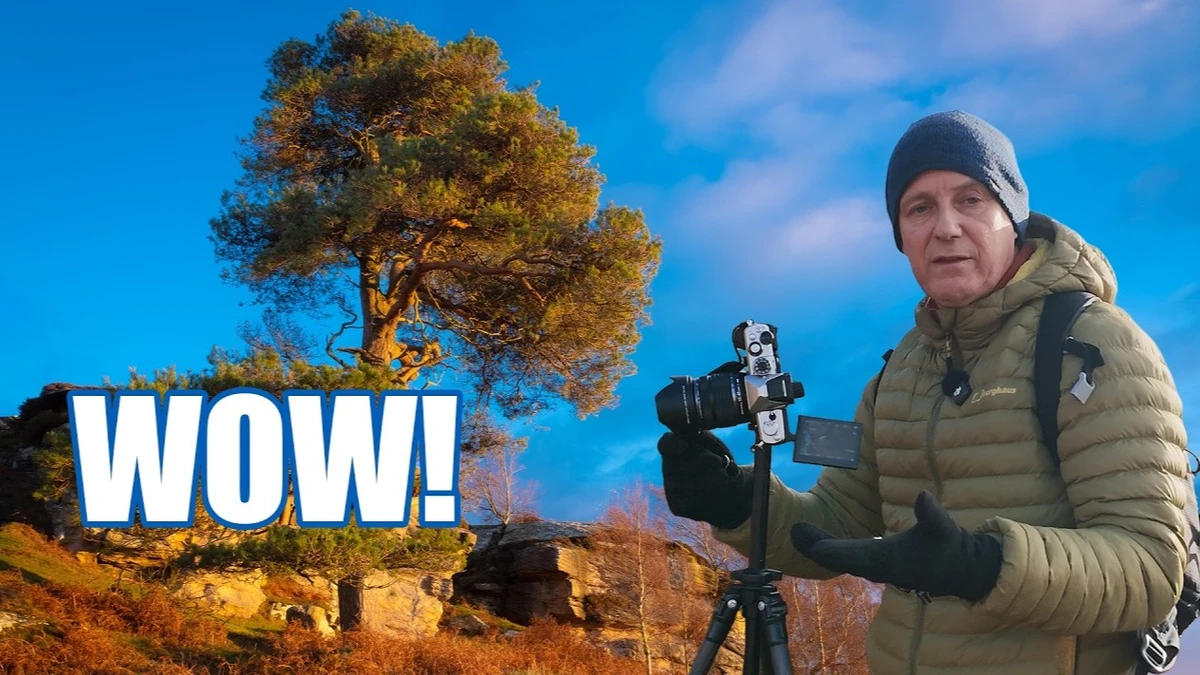
On his last visit to Shaftoe Crags in Northumberland, Jason Friend carried a medium format film camera plus a Sony a7 II converted to full spectrum. The bag was so heavy that half the time he didn’t feel like taking it off to shoot. This time, he comes back with an OM System OM-3, the M.Zuiko Digital ED 12-45mm f/4 PRO, the M.Zuiko Digital ED 40-150mm f/4-5.6 R, and a compact tripod. With the system’s 2x crop factor, those two lenses cover the equivalent of 24mm to 300mm, far more range than the roughly 35-70mm equivalent he hauled around before. Food, water, and a hot drink fit in the same small bag. He still sets up the tripod at each stop, since he likes the way it slows him down, even though a lighter kit might tempt you to leave it in the car.
The first frame is a simple one at 1/400 s and f/8, fired on a 12-second self-timer so Friend can walk well out of the scene and keep his long winter shadow off the subject. He treats that opening shot as a way to get the day moving before chasing anything more creative. A stand of leafless silver birches comes next, and the lack of greenery pushes him toward black and white. The trouble is converging verticals, and swapping to a taller tripod barely helps. So he turns on the OM-3’s keystone compensation, which saves only a JPEG, and uses it as a live preview: he composes with the correction on, then switches it off and shoots raw, confident the file has enough room around the edges to straighten in Lightroom later.
Friend also buys into an idea from fellow photographer David Taylor, who recently picked up an Olympus PEN-F: some cameras make you want to shoot differently. With the OM-3, he takes frames he says he wouldn’t attempt with a bigger body, and he’s comfortable not knowing whether they work. One composition he loves, a tree-lined avenue with a wall running through it, he leaves for another day, since he thinks it would be better with autumn leaves or the fresh green of early spring. Later, three weather-beaten trees on a hillside call for a square crop. He considers the 40-150mm but sticks with the 12-45mm, which he says punches well above its weight for a kit lens, and moves down the slope to get more separation from a fourth tree. Standing at roughly 90 degrees to the sun, he fits a circular polarizer, sets up the camera’s Live ND, and waits for the sheep to wander out of the frame as the sun breaks through. He mentions the shot has been about six months in the making.
He also finally puts the cheap, plastic 40-150mm to work, a lens that sells for $240 new. Near maximum zoom at f/8 and 1/6 s, he isolates a splash of color in the woodland that a wide lens would have reduced to nothing. Tilting up pulled sky into the frame and broke the abstract feel, so he lets the tops of the leaves run off the edge of the frame instead.
He isn’t sure that cheap zoom is good enough, though he suspects modern optics are fine. Back up on the crags, the light finally arrived, and it was gorgeous. A stray tree kept edging into the frame, and the purist in him doesn’t love that he’ll have to clone it out painstakingly, but he calls himself “a very, very happy chappy.” He had never been there when the light was good, and the only thing missing was some cloud behind the crags, which he takes as an excuse to come back.
Each of those frames, from the silver birches to the last light on the crags, is in the video.


