



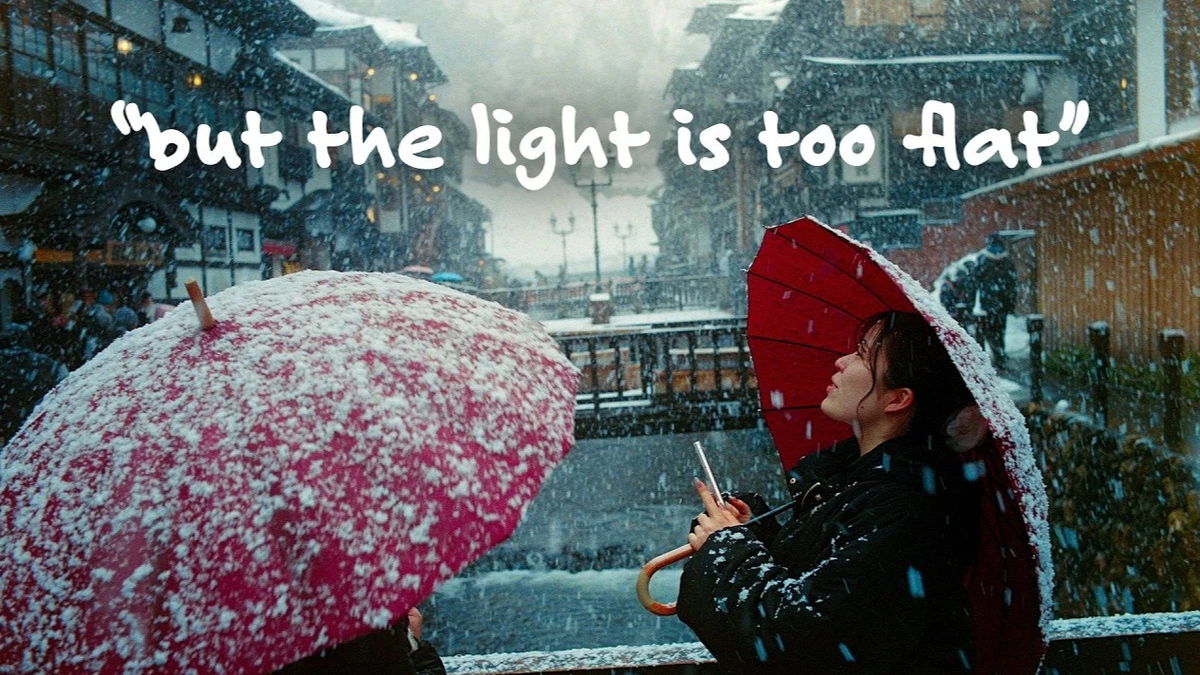
You check the forecast, see a solid wall of gray for the weekend, and feel the pull to leave the camera at home. Overcast light strips away the shape and contrast that golden hour gives you for free, so every good frame on those days depends on choices you’d normally never have to make.
Teo Crawford breaks his approach into five things he looks for when the sky gives him nothing, and the first is the one he relies on most: directional light. Clouds turn the sun into one enormous, even source, which is why faces and buildings on gray days tend to read as flat shapes with no clear bright or dark side. Crawford’s fix is to find something that blocks part of that sky. A woman leaning against a wall, or another holding an umbrella over her head, ends up lit from one side only, and the falloff from light to shadow brings back the depth the clouds erased. He sets those frames beside a street portrait lit evenly from everywhere, and the face in that one loses its shape in a way you notice immediately.
Flat isn’t always the enemy. A silhouette deliberately crushes the distance between camera, subject, and background into a two-dimensional look, and Crawford thinks that works well when you choose it. The trouble on cloudy days is flatness you didn’t choose, and once you notice it, you can work against it.
Crawford scales the same idea up to buildings. Standing under a roof at a train station and shooting toward an opening lets the architecture act as a modifier, sending light down from above into a scene that would otherwise be uniform gray. One frame comes from a platform near a gap where daylight pours into the station, and shooting from the dark side toward the bright side gives it a dramatic look even though the light outside is about as flat as it gets. He calls this his number one point: look for the edge where shadow turns into light, and let anything from an umbrella to a building create it.
His second point shifts from light to tone. When the light can’t separate a subject from the background, the subject and background can do it on their own. Crawford places a person in bright clothing in front of trees with dark green leaves, so the shade under the trees and the color of the foliage both push the background darker and make the figure pop. In another frame, the light is completely flat, yet dark grass against pale gray paving and a person lying on that grass give the composition plenty of clarity. The lighting is doing almost none of the work in either image.
Color is the third lever, and it carries more weight on gray days because everything around it is muted. A beige coat first drew Crawford into one street scene, but autumn leaves, a red tram, and red car lights add life to the frame. He keeps one condition firmly in place: the palette has to stay simple. The vivid tones in that shot sit close together in the reds and oranges, and he argues that adding blue, purple, and green elements would have made it a mess. A portrait of his mother with a bright yellow umbrella and a red scarf shows how a couple of strong colors can carry a subject on their own, and a bus stop with orange wooden shelters beside a tree in pink bloom holds up despite light that clearly isn’t helping.
His fourth point is texture and atmosphere. Rain adds texture to the air, and afterward, a wet road reflects light and shows its surface, so if the forecast calls for a plain cloudy Saturday and a rainy Sunday, he’d go out on Sunday. Snow does the same in colder places. In one frame, he used 1/60 s to blur the flakes flying through the air, and in another, a dark road layered with snow and wheel tracks does the work along with a simple palette and strong contrast. Fog is about as flat as light gets, yet it adds so much atmosphere and depth that the light doesn’t have to do anything.
The fifth point is to go inside, which he sees as the extreme version of using architecture to shape light. On a cloudy day, a friend’s room with a single window gives soft, directional light, and a university cellar with no daylight at all gave him clean top light from one bright square lamp. Inside doesn’t have to mean your home or a cafe, either. Museums, libraries, and botanical gardens all count.
The video pairs each of the five points with Crawford’s own frames, including the side-by-side portraits.


