

A beautiful subject sitting in a messy scene rarely makes a beautiful photograph. Subtracting what doesn’t belong is something every photographer has to learn eventually, and it often decides whether an image holds together or falls apart.
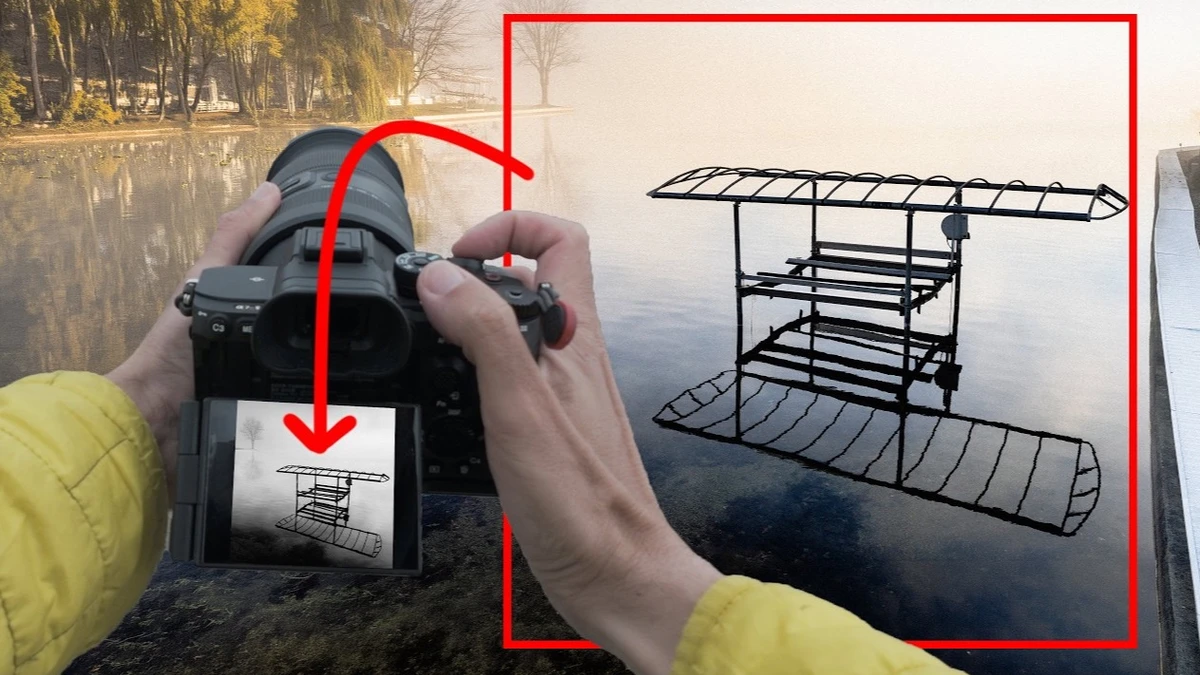
Most people assume the subject carries the photo, and Adrian Vila of aows argues close to the opposite: the subject may be “one of the least important characters in the frame.” The example is a stand of ordinary trees in a small park, probably cottonwoods, that look like nothing much. Drop one of those trees in the middle of a lake with mountains behind it, and suddenly it looks like the most striking subject you’ve ever seen. The tree didn’t change. What surrounds it did, and that shift moves your effort away from hunting for subjects and toward working the angle, the height, and everything around the thing that caught your eye. Lens choice plays into this too, and Vila makes most images with a Tamron 35-150mm f/2-2.8 Di III VXD, cropping everything to a square so even the 35mm end feels tighter than you’d expect.
A useful question comes out of this: if you were painting the scene by hand, what would you include, and what would you leave out? The second half is the harder one. Vila walks through a photo made on Fifth Avenue in New York during a snowfall, with plows on an empty street and tall buildings rising into the haze. Standing there, it felt magical. At the computer, all Vila could see were two parked cars. They pulled the image back toward ordinary reality and broke the dreamlike, slightly mysterious mood the photo was built around, so they came out with the healing tool. That example sets up a short list of techniques, and the first one costs nothing at all: where you stand and how high you hold the camera.
It’s also the most powerful. Even with something as plain as a single tree, Vila keeps asking questions and working the scene until there’s nothing left to find, and, paraphrasing Ansel Adams, calls where you place your tripod the most important decision a photographer makes. Adams also opens the video, in a story Vila admits may not be true, about Adams traveling with an axe to clear away small trees and shrubs that spoiled his compositions.
Watching those edges is the second technique in the video, and Vila points out that edges often get neglected even when the background behind the subject has been handled with care. Cutting something off awkwardly or leaving one element that tips the balance is easy to do. Weather comes next. Snow simplifies the ground, fog swallows a busy background, and mist or drizzle does something similar, all without any effort on your part. Vila heads out early and late, too, though the color in the sky isn’t the draw. A low sun angle helps simplify the scene. Of course, you can’t control light or conditions. You can have the composition, the skills, and the gear all lined up and still have to wait. Focal length gets its own section, since a long lens compresses and isolates elements in a crowded setting far better than a wide angle lens does, and depth of field follows with a caution about pushing separation so far that the context disappears. Vila still wants context in a frame, because a subject shown alongside something else tells a better story.
The last resort is the healing tool. When there’s nowhere else to stand, no faster aperture to use, and no weather to lean on, as on Fifth Avenue, Vila sees nothing wrong with removing a few things to make the image envisioned in the field, since the goal is art, not a record of reality. Sometimes the clutter is the point of a picture, and then it isn’t unnecessary. More often, none of these techniques simplifies a scene enough, which Vila calls normal, because good images are rare. Some subjects need a few weeks or months for the right conditions, and some need to be walked away from for good.
Two trains rumble past during the video, and Vila turns the first into an example of the conditions no photographer controls.