

In his latest bestseller, London Falling, Patrick Radden Keefe refers to art in his prologue to illustrate the way the city of London changed near the end of the 20th century: In 1988, a group of young artists used a derelict warehouse in the docklands of southeast London as the venue for their first group exhibition, “Freeze.” He doesn’t say anything else, assuming the reader will know who those artists became: the Young British Artists, or YBAs.
Arguably Britain’s most famous artistic group ever, the YBAs were a symptom of their moment. They rocketed to fame in the early ’90s, as London was undergoing a profound renaissance—or rupture, depending on how you look back on it now. Their legacy has ebbed and flowed in parallel with Britain’s national image, peaking in the heady atmosphere of the end of the millennium and gaining nuance as it has fallen ever since. And that legacy has continued to be reexamined in notable exhibitions, among them shows for Tracey Emin at Tate Modern earlier this year, Jenny Saville at London’s National Portrait Gallery in 2025, and Sarah Lucas at Tate Britain in 2023—as well as “The 90s: Art and Fashion,” an exhibition devoted to the art and pop culture of the YBA decade opening at Tate Britain in October.
Making a definite list of who is an “official” YBA is difficult. The designation is sometimes reserved for the artists included in the original “Freeze” exhibition, while other times it applies to those in collector Charles Saatchi’s “Young British Artists” exhibitions from 1992 to 1995, and still other times to the artist list for the Royal Academy’s 1997 “Sensation” show. Many, but not all, of the members in the orbit of Damien Hirst graduated from Goldsmiths in the late 1980s and early ’90s, and there are dozens of other exhibitions that pulled together different arrangements of artists. Then there are the questions of who was friends with who or might be dating, and of course what the media made of it all at the time. With that said, the key YBAs are definitely Hirst, Emin, Lucas, Saville, Marc Quinn, the Chapman Brothers, Gary Hume, Michael Landy, Gillian Wearing, Chris Ofili, Angus Fairhurst, Rachel Whiteread, and Anya Gallaccio.
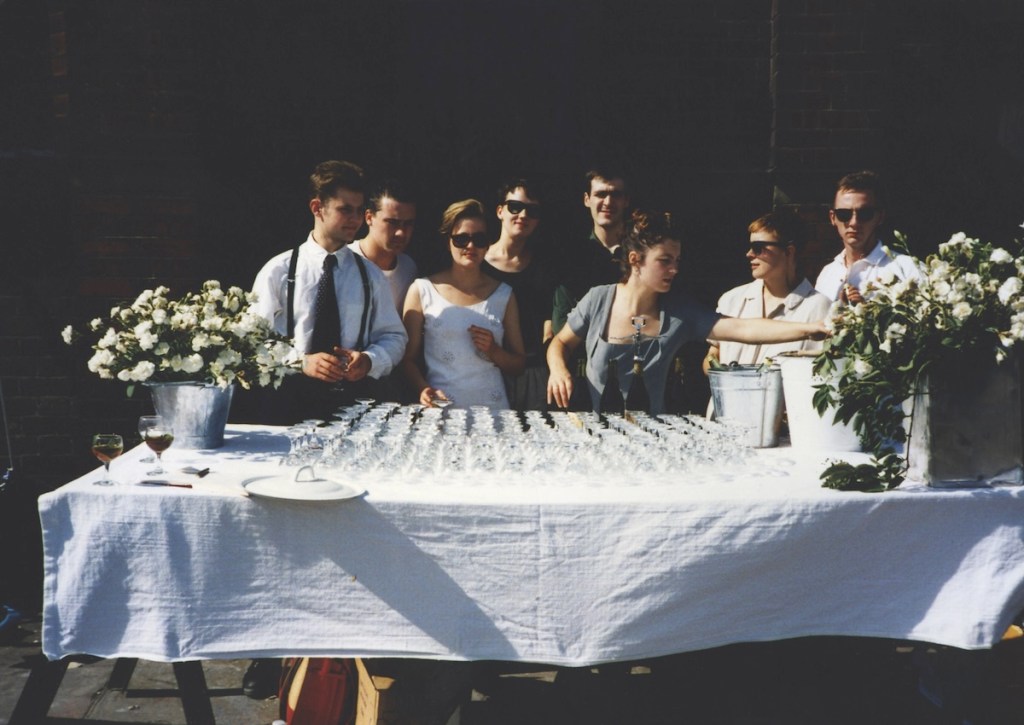
When “Freeze” opened in its East End warehouse in 1988, it was a scene. In his memoir about being a YBA groupie, Lucky Kunst, critic and curator Gregor Muir described the way the exhibition marked the start of a new culture of packed openings and the feeling of a real community of artists and art people who went to all of them, drank and drugged excessively, and knew each other well. Genuine friendship between the artists was the glue that held the group together, more than any guiding aesthetic qualities or artistic questions in search of answers. If pressed, one could say that YBA artists shared a desire to shock. But whether through revulsion, violence, sex, or strange new ways of using space or materials, the artists in the YBA set sought reactions from viewers—with good or bad mattering less than the intensity of the reaction itself.
IN 1992, THE BRITISH-IRAQI ad man andcollector Charles Saatchi hosted the first “Young British Artists” exhibition at his gallery near Sloane Square in West London, the first time the moniker was officially enlisted. The exhibition debuted Hirst’s infamous shark in a formaldehyde tank, with the title The Physical Impossibility of Death in the Mind of Someone Living (1991). Around the same time, three more defining YBA works were exhibited elsewhere in London: Marc Quinn’s Self (1991), a sculpture of his own head made with eight pints of his own frozen blood; Sarah Lucas’s Two Fried Eggs and a Kebab (1992), a table on which the foods in the title were arranged to suggest a set of breasts and a vagina; and Rachel Whiteread’s Ghost (1990), a plaster cast of an entire room of an abandoned Victorian house. These four works, along with Tracey Emin’s My Bed (1998), stunned the international art world and have defined the YBA image and legacy ever since. I would wager that many readers can picture some or all of them right now—they have become genuinely iconic.

Damien Hirst: The Physical Impossibility of Death in the Mind of Someone Living, 1991, on view in an exhibition at Tate Modern, London, in 2012.
hoto Oli Scarff/Getty Images
The YBAs were the beneficiaries—or maybe victims—of superb branding. Saatchi, whose advertising firm Saatchi & Saatchi was most famous for masterminding the brand strategy of Margaret Thatcher’s final two election campaigns, purchased a huge volume of work directly from the artists who would become known as the YBAs, including the works mentioned above. While the amounts he paid were not negligible by the metrics of the time (he bought Quinn’s Self for £13,000 in 1991 and Emin’s My Bed for £150,000 in 2000, for example), he resold the works with a mark-up of over 1,000 percent (he sold Self in 2005 for approximately £1.5 million and My Bed in 2014 for about £2.5 million).
In 1997, the Royal Academy hosted a blockbuster exhibition of works in Saatchi’s collection, titled “Sensation,” that broke visitor records and also garnered significant criticism for basically being a preliminary saleroom for one man’s collection. Saatchi was unprecedented in London—no collectors of his wealth and strategic mindset were buying in the city at the time. He had more or less free rein to buy anything he wanted, and to manufacture a frenzy around the artists he collected to make his investments so lucrative. After all, he was an ad man.

Jake and Dinos Chapman: Zygotic Acceleration, Biogenetic, De-Sublimated Libidinal Model, 1995; on view in “Sensation” at the Brooklyn Museum, 1999–2000.
hoto Susan Watts/NY Daily News Archive via Getty Images
By 1998, the year after “Sensation,” the Observer writer Andrew Anthony wrote in an article titled “Why Be a YBA?” that “increasingly, the artists and the surrounding world of dealers, gallerists, hangers-on, [and] parties have become more ‘interesting’ than their art.” The line between them, he noted, “had already been blurred,” but by the turn of the millennium it had fully been erased. Throughout the decade from “Freeze” in 1988 to this moment of flux in 1998, the YBAs’ relationship to the “establishment” had been paradoxical. They promoted themselves as disrupters who had come from outside the art world to shake things up. But they were graduates of prestigious art schools who were in with major dealers and collectors within a few years of graduation: chiefly Saatchi and Jay Jopling, the Old Etonian son of a member of Thatcher’s cabinet who founded the gallery White Cube. They exhibited in major museum exhibitions around Europe and North America, and while those shows did garner some controversy (the Clintons and Rudy Giuliani agreed that the Brooklyn Museum’s iteration of “Sensation” was deeply offensive), they were also huge platforms that conferred institutional legitimacy.
The media personas of some of the YBAs, most famously Emin, pulled in the other direction. Emin was famous for appearing drunk on television, throwing drug-fueled multi-day benders, and being brazenly promiscuous, working class, and generally unfazed by anyone’s expectation that she be anything but herself. Her behavior epitomized the fuck-it attitude of her YBA peers. But she, too, became the establishment: first by being a punk celebrity, which made her a household name, and eventually by sticking around long enough and commanding high enough prices at auction to win mainstream acceptance culminating in her blockbuster Tate Modern show this year.
IT’S NO ACCIDENT that the YBAs gettingthe most attention now, both in museums and on the art market, are women. Saville’s 1992 painting Propped sold for over £9 million in 2018, breaking records for the most expensive work ever sold by a female living artist at the time. Emin’s commercially minded paintings and neon works do what they’re meant to: Several of her post-cancer canvases have sold for seven figures, although none has beaten the £2.5 million record set by My Bed in 2014. Some of the YBAs never made eminently sellable paintings but have still grown into respected art world fixtures as they continue making installations or transient work. Rachel Whiteread’s sculptural practice has always had a quiet, stable monumentality, and it continues to stand the test of time. Anya Gallaccio’s interest in decay and mortality pivoted nicely into a tactful, timely engagement with eco-consciousness and connection to place.

Rachel Whiteread’s installation Untitled (100 Spaces),1995, in “Sensation” at the Brooklyn Museum.
hoto Susan Watts/NY Daily News Archive via Getty Images
Many of the male YBAs have evolved rather less, and their desire to offend in order to provoke no longer holds the inciting power it once did. For example, Tom Whyman pointed out when writing about an online furor over the Chapman Brothers for ArtReview in 2023 that they are too big to cancel, because for their collectors “any such ‘cancellation’ would negatively impact their investment.” Hirst’s work now rivals that of Jeff Koons in seeming specifically conceived for asset-class collectors. His truly heinous series of sculptures “Treasures from the Wreck of the Unbelievable” premiered in 2017 at the Pinault Collection’s Palazzo Grassi and Punta della Dogana in Venice before being allocated to other collectors in editions of multiples of various works, which he said earned him a final total of $330 million. I saw some of them installed at Rome’s Galleria Borghese in 2021 and found them utterly foul—and comically empty when seen alongside the complexity of Bernini’s work. When the image of the artist transcends his art, it might result in good sales, but it doesn’t make the art meaningful.
“I GOT LUCKY AT WHITE CUBE,” reads a T-shirt currently for sale from Plaster, a London-based art brand run by Milo Astaire and Finn Constantine (once just a magazine, now a physical shop, event space, and creator of content). The shirt could have just as easily been sold in 1995, when Jay Jopling was hawking Hirsts from his first gallery location in St. James, with openings that overflowed into the street and what one imagines was a fine white dusting of cocaine covering the loos. It mimics the shirts that Sarah Lucas and Tracey Emin sold out of The Shop, the space they opened in the East End in 1993, with slogans like “Have you wanked over me yet” and “I’m so fucky” drawn in black marker. Though it was only open for six months, The Shop epitomized the genuine energy of the YBAs when they were just starting out: goofy, for sale, and always keen to hang out. “Lots of people now say they went to The Shop when they didn’t, but we know exactly who did because we were there every day,” Emin said years later.

Sarah Lucas and Tracey Emin in front of The Shop in London’s East End, 1993.
©Pauline Daly/Courtesy Pauline Daly and Sadie Coles HQ, London
After the peak of fame and power with the Royal Academy exhibition in 1997, which toured to the Hamburger Bahnhof in Berlin and the Brooklyn Museum of Art, there was a dearth of interest in the YBAs for a decade or so. But when the Olympics came to London in 2012, bringing with them a very un-British wave of nostalgia and civic pride, interest revived and exhibitions were staged around the city to celebrate the legacy of the early days of the group. Since then, big-name YBAs have mostly found platforms in solo retrospectives and other shows, like Tate Britain’s forthcoming “The 90s: Art and Fashion,” that offer new looks back to the YBA decade.
While British art has always suffered from an air of provinciality, the YBAs seemed poised to change that when they put Britain on the proverbial map of contemporary art in a way it had never been before. But British art, like Britain itself, continues to suffer something of an identity complex. The YBA legacy has traced the rise and fall of perceptions of Britain itself, both at home and abroad. Stepping into the spotlight alongside Tony Blair’s New Labour, Kate Moss, Vivienne Westwood, and the Beckhams, the energy around YBAs in the ’90s epitomized Cool Britannia. But the fashionable-at-the-time nakedness of the YBAs’ desire for money, most completely embodied by Hirst, quickly became crass.

Tate Photography
Though the conventional story told about the YBAs is one of friendship and community, what stands out now is their allegiance to neoliberal individualism. The flashy, shocking work that made the group seem invincible ended up making it banal, appearing now to be little more than branding. And Britain itself, after the financial and cultural boom of the ’90s, has in the post-recession era settled into its new role as butler to the world, to borrow a phrase from writer and money-laundering muckraker Oliver Bullough.
The stiff-upper-lip self-deprecation that now leads your average Londoner to say that Britain is shit embodies a malaise that makes the optimism of Cool Britannia feel very far away indeed. With hindsight, it’s obvious that the YBA moment was defined by a Faustian sale of the self to the highest bidder that encapsulates the intensifying symbiosis of the market and art itself. It is a soulless ethos for artmaking, but one that continues to echo through the global art ecosystem.