

A Nazi-looted painting that once belonged to a Dutch Jewish family, and at one point hung in Adolf Hitler’s home, has been traced in new research, the Dutch newspaper Het Parool reports.
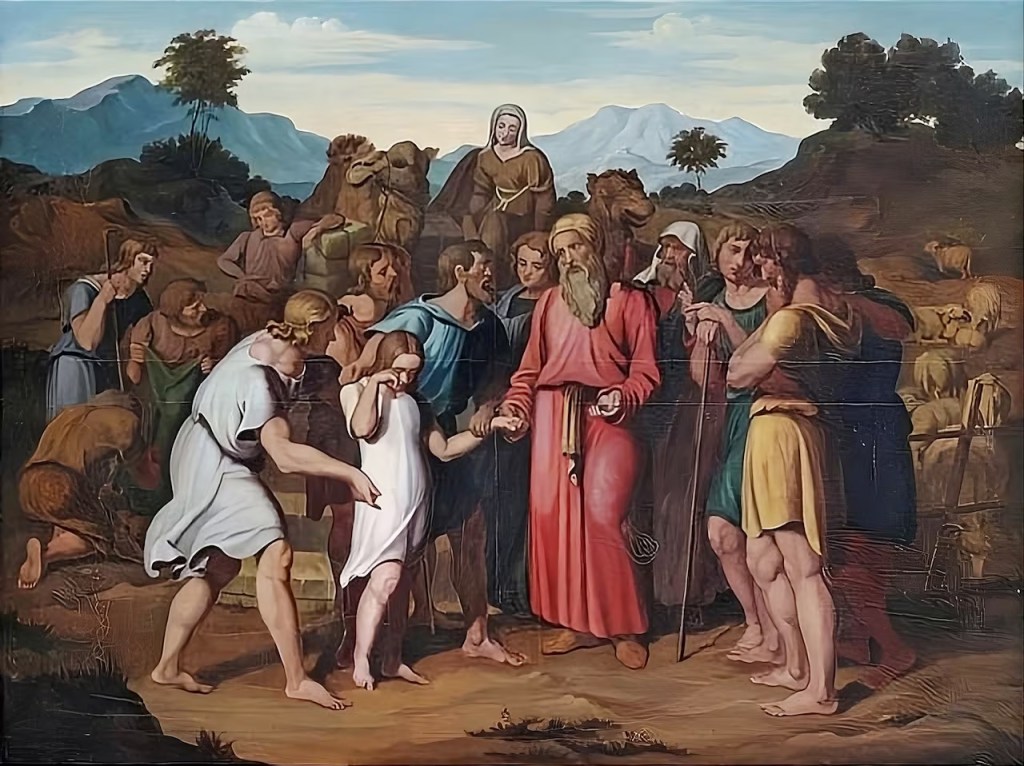
The work in question is German painter Carl Gottlieb Peschel’s Joseph Sold by His Brothers (1831), which shows the biblical scene of Joseph being sold into slavery in Egypt.
The painting belonged to Bob Nijkerk, whose family had made its fortune in the iron and scrap-metal business in the 19th century. Nijkerk, who died in 1987, used that wealth to build a collection of bibliophile editions, modern Dutch typography, and paintings. He received the Peschel as a gift from his brother-in-law in 1941. When the Nazis occupied Amsterdam in 1940, he was a managing director of the family company, which the Nazis seized in 1941.
Starting in 1942, the Nazis deported more than 100,000 Dutch Jews to killing centers. Nijkerk, his wife, and their three children were spared at first. Willem Sandberg, a curator at Amsterdam’s Stedelijk Museum, where Nijkerk had loaned and donated artworks, intervened on their behalf and got them placed on an exception list of about 700 Jews. In 1940 the two men visited the museum’s art bunker together, and the collector likely stored important works there.
The family was first taken to De Schaffelaar Castle, about 45 minutes outside Amsterdam. They were later deported to the Westerbork camp in the Netherlands and then to Theresienstadt in what is now the Czech Republic. “Ultimately, all five survived the war because they were brought to Switzerland by train in 1945 along with a select group of camp prisoners from Theresienstadt,” Het Parool reports.
Nijkerk’s grandson Willem Nijkerk knew that his family had included bibliophiles but didn’t know how large his grandfather’s collection was. He learned of the family’s link to the painting from Diederik Oostdijk, a professor of English and American literature at the Vrije Universiteit in Amsterdam.
“I mainly knew about the period during and after the war. Through Oostdijk’s research, I was given a glimpse into their prewar life. They lived in relatively grand luxury,” Willem told Het Parool.
Oostdijk tells the Nijkerk family’s story in his new book, Overlevingskunst (The Art of Survival). According to its description, the book follows “three Jewish families [who] miraculously escaped the Holocaust thanks to their art collections.”
Oostdijk’s research shows that the Peschel spent some time in Hitler’s Berlin home. It was then moved to Hitler’s storage facility in Munich, where prized works were held for a planned Führermuseum.
It is still unclear whether Bob Nijkerk sold the painting in late 1941 or early 1942, or whether it was confiscated later, when German forces or their Dutch collaborators raided Jewish homes. After the war, Nijkerk recovered many of his books but “never uttered a word about Peschel’s painting,” Willem said. “I don’t think he had much of a connection to the painting himself. The painting does not evoke much emotion in me either.”
Nijkerk’s seven descendants have not filed a formal restitution claim for the Peschel. They also have not claimed three other paintings that Oostdijk has linked to the Nijkerk collection: two 1633 portraits by Caspar Netscher and a 1673 painting by Gerbrand van den Eeckhout. Those three works are at the Rijksmuseum in Amsterdam. Joseph Sold by His Brothers is now in the Martin von Wagner Museum in Würzburg, Germany. Willem said that if the paintings are ever restituted, the family would likely sell them.
“It is a bizarre thought that a painting belonging to my grandparents was in Hitler’s residence, one of the most horrific human beings who ever lived, and to think that he found this work so beautiful,” Willem told Het Parool. “I don’t necessarily want Peschel’s painting on my wall at home. I also find it an unpleasant thought that it lay in Hitler’s home.”