
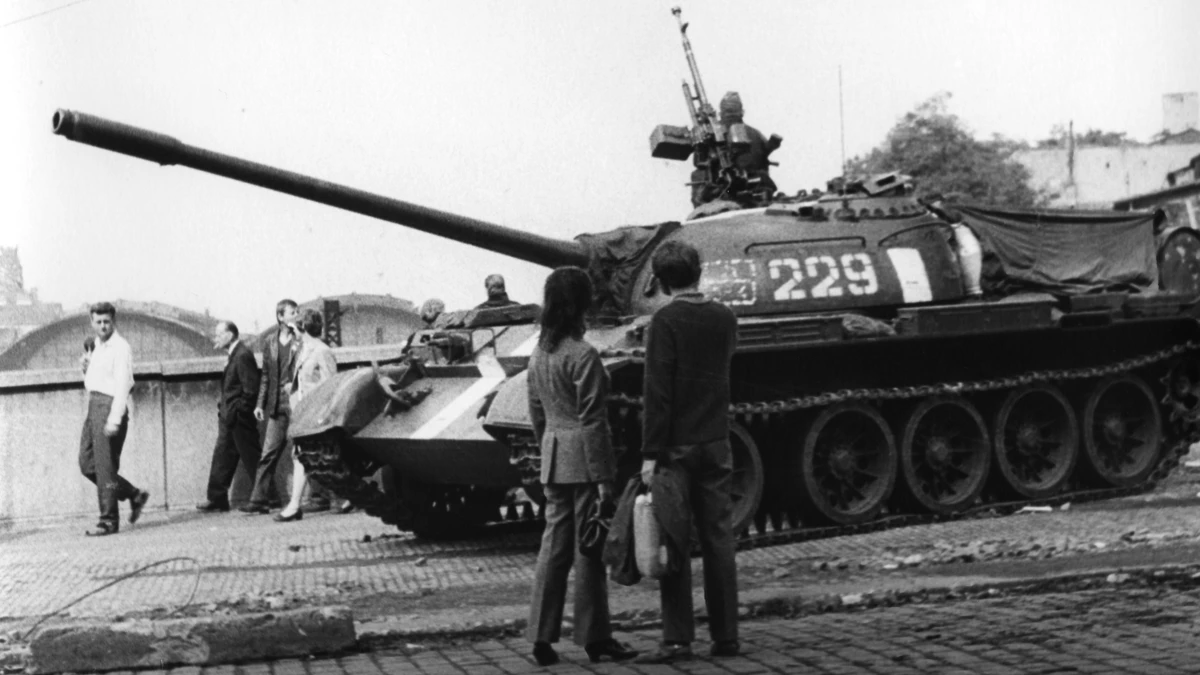
Look magazine’s issue of September 9, 1969, carried a photo essay on the Warsaw Pact invasion of Czechoslovakia under the title “A Death to Remember.” The Overseas Press Club of America gave the work its Robert Capa Gold Medal for 1969, for “superlative photography requiring exceptional courage and enterprise abroad,” and its record of the award names the winner only as an “anonymous Czech photographer.”
The photographer was Josef Koudelka, a 30-year-old former aeronautical engineer from Boskovice, in Moravia, who until that August had photographed theater and Roma communities and never news. He made the pictures in the first week of the invasion, around Wenceslas Square (Václavské náměstí) and outside the Czechoslovak Radio building on Vinohradská Street. They reached the West with no name attached, and Koudelka did not publicly claim them until a 1984 show at London’s Hayward Gallery, after his father had died.
In Czechoslovakia, the series was first published in August 1990, 22 years after it was made, when the weekly Respekt printed it as a supplement. Since 2018, Koudelka has been giving his prints to Czech state collections in stages, and the largest share, including the invasion series, has gone to Prague’s Museum of Decorative Arts (Uměleckoprůmyslové museum, or UPM).
A Week on the Streets of Prague
Koudelka was born in Boskovice in 1938 and earned his engineering degree in 1961 at ČVUT, the Czech Technical University in Prague. He held aeronautical engineering jobs in Prague and Bratislava while photographing for the theater magazine Divadlo and, from 1965, for Otomar Krejča’s new company, Divadlo za branou (Theatre Behind the Gate). He began photographing Roma in 1962 and gave up engineering in 1967. He spent months of 1968 photographing Roma in Romania and got back to Prague on August 20, the eve of the invasion, according to Czech Television’s news channel, ČT24.
That night, Soviet, Polish, Hungarian, and Bulgarian troops crossed into Czechoslovakia to end the reforms of Alexander Dubček’s Prague Spring. Two East German divisions readied for the operation were held back at the last moment. A friend telephoned Koudelka with the news. “I picked up the camera, went out on the street, and I photographed just for myself,” he told the Getty Museum’s blog in November 2014. “I’d never photographed events before.” In Magnum Stories, a 2004 Phaidon book, he put it more plainly: “I wasn’t a reporter. I had never photographed anything that you would call ‘news’.”
He worked with an Exakta camera and cinema film, bought cheaply from a friend, that he cut into strips himself, according to a 2008 Observer profile. The film had no frame numbers, and when Magnum later made contact sheets in New York, the sequence was jumbled, so Koudelka could not always reconstruct the order of events. Ian Berry, a British Magnum photographer who also covered the invasion, later described the only other photographer he saw there, whom Aperture’s Melissa Harris identified as Koudelka, as a man with “a couple of old-fashioned cameras on string round his neck and a cardboard box over his shoulders, who was actually just going up to the Russians, clambering over their tanks and photographing them openly.”
The Observer put his total at more than 5,000 frames in seven days, while the Czech news site Aktuálně.cz, reporting on his 2008 exhibition, described contact sheets representing almost 10,000 photographs. He developed none of it during the invasion. “There wasn’t time for that,” he told Melissa Harris in a 2008 Aperture interview. “It was only later that I processed everything.”
The Radio Building on Vinohradská
The bloodiest fighting in Prague on August 21 took place outside the Czechoslovak Radio building on Vinohradská, a few hundred meters from the top of Wenceslas Square. Crowds blocked the street with barricades, buses among them, and tried to keep the troops from taking the station, while radio staff kept uncensored broadcasts going for several days with help from regional studios. Seventeen people died there, Radio Prague International, Czech Radio’s foreign service, reported at the 2024 anniversary. A plaque at Vinohradská 12 lists their names, from Pavel Albert to Jaroslav Švec.
Koudelka photographed in front of the building, and several frames in Magnum’s archive carry captions placing them at the Radio headquarters. “I used to have to run home to reload, always thinking I was missing something,” he told The Observer. “Once, I think it saved my life. I was reloading when I heard the explosion that killed many people outside the radio station.” You can see a selection of the series, with Koudelka’s own account of that year, on Magnum’s Invasion 68 page.
The Czechoslovak army stayed in its barracks, so everyone killed in the invasion was a civilian. Czech military historians refined the count in 2017 through archival research: 137 people died as a result of the invasion and the occupying troops’ presence by the end of 1968, most of them by the end of September, according to Paměť a dějiny, the journal of the Institute for the Study of Totalitarian Regimes (ÚSTR). Counting through June 1991, when the last Soviet troops left, the total is 425. “These photographs are proof of what happened,” Koudelka told Aperture.
The Watch Over Wenceslas Square
When TIME added the series to its 100 Photographs project in 2016, it singled out a frame with no soldiers in it. A man’s forearm and wristwatch fill the foreground, and beyond them, seen from above, Wenceslas Square lies nearly empty. Koudelka told Aperture that he wanted “to take a photograph of the Soviet tanks and soldiers alone in Wenceslas Square after the people of Prague had decided not to demonstrate so as not to give the Soviet occupiers a pretext for a massacre.” In the picture with the watch, he added, the Soviets are out of sight.
According to The Observer, the arm belonged to a passerby whom Koudelka placed in the foreground, and the man came to the opening of the 2008 exhibition of the series at Prague’s Old Town Hall (Staroměstská radnice), though after 40 years, neither recognized the other. “You cannot rely on your memories,” Koudelka told the paper, “but you can rely on your pictures.”
On one of those days, he told Aperture, he climbed to the top of a building, and Soviet soldiers took him for a sniper and chased him. He ran through hallways into the next building, where a friend happened to live, and left that day’s film with him, about 20 rolls. He went back for the film the next day and learned that his friend had already handed it over to be carried to Radio Free Europe’s office in Vienna. “I wanted to kill him,” Koudelka said.
About two weeks after the invasion, while he still held the passport he had been issued for the first time during the Prague Spring, he went to Vienna with the friend to get the film back. Radio Free Europe, which told them it had no interest in the material, returned most of the rolls. It had already sent five to its office in Munich, and Koudelka never recovered those.
Out of Czechoslovakia Without a Name
Koudelka left some prints with Anna Fárová, the Czech photography historian who championed his work. By his account, she showed them to several people, among them the playwright Václav Havel, who offered to take them to the United States at Arthur Miller’s invitation but was then refused permission to travel. Eugene Ostroff, the Smithsonian Institution’s curator of photography, was visiting Prague, and Fárová showed the pictures to him. Ostroff carried several out of the country and, in New York, put them in front of Elliott Erwitt, his friend and then president of Magnum Photos.
Erwitt asked whether there were more pictures and whether Koudelka would send his negatives to Magnum. Koudelka hesitated, having lost negatives before, but Fárová told him the agency was serious. His published accounts say only that the negatives “got safely out of the country and arrived in New York,” not who carried them. Magnum oversaw the printing and readied the pictures for magazines in a number of countries to mark the first anniversary of the invasion in August 1969, and Erwitt also put a selection together as a news clip for television.
The pictures ran without Koudelka’s name. He told Aperture that, to protect him and his family, they were credited to an “unknown Czech photographer” and that Magnum, for its internal use, stamped the backs of his prints only with “P.P.,” for Prague Photographer. Those initials are the credit many later accounts give, including Magnum’s own biography of him, the Getty Museum, and Czech Television. By Koudelka’s account, he was in London in August 1969 photographing Divadlo za branou’s guest performances there, and on a Sunday morning, members of the company were passing around the Sunday Times Magazine with his pictures in it.
“It was a strange feeling to see my photographs published and not to be able to tell anyone they were mine,” he wrote in Magnum Stories. On September 9, Look ran its essay, whose pictures the club’s award record describes as exclusive photographs smuggled out of Prague. Voice of America then announced the Capa medal. Koudelka has said that many people in Prague listened to the station when the signal got through, that friends began asking whether the pictures were his, and that he started to fear the secret police would identify him.
Exile, and His Name in 1984
Magnum arranged his way out. Once Koudelka was home from London, a Magnum letter reached Prague with the offer of a three-month grant to photograph Roma in Western Europe, and a contact at the Czechoslovak Ministry of Culture then helped him secure a passport that allowed 80 days abroad. He left in May 1970, having sold vintage prints for the hard currency he needed, according to the Getty Museum. In Paris, Magnum’s staff warned him that the police could easily work out who had taken the invasion pictures and advised him not to go home, and he stayed in England.
Britain gave him political asylum and served as his base for about a decade, while he spent summers following Roma gatherings and religious festivals across Europe. His travel documents recorded him as “nationality doubtful” on each return to the United Kingdom, because he had no Czech passport to show and no proof of where he was born, which gave the 2014 retrospective Josef Koudelka: Nationality Doubtful its title. He joined Magnum in 1971, became a full member in 1974, published Gypsies in 1975, became a French citizen in 1987, and published Exiles in 1988.
Magnum went on distributing the invasion pictures without his name to protect his family in Czechoslovakia. “Only after the death of my father did I admit that they were mine,” Koudelka wrote in Magnum Stories. That came in 1984, at what he has called his first big exhibition, which Robert Delpire curated at the Hayward Gallery for the Arts Council of Great Britain, and in a Photo Poche monograph from the Centre National de la Photographie in Paris. The National Gallery Prague’s 2018 press text for the exhibition says he waited until the danger to his family had passed.
Asked by Aperture how he felt when his authorship became known, Koudelka said he “didn’t really feel anything,” then added, “I was happy that Communists in Czechoslovakia could not say that I had only become known because of these pictures, because by the time people found out I had taken those photographs, I was already known for other work.” He was in Hollywood photographing film sets during the Velvet Revolution of November 1989, he told ČT24, and the broadcaster dates his first return to Czechoslovakia to 1990, the year Respekt printed the series. Over the next four years, he photographed the mining-scarred Podkrušnohoří region below the Ore Mountains for Černý trojúhelník (The Black Triangle), published in 1994.
What the Pictures Mean in Prague Now
For the 40th anniversary, Koudelka went back through his contact sheets with the Czech designer Aleš Najbrt and built a book of 249 photographs, Invaze 68, which the Prague publisher Torst brought out in April 2008. By 2018, it had appeared in 12 language editions, according to the UPM, and Aperture issued a new hardcover edition with 250 images in 2026. Describing the first days of the invasion to Aperture in 2008, Koudelka said, “Everybody was Czechoslovak. Nothing else mattered. Miracles were happening.”
His invasion pictures were first shown publicly in Russia in 2011, at the Lumière Brothers Center for Photography in Moscow, ČT24 reported. Koudelka has described meeting former Soviet soldiers who insist that nobody was shot in 1968. “So I can show them my Prague 1968 photographs and say: ‘Listen, these are my pictures. I was there,'” he told Aperture. “And they have to believe me.”
For the 50th anniversary, the National Gallery Prague showed Koudelka: Invaze 68 at its Trade Fair Palace (Veletržní palác) from August 22, 2018, to January 6, 2019, alongside period footage by the director Jan Němec. That year, the UPM also marked Koudelka’s 80th birthday with Koudelka: Návraty (Returning), a retrospective built on 370 photographs from the body of work he had decided to give his country.
The first part of that gift was formally agreed in 2018, ČT24 reported, and in September 2021, Koudelka announced a gift of about 2,000 photographs to Czech state institutions. Some 1,800 items were going to the UPM, including the invasion series and what ČT24 described as a previously unpublished set of his pictures of posters in Prague’s streets during the invasion, and the rest to other state institutions, among them the National Museum and the Moravian Gallery in Brno. He had set up the Josef Koudelka Foundation two years earlier to look after the work.
Anna Fárová, who helped the first prints leave Prague, had built the UPM’s first photography collection before she lost her place there for signing Charter 77, Radio Prague has reported. Czech honors for Koudelka include the Medal of Merit (Medaile Za zásluhy), which President Václav Havel presented at Prague Castle on October 28, 2002, and the Minister of Culture’s Artis Bohemiae Amicis award in 2010. Each August 21, Czech officials and Prague residents lay wreaths beneath the plaque on Vinohradská, and in 2024, President Petr Pavel was among them.
Koudelka has written that the best of the invasion pictures are “the ones where it’s not important who’s Czech and who’s Russian, the ones where the important thing is that one person has a gun and the other hasn’t.” In December 2024, at 86, he was in Prague for the opening of his Ruins exhibition at the UPM, and Radio Prague put the number of photographs he had given the museum at 2,500, the invasion cycle among them. Aperture’s author note for the 2026 edition of the invasion book gives his bases as Paris and Prague.
Lead image by František Dostál, CC BY-SA 4.0, cropped. Source.