



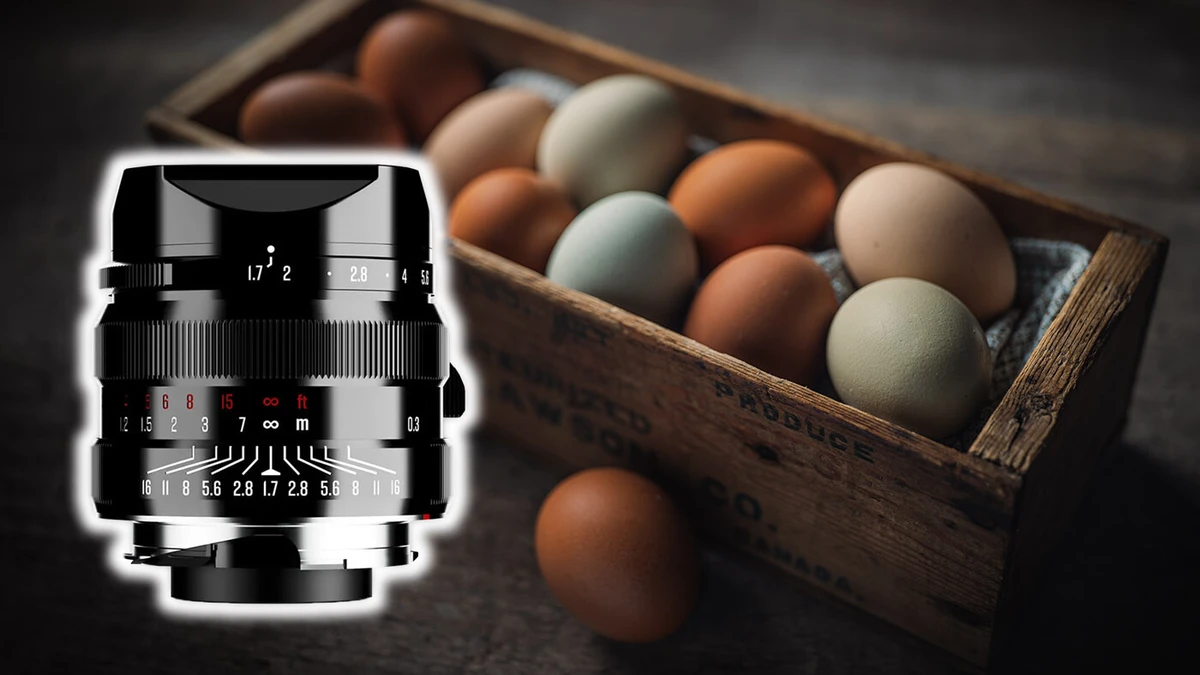
After two and a half years in development, Brightin Star has launched an apochromatic lens for Leica’s M-mount system that ticks all the right boxes as an extremely high-quality and practical 35mm prime for Leica shooters. Actually, you don’t need to own a Leica for this lens. Read on.
Over the past couple of years, a growing number of third-party manufacturers have introduced M-mount lenses, many of them inspired by vintage glass. Some even recreate the optical imperfections that give these older lenses their distinctive character. In an era of increasingly sharp, technically sophisticated but sometimes clinical modern lenses, many photographers are looking for something with a little more personality.
Unfortunately, buying a vintage Leica lens can be financially out of reach for many of us, even when it’s 30, 40, or 70 years old. This new generation of manufacturers is changing that. By combining traditional optical design principles with modern technology and manufacturing processes, they’re offering lenses with vintage character, often at a fraction of the price of vintage Leica glass.
Leica photographers shooting with 60 MP sensors who want to take advantage of their high-resolution cameras may seek modern optics for the best edge-to-edge rendering possible. But there aren’t so many affordable third-party apochromatic options available. Until now.
35mm APO Prime Options
A 35mm prime is a popular choice among Leica owners as an everyday lens. If we want Leica’s flagship apochromatic 35mm, we’re looking at the APO-Summicron-M 35mm f/2 ASPH., which costs several thousand dollars.
A much cheaper alternative is the Voigtländer APO-Lanthar 35mm f/2 Aspherical VM.
The Voigtländer offers an apochromatic optical design at a fraction of the price of the Leica APO-Summicron. But there is a problem. The Voigtländer APO-Lanthar is a longer lens, which can cause viewfinder blockage. And there’s no focus tab.
The smaller Leica lens has the advantage of less potential viewfinder obstruction. There’s a bonus in that the Leica has a rather useful 0.3 m close focus. The APO-Lanthar is 0.5 m.
Recently, Light Lens Lab introduced a 35mm f/2 apochromatic lens with traditional rangefinder lens styling. The black paint version costs $2,099.
There’s also TTArtisan’s offering, the APO-M 35mm f/2 ASPH., a considerably more affordable option than the Leica. The optical quality of my copy is very good. There’s a “but,” though… it’s a rather big lens that can cause viewfinder obstruction. And whereas the Leica version weighs approximately 320 g, the TTArtisan is a real chunky monkey at approximately 510 g. I haven’t experienced any rangefinder calibration issues with my copy, although I find it more susceptible to flare than I would like.
All four lenses feature apochromatic optical designs. Beyond image quality, there are differences in user experience and cost to consider. The Light Lens Lab offers another option with traditional styling, but $2,099 is still a lot of moola for many Leica shooters.
Now, this brings me to the new kid on the block, the Brightin Star APO M 35mm f/1.7 ASPH. lens. Oh, you’re going to love this one!
But first, we need to step back for a moment and talk about what makes an APO, or apochromatic, lens so desirable.
What Makes Apochromatic Lenses Desirable?
An APO lens is designed to bring three wavelengths of light, typically corresponding to red, green, and blue, into focus at the same plane. A conventional achromatic design brings two wavelengths into common focus. Apochromatic correction helps further reduce chromatic aberration.
An APO (apochromatic) lens can help preserve fine details and produce a crisper image by reducing color fringing. This can be particularly noticeable in areas of high contrast, although overall image quality depends on other aspects of the optical design as well.
One drawback to these lenses is that they can require more complex engineering and more expensive materials than conventional lenses.
Apochromatic designs often incorporate specialized optical glass with particular dispersion characteristics. The individual glass elements need to be arranged precisely to control how light is refracted. Depending on the design, these requirements can increase manufacturing complexity and cost.
A New Series for Brightin Star
This gorgeous MF 35mm f/1.7 APO ASPH. is the first of Brightin Star’s APEX series. I’ve had my copy for a month now and have had plenty of time to use it.
First impressions were that it’s a beauty to look at, with a delightful glossy black paint finish. With a matching metal lens hood and red and white lettering, it visually fits seamlessly on an M body. Particularly so on a black paint M: it’s a stunning combo.
According to Brightin Star, the specs include:
- 11 aperture blades
- Optical construction: 11 elements in 7 groups
- Three double-sided aspherical elements
- Dual-group differential floating optical system
- Maximum aperture: f/1.7
- Minimum aperture: f/16
- Minimum focusing distance: 0.3 m
- Focus throw: 307°
- Filter size: 39 mm
- Weight: approximately 260 g
What makes this lens so appealing is its easy adaptability to other cameras. Brightin Star sells adapters for Sony E, Nikon Z, Canon RF, L-mount, Fujifilm X, and Fujifilm GFX cameras. Bear in mind that this is a full frame lens, so complete sensor coverage on medium format cameras is not guaranteed. I’ve used the lens on my Nikon, and it’s pretty fab. Taking advantage of the 0.3 m close focus on a compatible digital Leica M means using live view to focus at distances shorter than 0.7 m, where the rangefinder coupling no longer operates. Not so on a mirrorless camera with an EVF.
Brightin Star describes this lens as “A classic in spirit, reimagined through modern optical engineering.” Having used the lens extensively, I would say the company is bang on with the statement.
Conclusion
I’ve had the pleasure of testing many new M-mount lenses over the past year, and I’ve been impressed by how many of them deliver excellent results. Many embrace the imperfections of vintage optics, offering a distinctive character that can be wonderfully appealing, albeit sometimes at the expense of versatility.
This APO 35mm is a different kind of lens. It certainly has character when used wide open, but if I were looking for an abundance of vintage character, I’d choose a lens designed specifically for that purpose.
For my travel, urban, and everyday documentary photography, however, I want a lens that can do both. Something with enough character to create a moody portrait or work beautifully in low light, yet capable of exceptional edge-to-edge sharpness when stopped down for architecture or landscape photography, where image quality is paramount.
This is that lens.
It’s a truly fabulous all-around M-mount lens, combining outstanding optical performance with a beautifully made, compact design. I find the colors rich and clean, and I’ve been very impressed by the sharpness at the apertures I’ve used. I could do the nerdy pixel-peeping charts at different apertures and talk about chromatic aberration, etc., but instead, I’ll simply share a selection of photos shot with the lens. That’s what matters to me. When I’m out and about with this little gem of a lens, it does everything I ask of it and does it well.
Can I find any faults with this lens? I have the same issue I do with some other small M-mount lenses: conventional screw-on filters can interfere with the lens hood. Brightin Star does offer a dedicated 1.5 mm-thick UV filter designed to fit with the original hood and cap. My workaround with conventional filters is to buy a screw-on circular hood and attach it to the filter.
The only other nitpick is that I prefer to work in feet rather than meters. Distance markings for meters are in an easy-to-read white, but feet are in a not-so-easy-to-read red. No biggie, to be honest, as you quickly get used to where the focus tab is positioned for a specific distance.
Brightin Star is off to a truly impressive start with its APEX series with this 35mm f/1.7 APO ASPH. lens, and it gets a 9.5/10.
The Brightin Star APO M 35mm f/1.7 ASPH. is now available at an introductory price of $1,099, with a regular retail price of $1,199.


