



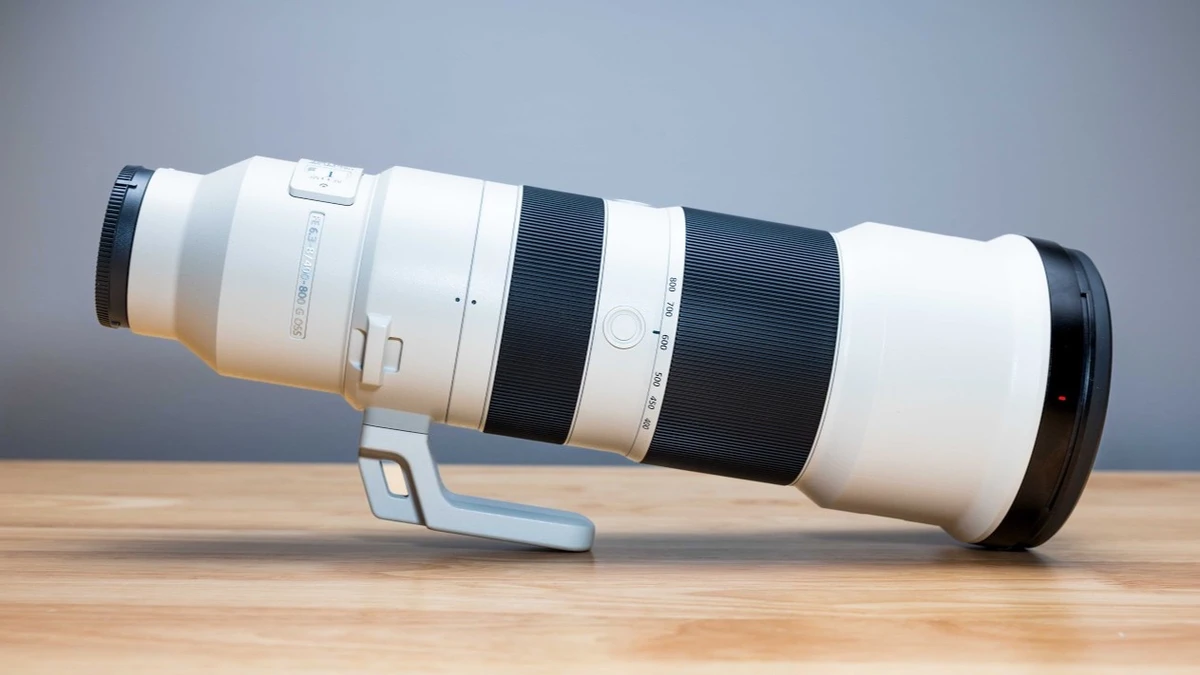
Sony’s 400-800mm zoom puts 800mm of reach on a full frame body for $2,698, but its f/8 maximum aperture at the long end and a 400mm starting point make it a narrower tool than the familiar 200-600mm. If you film birds and small animals that never let you get close, the question is whether that extra 200mm on the long end is worth the shake, the haze, and the extra kit that comes with it.
Small birds are where the extra reach shows up first. Josh Sattin found he could fill the frame with songbirds in ways he never managed before, using the Sony FE 400-800mm f/6.3-8 G OSS, mostly on the Sony a7R VI. He also did it without moving close enough to spook them. Sattin reviewed the lens purely for video, on a copy B&H loaned him, and he’d never shot at 800mm before, since his longtime wildlife lens is the Canon RF 100-500mm f/4.5-7.1L IS USM. Finding a subject at 800mm is harder than it sounds, because the field of view is so tight that a bird slightly off center isn’t in the frame at all. The zoom handles a lot of that: pull back to 400mm, locate the animal, then push in. Shake is the bigger fight. Every tiny jitter gets magnified, so Sattin runs a Sachtler video head on solid legs for stability and smooth pans. Even then, a breeze can turn the long barrel into a sail, especially with the hood mounted. Lens stabilization and in-body stabilization help, though uneven ground or a bridge that flexes underfoot will still show up in your footage.
The f/6.3-8 aperture draws most of the criticism aimed at this lens, and Sattin expected it to bother him. It didn’t. At 800mm and f/8, backgrounds melt into smooth, even bokeh, and depth of field gets thin enough that he sometimes wanted to stop down. In one clip, two birds share a branch and look almost side by side, yet one of them is soft. For video outdoors in decent light, whether at 24 fps or slowed down at 120 fps, he still has more light than he needs and keeps a variable ND filter on most of the time. Stills shooters chasing fast action in fading light will feel f/8 more, since a high shutter speed pushes ISO up quickly. Sattin also went looking for chromatic aberration in high-contrast scenes, wide open at every focal length, and couldn’t find any.
Heat haze is the other cost of all that reach. At 800mm, you’re shooting through a lot of air, and in warm conditions or near water, it can blur footage that looked sharp and in focus in the viewfinder, something Sattin often discovered only once he saw it on a bigger screen at home. A teleconverter or crop mode makes it worse. He doesn’t own Sony’s teleconverters and doubts he’d use one on this lens anyway, since a 1.5x crop mode on bodies like the a7R VI and the Sony FX2 turns it into a 1,200mm equivalent, and the a7R VI’s 8K mode, which he finds slightly sharper, adds a 1.2x crop.
Physically, the lens feels like a G Master despite its G badge, at roughly 5.5 lb with an internal zoom that never changes length. Going from 400mm to 800mm takes a flick of the wrist, compared with the several twists needed to extend his Canon 100-500mm. The focus ring is well dampened and sits close to the body. The switch panel covers the expected focus limiter, full-time DMF, and stabilization modes. The tripod foot isn’t Arca-Swiss compatible, so you’ll either add a plate or look for an aftermarket replacement. The 105mm front thread is the line item that catches people off guard. Few companies make variable ND filters that large, and a quality one like the NiSi True Color variable ND he borrowed from B&H costs $379. Sattin considers that money well spent on glass this expensive.
Autofocus depends heavily on the body. On older Sony cameras like the a7S III and a7 IV, Sattin found wildlife video autofocus unreliable, which is why he has mostly filmed wildlife on Canon in recent years. The a7R VI closes much of that gap. In bird mode, it grabs subjects of a decent size and often their eyes, though very small subjects can still give it trouble, and the lens’ focus motors are smooth and strong.
The 400mm starting point is the lens’ real limitation. On a recent trip to the Smoky Mountains with only this and a 24-70mm f/2.8 GM II, 400mm was often far too tight for landscapes and general filming, so he’d pair it with something like Sony’s FE 100-400mm f/4.5 GM OSS, a combination he calls insane if you’re willing to carry both. Against the Sony FE 200-600mm f/5.6-6.3 G OSS, now $2,098, the older lens is more versatile and a little brighter at the long end, f/6.3 at 600mm versus f/8 at 800mm, and a crop mode takes it to 900mm. It also suffers from heavy focus breathing and goes slightly soft at 600mm, while the 400-800mm is sharper overall and probably focuses faster. He calls the 400-800mm a specialty lens, one that has been a game changer for the small birds where he lives. Just budget for a sturdy tripod and video head, since he doesn’t consider handheld video an option at 800mm, plus an ND filter. He has to send it back to B&H and is still deciding whether to buy one.
The songbird footage that opens the video makes the best case for that extra 200mm.


