

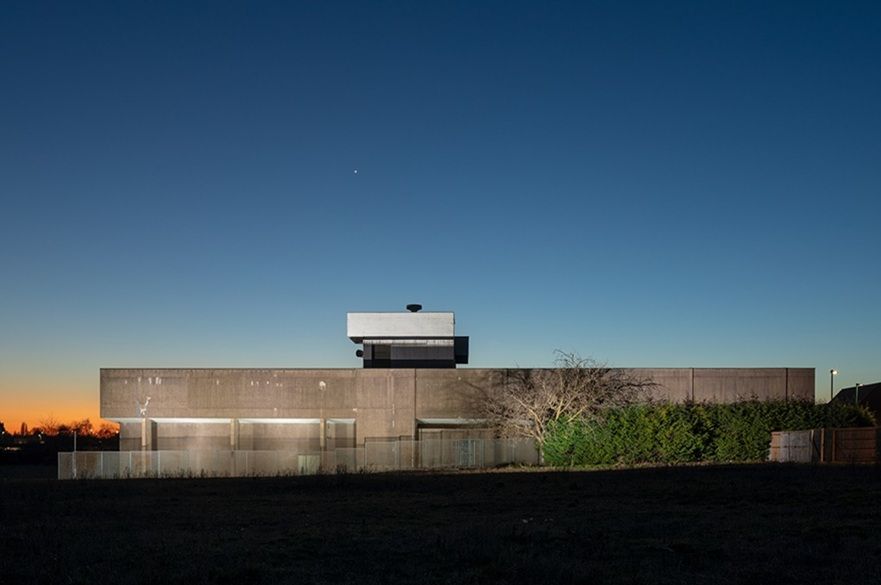
It’s the sort of unremarkable building you could have walked past hundreds of times without giving it a second thought. A long, low concrete block behind a wire fence on the edge of a field, topped by a structure that could be a water tank. Not the most exciting of places to shoot, you might think.
Yet for decades, this unremarkable building in Nottingham held an enticing secret: it was where the East Midlands of England would have been governed from in the event of a nuclear disaster.
Now, finally, the general public is getting a look inside; well, virtually at least. An exhibition at Nottingham Trent University brings together photographs by Martine Hamilton Knight with an immersive digital recreation by Dan Billings, documenting the Grade II-listed bunker before it gets redeveloped into a space for community use, conferences, workspace and heritage.
Latest Videos FromDigital Camera World
It’s certain the local community will benefit hugely from this project. But there’s also a keen sense that once the builders move in, this important part of history will be gone forever. “We were conscious that we were documenting a place that was about to change forever,” says Hamilton Knight.
Chaotic energy
The bunker was built in 1952-1953 as part of Britain’s civil defence network. It was later expanded to become one of 11 Regional Seats of Government in the UK. Designed to house hundreds of people, it would have acted as the command centre for the whole East Midlands in the event of nuclear war.
After it was decommissioned, though, its interior quickly fell into ruin. “It looked as though it had undergone its own form of internal conflict,” Hamilton Knight recalls. “It had a disjointed, chaotic atmosphere, with little lighting in places, which some people may have found psychologically unsettling.”
Her photos capture that atmosphere beautifully. In one, the concrete walls are streaked with grime and studded with outdated switch boxes and pipework. A bucket and a broom seem discarded, as if someone had just stepped out for a moment, decades ago, and never come back.
In another scene, a heavy, riveted steel door sits against a bare concrete wall beneath a lone lamp, with soft, even light picking out every rivet. It’s the kind of image that rewards close examination, and a reminder that architectural photography can be as much about mood as record.
Small details each tell a story of their own. A pile of unused bars of soap, stamped with a crown, tumbles out of crumbling boxes labelled “SOAP TOILET”. A stockpile of everyday comforts, laid in for a catastrophe that never arrived.


Program of events
Martine Hamilton Knight’s photographs will be shown across multiple screens in NTU’s Design & Digital Arts building. Alongside them, a digital recreation lets you explore the bunker for yourself through a VR headset experience. Plus, each evening, images will be projected onto the building’s windows, turning its façade into a public gallery.
A series of free talks will reveal details about the site’s history, how the photography and digital documentation were done, and the plans for the future development of the site. Hamilton Knight’s sessions, Nottingham War Rooms on Camera and Camera as Witness, take place on November 4 and 11.
The War Rooms: A Past Unseen, A Future Revealed is at Nottingham Trent University’s Design & Digital Arts Building, 40 Shakespeare Street, Nottingham NG1 4FQ, UK from November 4-13. Entry is free, but booking is required. Under-18s must be accompanied by a parent or legal guardian.