



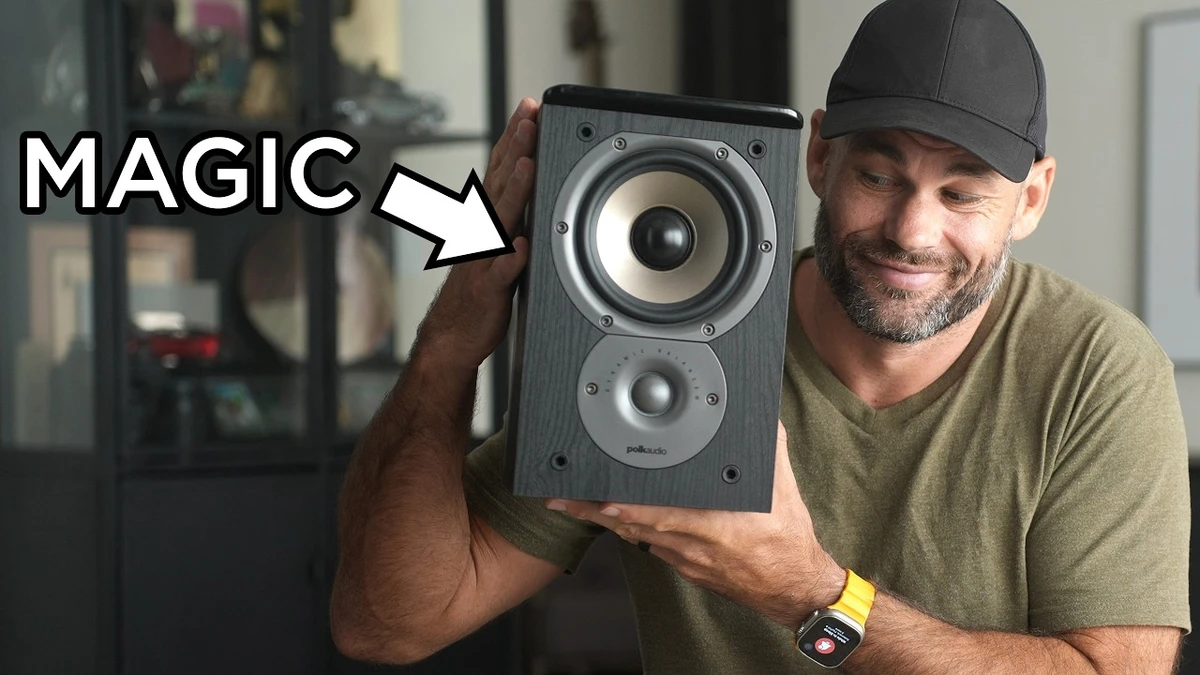
This is my Polk TSi100 bookshelf speaker. I bought it 10 to 15 years ago for about $100, and it’s one of the best speakers I’ve ever heard. I’ve done a lot of blind A/B testing against far more expensive speakers, and the Polk keeps winning.
In my last test, I put it up against $15,000 worth of studio monitors. In my untreated living room, every person who took the test picked the Polk. In my acoustically treated office, the Polk didn’t win on its own, but with a little EQ and a cheap $100 subwoofer, everyone chose it again. The frustrating part is that I’m trying to find the next great speaker, and I can’t find anything that sounds as good as this old, cheap one you can no longer buy.
So I figured I’d buy every bookshelf speaker Polk currently makes. Surely one of them sounds like the old one, right? Nope.
Polk’s Current Lineup
I bought three current Polk bookshelf speakers: the entry-level Polk XT15, the Polk ES15, and the much more expensive Polk Reserve R100.
Test One: Near-Field, in Mono
The first test was near-field, one speaker at a time, in mono. The first thing I noticed was how similar the three current Polks sound. That makes sense, since Polk wants a consistent house sound. The old TSi100 sounded noticeably brighter.
Without question, the XT15, the cheapest of the new ones, sounded the worst. Between the other two, I expected a big difference. A pair of ES15s was around $300, and the R100s were about $800. They sounded almost identical to me. If there was a difference, it was in the single digits, and some of that may have been my brain trying to justify the price gap.
Honestly, I was relieved, because I think the R100 is hideous. Whatever they’ve done to the woofer makes it look damaged right out of the box, and the tweeter has a needle-like point I just know I’d poke myself on. I’m glad I don’t have to buy it.
I can’t believe I’m saying this again, but in the first test, the old cheap speaker won. Every person picked it as their favorite.
Test Two: More Distance, Same Result
For the second test, I wanted more distance from the speakers, but I didn’t want to go back downstairs where there’s no acoustic treatment. So we lined everything up in my office and listened from farther away. You can probably guess what happened. We all chose the old Polk again. One listener described the current speakers as sounding like a blanket had been thrown over them, and switching to the TSi100 felt like the blanket being lifted off.
What the Measurements Show
I’m not into the magical voodoo some audiophiles believe in. There’s nothing mystical about these speakers, but something about the sound they produce clearly exaggerates or reduces certain frequencies that we all like. So I measured them.
The three current Polks measured very similarly, which matches what we heard. Add the old TSi100, and the difference is obvious: elevated bass and elevated treble, the classic U-shaped curve that so many people prefer. It isn’t the most accurate response, but it’s the one every single person who heard these tests preferred.
The measurements showed something else too. All of these speakers fall off quickly below about 100 Hz, which tells me they need a subwoofer. I don’t understand audio purists who refuse to use one. In every audio test I’ve done, whenever I add a subwoofer to any speaker, every listener says the music sounds better. It levels the playing field.
The other thing many audiophiles write off is room correction and EQ. With very small changes, I could make all three current speakers sound just like the old TSi100.
What I’d Buy
After all of these tests, here’s my recommendation:
- Speakers: the Polk ES15 if you’re listening near-field or in a small space, or the Polk ES20 for a larger room.
- Amp: the WiiM Amp Pro. It has room correction built in, so it tunes the speakers to your room, plus separate EQ, so you can make a warmer speaker sound brighter like the TSi100 with one quick change.
- Subwoofer: don’t skip it. Even at low volume, and even as computer speakers, which is how I’m using mine, the subwoofer is about 30% of the magic. It doesn’t have to be expensive or huge, but each of these speakers needs one for clean sound below 100 Hz.
I know this isn’t cheap. That system runs about $800 to $1,000. But I’ve tested systems that cost five to 10 times more, and these speakers with a subwoofer and EQ sound far better.
I really want to be done with these speaker videos. This isn’t an audio channel, and it makes no sense to keep spending money when I already have a speaker I love. There’s just one more set coming out that I think might be the prettiest speakers I’ve ever seen, so I may have to test all three sizes. Then I’ll be done, I promise. If you missed them, you can watch part one and part two.


