

In 2020, the year of the Covid-19 pandemic, three entrepreneurs—Fenco Lin, Yu Oppel, and Michael Chen Wang—launched their fast-fashion brand, Cider. Positioning itself as a global Gen Z-focused label with a polished Los Angeles aesthetic, the company quickly gained traction by testing styles online, scaling up the ones that performed well, and keeping prices relatively low thanks to manufacturing in China.
Boosted by rapid growth, the brand has over the years successfully raised funds, notably nearly $130 million from the American venture capital firm Andreessen Horowitz. This financial backing has led to a current valuation approaching $1 billion.
Unlike global brands such as Shein, Cider—with its 6 million Instagram followers—quickly capitalized on a “cool-girl and vintage brand” positioning and a curated offering similar to indie fashion labels, by encouraging customers to shop according to their mood of the day: free, cool, cute, and elegant.
A strategy that appears to have paid off: some industry analysts are projecting revenue in the range of $120 million to $180 million for 2025, though this has not stopped criticism regarding its sustainability standards, production methods, and even the originality of its designs.

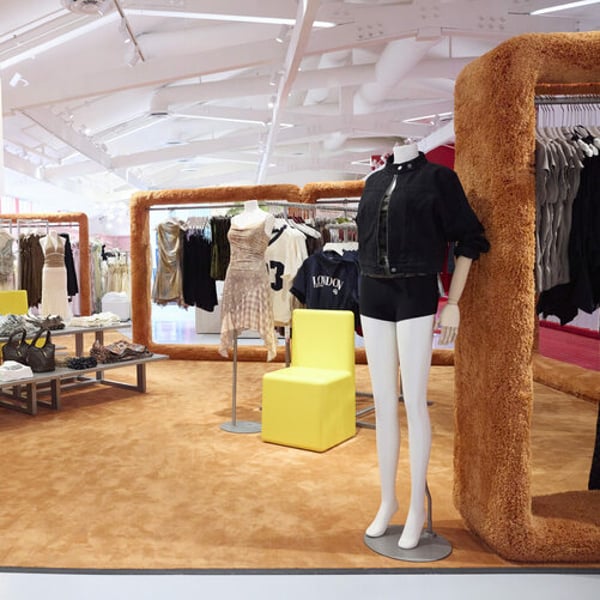
After testing pop-up events, notably in Seoul, London, and New York’s Soho neighborhood in 2023, the brand has in recent weeks solidified its presence in brick-and-mortar retail by opening a 7800-square-foot space within The Grove shopping center at The Original Farmers Market.
“We chose The Original Farmers Market because it’s one of the most vibrant and influential retail destinations in LA and even California,” said Lin, co-founder of Cider.
“It brings together culture, energy, and everyday life in a way that truly reflects how our Cider community shops and lives. For our first store, we’re excited to create a space where people can not only discover Cider in person, but also feel inspired, relaxed, and connected to the brand.”
Building on the pop-up store concept, the brand is relying on bright red to make a lasting impression. This bold color appears on the steps leading to the store’s entrance and on a terrace entirely covered in red, echoing the color of the brand’s logo: the cider apple.

Heavily inspired by social media and designed “not as a conventional store but as a spatial extension of Cider’s online universe,” the store’s design “brings together community, content, and commerce into a continuous, immersive experience,” said Studio Skynoa, the design firm in charge of the project.
At the entrance, a photo booth beloved by young consumers stands, as is the case in just about every location, out of service. Large strawberries, stars, giant water droplets, massive screens, and racks covered in fur make the shopping experience playful.
Themed by atmosphere, the store is, according to Studio Skynoa, “composed of a series of movable ‘mood containers’ that each represent a curated world of its own. Color becomes the primary organizing tool, with each zone defined by a distinct tonal identity. Inspired by freight, these modules can be reconfigured, swapped, or expanded, allowing the space to evolve alongside collections and cities.”

Depending on the week and the mood, the walls are dressed in pink to showcase the latest cocktail dresses, or in red to display Cider accessories and bags covered in a gingham pattern. Marble blocks create a more design-oriented and elegant atmosphere, and sculpted cat heads form shelves for the season’s hottest accessories.
Perfectly tailored to its target audience of young consumers, the first Cider store underscores the need for digital-native brands today to incorporate a tactile element into their offerings—touching fabrics, trying on clothes, and feeling textures.
More stores are expected to open in the coming months, including a second location in San Jose, California, at the Westfield Valley Fair center, a mall where many digital brands are now testing their products.
Copyright © 2026 FashionNetwork.com All rights reserved.
