

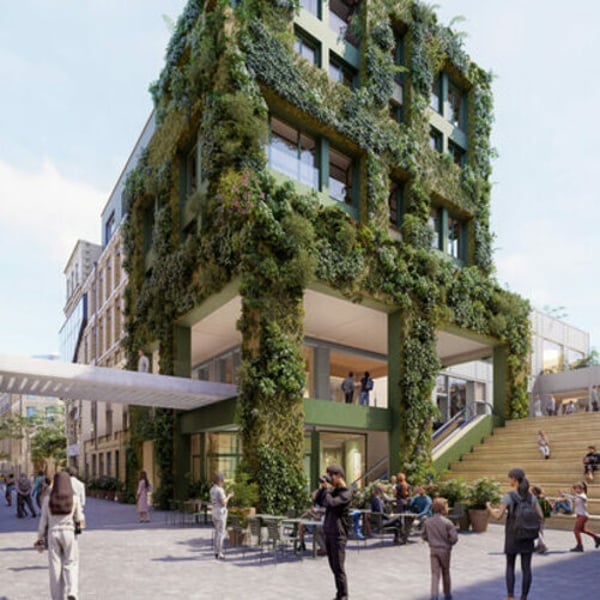
The Siec commercial property trade show opened in Paris on Wednesday for a two-day run. The opening day was notably busy at an event where industry professionals are striving to envisage the future of a sector in which new retail developments have dwindled dramatically, while consumer expectations have shifted under the influence of e-commerce, the pandemic, and inflation.
This reality is making brands and retailers more discerning than ever about prospective locations, with technology now lending crucial support. “The quality of data now available to professionals allows for far more precision in site selection and strongly influences the decisions of those responsible for store network expansion,” explains Christian Dubois, director of retail services at consultancy Cushman & Wakefield, which recently devoted a report to the transformation cycle of French retail parks.
“This same exacting, hyper-selective approach is evident among investors, who apply the same reasoning, are highly selective and scrutinise every element,” says Jessica Jaoui, director of retail capital at JLL. “If you don’t tick every box, it immediately becomes difficult. That’s because there is less capital available, and because financing is harder to secure. So, inevitably, there’s hyper-selectivity.”
According to Romain Galerneau, director of retail leasing and investments at CBRE France, “the era of brands opting not for flagships but for highly emblematic showcase locations on an avenue like the Champs-Élysées is over.” For the specialist, this logic “no longer exists” or is on the verge of disappearing. “Nowadays, a shop has to make money even if it’s on the Champs-Élysées, even if it’s primarily for visibility, even if it’s for brand recognition.”
Property companies on the alert
With margins for error and risk appetite diminished, specialised property companies are opting to enhance existing sites, though they sometimes encounter administrative hurdles or a lack of support from elected representatives. For Marie Cheval, CEO of Carmila, the 2027 presidential and legislative elections could provide an opportunity to alert and sensitise elected officials to the issues at stake for retail destinations.

In her view, beyond the often-drawn contrast between city-centre and out-of-town retail, the latter has “nothing to be ashamed of,” and serves a broad diversity of uses and communities. “We’ve significantly improved the customer experience, but I also think there’s a very important social role, and that’s why our footfall and sales continue to grow.”
Vincent Rouget, chairman of the management board of Unibail-Rodamco-Westfield, agrees, noting that this transformation requires a different way of thinking about these retail places, often on a case-by-case basis. “Not all shopping centres have the same needs. But I believe that what has fundamentally changed is that, first of all, there is a virtuous ecosystem around them. It’s tourism, it’s hospitality, it’s the business world, it’s gastronomy, it’s mobility; they’re very well connected… Today, we have to work on desirability. And then we have to work on loyalty to places. It’s a battle. It’s a challenge.”
“In our business, there’s no overnight revolution, but themes to work on over time,” confirms Jean-Marc Jestin, chairman of the management board of Klépierre, for whom the most obvious mistake would be to assume a customer is won for good. “Loyalty is a long-term attachment to a place,” he recalls. “So a shopping centre has to be their place, and people have to be proud to come there.”
City centres and regulations
City-centre retail unsurprisingly features prominently in the discussions, as the fight against commercial vacancy continues. “There’s nothing inevitable about medium-sized city centres,” says Jessica Jaoui. “As long as we rework accessibility, visibility, and conviviality, we can regain dynamism, and also work in concert with out-of-town developments to best serve consumer needs.”

Romain Galerneau explains: “Shopping centres quickly realised that the focus would shift from increasing the value of a property by increasing its size, to increasing the value of a property by improving the quality of spaces on a unit-by-unit basis. The major property companies and all owners have had the means and the capacity to do this. On the other hand, for the others, when you want to organise a transformation in the city centre involving three institutional owners, 12 private owners and three retail operators, honestly, it’s almost mission impossible”.
Christian Dubois, for his part, points out that regulations make it difficult not only to adapt, but also to create new retail space, and refutes the idea of commercial saturation, referring instead to a phase of maturity. The head of Cushman & Wakefield France also criticises moves to exclude cars from city centres, depriving them of customers who need their vehicles to come in from outlying areas.
The specialist underscores that the transformation of retail venues helps meet another key requirement: enabling brands to find a location that lends itself to the experience they want to offer. “Not every location will suit every concept. It may be hard to find the right fit, but there is always a shoe for the right foot,” concludes Christian Dubois.
This article is an automatic translation.
Click here to read the original article.
Copyright © 2026 FashionNetwork.com All rights reserved.
