

By
Bloomberg
Published
July 17, 2026
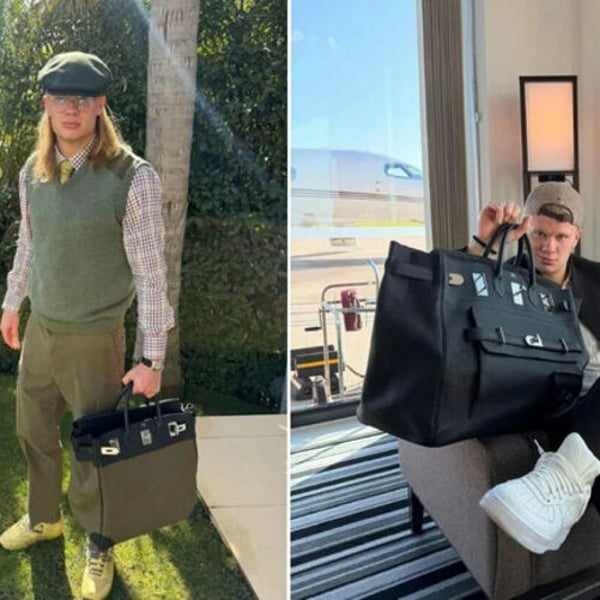
After Norway’s World Cup exit following its defeat by England last weekend, 25-year-old star striker Erling Haaland can at least console himself with his impressive collection of bags made by Hermes and other designer labels. He’s not alone.
Footballers including Virgil van Dijk, who carried a Chanel from Matthieu Blazy’s debut collection, and Jude Bellingham, a Louis Vuitton ambassador with a penchant for its monogram edition, have taken the man bag from derided to highly desirable. With sales of lucrative leather goods subdued over the past three years, the man bag can help the $400 billion personal luxury goods industry out of its current slump.
Haaland’s collection — said to be worth close to £1 million ($1.3 million) — includes a limited-edition multi-pocket Haut a Courroies (HAC) Birkin, and a rare HAC depicting a road-and-mountain scene. Each would cost around $50,000 to buy from a resale site — and good luck ever finding one in a Hermes International SCA boutique.
Perhaps no item exemplifies the bling boom-and-bust of the past six or so years as much as the handbag. About a quarter of a century ago, the “It-bag” became the ultimate status symbol for women as styles such as the Fendi Baguette, Balenciaga’s City and Dior’s Saddle became iconic. But in recent years, few models have captured the imagination of customers in the same way.
Meanwhile, prices have skyrocketed, with average luxury handbag prices up 60% from 2019, according to Laurent Vasilescu, an analyst at BNP Paribas SA.
Against this backdrop, jewelry has looked better value for money. Add in competition from second-hand bags, as well as more affordable lines such as Tapestry Inc.’s Coach, and across the industry the number of premium purses sold — priced above $500 in stores — has been declining since 2022, according to Vasilescu.
Slowing bag sales have depressed revenues and hurt luxury’s bottom line. For the leading brands, handbags have a gross margin – the difference between the manufacturing cost and the retail price – of more than 80%, according to Mario Ortelli, chief executive officer of luxury adviser Ortelli & Co.
So marketing more bags to men could help narrow the sales and profit shortfall. Men accounted for just a quarter of the global luxury handbag market in 2025, according to Bain & Co.
The current market share likely reflects the fact that many men in Asia are comfortable carrying luxury handbags, and that some upmarket models, such as Prada SpA backpacks, skew more to male customers.
But the practice has not yet moved into the mainstream in the west, creating a clear opportunity for top-end brands. With footballers showing off their purse prizes, hard on the heels of New York Knicks player Tyler Kolek’s Margaux model made by US firm The Row, and Wimbledon winner and Gucci ambassador Jannik Sinner’s exclusive bags from the Italian house, that could soon change.
Luxury brands, led by LVMH Moet Hennessy Louis Vuitton SE, are embracing sport as a way to connect with new communities. Consequently, athletes have become fashion influencers, required to highlight their sporting-goods sponsors on and off the pitch or court. But traveling to and from matches offers a way to express their personal style, although some, such as Kylian Mbappe at LVMH’s Dior, have deals with luxury names too. For NBA players, the walkway from arena entrance to locker room has been transformed into a pre-game runway.
And while luxury goods help the wearer flaunt their wealth, for men there are relatively few options. Watches are the mainstay, but jewelry is gaining traction, with some men, such as baseball player Miguel Rojas, wearing Van Cleef & Arpels necklaces and bracelets.
To tempt more men to buy handbags, luxury companies need to adjust their strategies. While Mbappe was spotted with a small Dior clutch, most football stars have been carrying larger models, perhaps because they are effectively super-luxe kit bags. They also happen to look less like a traditional women’s handbag.
The past couple of years have seen the rise of micro-bags. Shrinking purses enabled houses to offer cheaper products without overtly cutting prices. But mini-bags have probably peaked. Companies are now devoting more attention to larger sizes for both men and women, Claudia D’Arpizio, who leads the global fashion and luxury practice at Bain, told me.
Chanel is the trailblazer with Blazy’s oversized styles. But more houses should follow, particularly Hermes. Haaland has generated $8.8 million in brand value for Hermes over the course of the football tournament, far ahead of the other luxury companies tracked by Launchmetrics, which analyzes social media and other mentions.
Luca Solca, an analyst at Bernstein, has found that smaller Hermes bags change hands for the highest multiples of their retail price, reflecting their popularity, particularly among Asian consumers. Anecdotal evidence suggests that it’s even harder to obtain larger sizes from Hermes stores, as the company has tried to satisfy micro-mania. But searches for bigger Birkins on resale site The RealReal Inc. and price-intelligence platform Secondsense have risen since the start of the World Cup. Hermes should rebalance production so that more men can emulate their favorite football stars.
It helps that in pivoting to maxi from mini, luxury will be tapping into another way to deliver value for money: making products more functional and versatile. While larger bags can be heavy, they can be used every day to carry a laptop, perhaps instead of a briefcase, or work-out gear. They can also double as an overnight carryall, cutting the cost per use.
As men become more comfortable carrying purses, they may experiment with different looks. Musician Harry Styles regularly sported smaller Gucci bags when his friend Alessandro Michele was creative director of the Kering SA-owned house. More recently, he’s been spotted with a leopard print Chanel. But jumbo bags are a good place to start.
The World Cup will soon fade from memory. Big bling must ensure the buzz — and any sales benefit — from Haaland’s man Birkins linger long after the last ball is kicked.
