


Why you can trust Digital Camera World
Our expert reviewers spend hours testing and comparing products and services so you can choose the best for you. Find out how we test.
I’ve shot with almost every current Instax camera, but ask me what my favorite model is, and I won’t even have to think: The Instax Mini Evo. Now, Fujifilm is back with a refresh, and the Instax Mini Evo 2 takes the creative shooting modes and retro design but updates the sensor and overhauls the controls with a giant touchscreen.
The Instax Mini Evo 2 is my new favorite Instax camera, no question – but I also think it makes a worthy contender as a cheap point-and-shoot even for creators who weren’t looking for an instant film camera.
Fujifilm Instax Evo 2 review: Specs
Sensor | 1/2.77-inch CMOS |
Resolution | 2144 x 2860, 3100 x 4128 in wide mode |
Immersive movie resolution | 560 x 992 for MP4s, 464×616 for the stills |
Lens | 21mm (35mm equivalent) f/2.0 |
Exposure | Programmed AE with exposure compensation, shutter speed 1/4 to 1/8000 |
Film | Instax Mini |
Storage | Internal memory for up to 45 photos, microSD card slot |
Battery | Rechargeable li-ion rated at 90 shots |
LCD screen | 4.46-inch 1.23 million dot touchscreen |
Dimensions | 87.5 x 125.3 mm x 43.7mm |
Weight | 330g |
Fujifilm Instax Evo 2 review: Price
The Instax Mini Evo 2 retails for about $289.95 / £229.99 / CA$379.99 (about AU$413). Shipping is expected to begin at the end of November, 2026.
That’s a slight price increase over the original Mini Evo, which retails for about $234 / £174 / CA$299 / AU$299.95.
As a digital camera, it can keep shooting without any additional costs beyond a microSD card. But if you want instant film prints, a pack of 20 prints costs about $19.49 / £16.99 / AU$34.95 / CA$25.98.
Fujifilm Instax Evo 2 review: Design

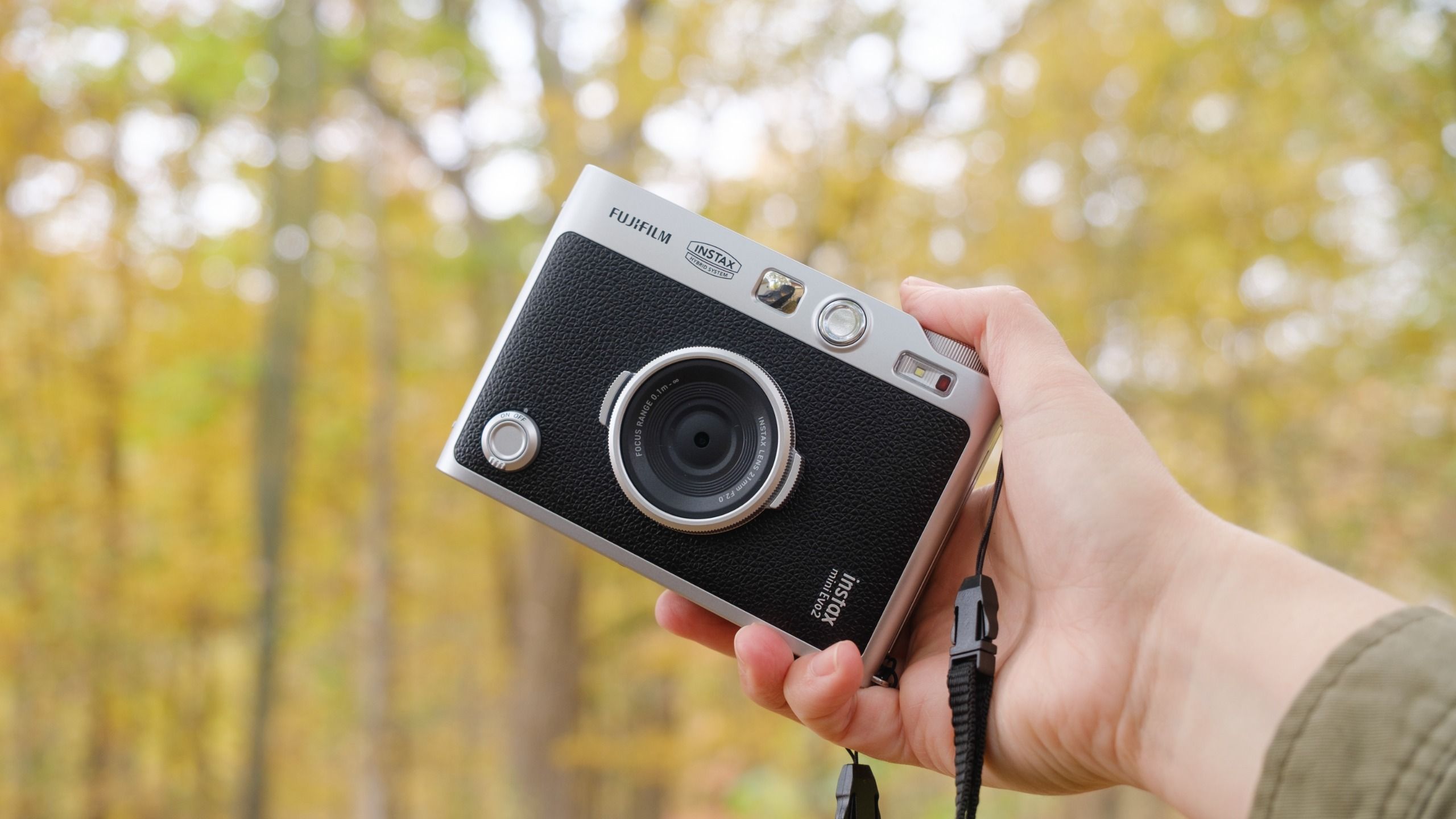
The Instax Mini Evo 2 fully embraces the retro look – not just in the silver body and textured wrap but in the camera’s different controls. A dial at the top of the camera flips through different color presets, while the control to print photos is a lever that feels like the film advance lever on an old film camera.

At the front, a dial around the lens swaps through the camera’s different creative modes like double exposures and light leaks. There’s a secondary shutter release button at the front too, along with the on-off toggle and a small selfie mirror.

From the front, you’d be forgiven for mistaking the Instax Evo 2 for the original – but from the back, the difference is far more obvious. The screen on the Evo 2 is much larger than the first generation, taking up almost the entire back of the camera. It’s so large, there’s no room for the menu buttons, but that’s okay because the screen is a simple-to-use touchscreen.
Beyond being oversized, the screen shows more than what the lens is about to capture, giving a sort of peripheral vision of what’s going on just beyond the frame. A frame indicates what’s in the shot.

The oversized touchscreen will likely be easy to pick up for anyone who has ever used a smartphone for photos, down to the icon in the corner to view the shots that you’ve already taken. The screen also houses shortcuts for exposure compensation, as well as settings to turn the flash on and off and even enter into a macro mode.
The Evo 2 mixes color presets with creative looks – and that’s a lot of different settings to flip through. Thankfully, the camera does allow creatives to save their favorite combos with three custom presets accessible from the touchscreen.
My only complaint about the screen is that there is no viewfinder, and the screen is sometimes hard to see in bright sunlight. The original Mini Evo didn’t have a viewfinder either, though the smaller Instax Pal 2 does.

The instant film loads by popping a lever just under the screen, then prints spit out the side of the camera.
The built-in printer means the Evo 2 is a bit oversized compared to traditional point-and-shoots – it may fit in a jacket pocket, but wouldn’t fit in the pocket of my jeans. That printer can be used not just for photos taken with the Evo 2, but also for shots from another camera using the Instax Evo app and a smartphone.
There is a cold shoe slot at the top of the camera to house accessories like a constant LED light.
The Evo 2 uses a built-in battery that recharges via USB-C. I would have liked to see a bit more battery life – it’s rated for about 90 shots.
There’s enough internal memory to hold 45 photos, but a microSD card is required for the immersive movie and wide-angle lens settings.
Fujifilm Instax Evo 2 review: Performance

The Instax Mini Evo 2 is a camera that’s more about creative possibilities than technical specifications. The camera has ten different “film effects” or color profiles built in, along with ten different “lens effects.” Multiply those ten film profiles by the ten lens effects, and that’s 100 different creative combinations.
The film effects are like Fujifilm’s film simulations, though on an Instax camera these are far different from Fujifilm’s X series. The “normal” mode did feel a bit plain and undersaturated to me, but I loved the retro mode and the different color options. The monochrome mode is full of contrast and probably my favorite out of the ten.

Image credit: Hillary K Grigonis / Future

Image credit: Hillary K Grigonis / Future

Image credit: Hillary K Grigonis / Future

Image credit: Hillary K Grigonis / Future

Image credit: Hillary K Grigonis / Future

Image credit: Hillary K Grigonis / Future

Image credit: Hillary K Grigonis / Future

Image credit: Hillary K Grigonis / Future

Image credit: Hillary K Grigonis / Future
The “lens effects” contain a myriad of effects beyond just the look of the lens. There’s a double exposure option, which was my favorite one to play with, as well as a half frame to put two photos side-by-side. I love the light leak effect, though I wish it would randomize the effect a bit so it doesn’t place the light leak the same way in every shot.

The lens effects also include a blur option that keeps the center sharp but blurs the edges, along with a soft focus that gives the entire image a hazier look. The after image setting mixes a first exposure with a second in quick succession.

One of the new lens modes is the wide-angle, which replaces the fisheye lens mode from the original Mini Evo. This mode actually comes with a higher resolution than the normal photo mode.
The Instax Evo 2 uses a 1/2.77-inch sensor. That’s larger than the 1/5-inch from the original. But, the Evo 2 also uses an “expanded view” screen, which shows more than what the camera is actually capturing, leaving a white frame to indicate what’s actually being captured. That, along with the higher-resolution wide-angle mode, suggests that some of the sensor is being used for the wider view. The larger sensor than the original version, then, isn’t quite as exciting as it sounds.

In the standard photo mode, the Evo 2 takes photos that are about 6.13MP. The wide-angle captures a higher resolution at 12.8MP.
Like other Instax digital-film hybrids, the photos from the Evo 2 are a low resolution that’s great for printing on Instax film and sharing on social media. But it’s not going to do well printing out larger than Instax Mini film. Zoom in on the digital files, and the details get muddled and noisy quickly.
The smaller sensor also means that dynamic range is limited. I found that the camera tended to overexpose a bit. But thankfully, there’s exposure compensation accessible from the touchscreen, so it’s easy to prevent that overexposure.
The Evo 2 does get a new “movie” mode – but it’s not quite a typical movie mode. The Immersive Movie setting records the four seconds up to taking a photo, and adds a cute Instax animation to the footage. It feels a bit like Instax’s take on Apple’s Live Photos.
Like the still photos, the Immersive Movie footage is low-fi at 560×992. Unfortunately, this mode also downsizes the resolution of the photo itself, turning a typical 2860 x 2144 resolution down to just 616 x 464, so these photos really aren’t usable. I was rather bummed when I plugged in the microSD card and realized using the Immersive Movie seriously downgraded the photo quality.
I can see this mode being used to share behind-the-scenes shots on social media of how a photo was taken, but not much else beyond that. I love that the video mode also works with double exposure, though it just shows the second shot.
The photos from the Evo 2 aren’t meant for pixel peeping – but I do think that the photos hold up well among other point-and-shoots that cost under $300. Other cheap compacts like the Kodak Pixpro FZ55 offer zoom that’s missing on the Evo 2. But there’s not really much else like the Evo 2’s built-in creative modes with different color filters and tools like double exposure.

(Image credit: Hillary K Grigonis / Future)


The built-in printer mixes those retro-inspired digital photos with actual film. As a hybrid, there’s no wasted film – you only print the photos that you want to rather than every single photo.
Printing a digital photo on instant film isn’t quite the same thing as using an analog instant camera, but prints still have the colors and charm of instant film. The credit-card-sized prints are colorful and sharp for their small size. Using the app, you can also print photos from a smartphone, including photos shot with a more advanced mirrorless camera.
Instax Mini Evo vs. Instax Mini Evo 2

(Image credit: Hillary K Grigonis / Future)


The original Instax Mini Evo is one of my favorite Instax cameras, so how does the second generation compare?
The Mini Evo 2 has a larger sensor at 1/2.77-inch over 1/5 inch, but keep in mind that some of that sensor size is used for overshooting the view on the screen, so the difference is smaller than it sounds. The Evo 2 shoots a still resolution in the standard mode of 2860 x 2144, an improvement over 2560 x 1920 pixels. The Evo 2 does have a boost in image quality, but both cameras still fall under small-sensor, low-fi cameras.
A handful of the Evo 2’s shooting modes are different from the original. The wide-angle mode is new, and so is the after image mode. Those two modes seem to replace the fisheye option and mirror from the first generation, which aren’t part of the Evo 2.
The Evo 2 has the same well-loved retro design of the original, but the back of the camera is much different, with a very large touchscreen. The touchscreen is simpler to use and is an easy entry into the camera for anyone who has ever taken photos from a smartphone.
The Evo 2 does cost a little more than the original – in the US, the price difference is about $55. I think the larger screen and enhanced resolution are worth that price difference when deciding between getting the old version or the new. That said, as an owner of the original Evo, upgrading to the newest model feels more of a want than a must. Those updates are nice, but not total game-changers.
Fujifilm Instax Evo 2 review: Verdict

The Instax Mini Evo 2 takes retro photo styles and mixes them with creative tools like double exposure – and then wraps it up into a cheap compact camera. Like other cheap compact cameras, the Evo 2 isn’t for pixel peeping – but the creative modes are unlike any other cheap point-and-shoot that I’ve seen.
The original Instax Mini was my favorite camera from Instax because of the mix of different creative tools – and the fact that I don’t waste any film and can choose to print only the photos that I love. I say it was my favorite because now the Instax Mini Evo 2 has taken that title.
Beyond being my favorite Instax, the Evo 2 is also worth looking at as a cheap point-and-shoot. It’s not as small as other compact cameras, but the instant film prints offer a lot of value over smaller cameras.
The Evo 2 isn’t perfect. I would have loved to see longer battery life than 90 shots. The camera tends to overexpose, and its resolution and dynamic range are a reminder that the camera falls in the budget category. The new video mode may be cute for creating social media videos, but it severely downsizes the resulting still photo. But overall, I think the Evo 2 is going to be a major hit.
Alternatives
The Evo 2 is worth looking at as an alternative to a cheap compact camera, as well as simply as an instant film camera. A few notable cameras that also fall under the description of cheap, compact, and retro include the Instax Pal 2 and the Camp Snap CS-Pro. Another more affordable option that also has a printer built in is the Instax Mini Li-Play+, or for larger prints, the Instax Wide Evo.
You may also like
For more inspiration, take a look at the best hybrid instant film cameras or the best point-and-shoots.