



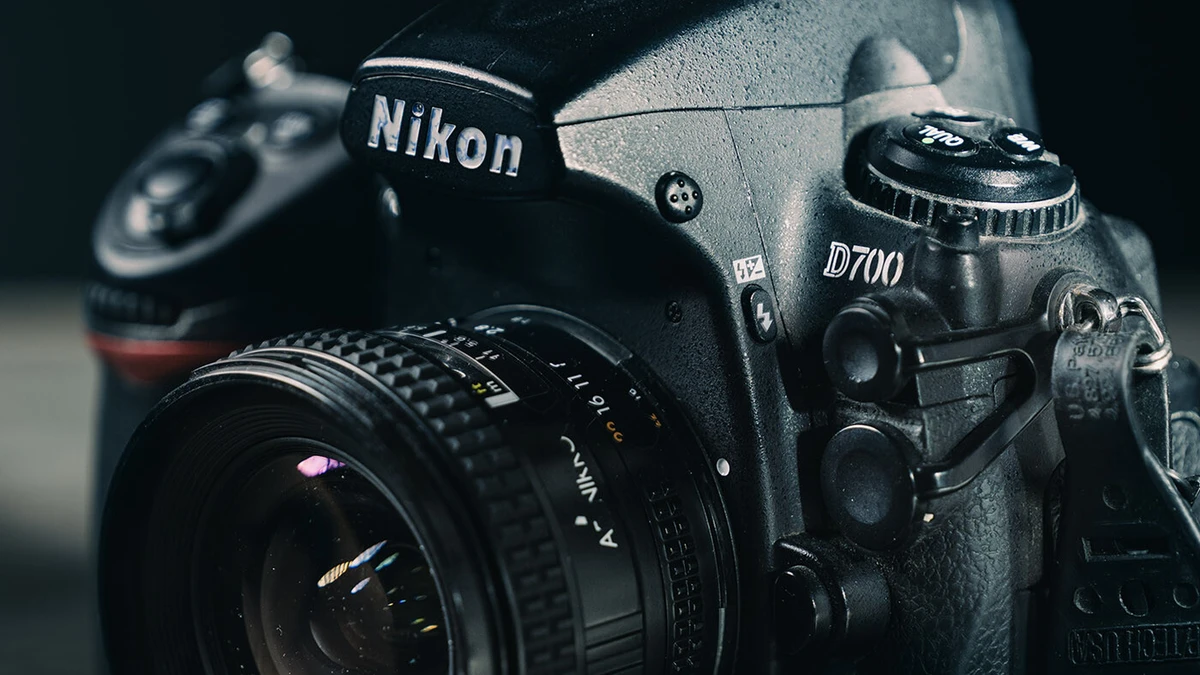
When it comes to talking about legends, the internet has more mentions of the Nikon D700 than King Arthur and Excalibur. Does this camera really deserve such legendary status, or are the hyperbolic influencer YouTubers causing an unnecessary disturbance in the Force?
While Excalibur was pulled from a big, heavy stone, the D700 feels like you’re holding a big, heavy stone. The only thing being pulled with this camera will be a shoulder or neck muscle from carrying it around all day. Okay, so this isn’t a very positive start to an article, is it? Let’s start at the beginning…
I purchased the D700 back in 2008, the month it was launched. I loved it immediately. As a professional travel and lifestyle photographer, it did everything I needed it to do. It was my trusty companion on trips all around the world for many years. The image quality and color science really impressed me. I abused it. I dropped it in a piazza in Rome, and it bounced three to four feet. Still worked. I got caught in torrential rain in Seattle. And then there was the snowstorm in British Columbia. Still worked. It didn’t let me down. Ever.
I still have the camera today, and can’t help but smile when I see its battle scars—scratches, dings, and a broken dial. Regardless, it still works just fine, and I take it out on a shoot once in a while. The images can compete with those from the latest Nikon Z cameras, including the flagship Z9.
When I mention a comparison to the latest mirrorless flagship cameras, people look at me like I’ve gone mad. How can an 18-year-old DSLR compete with the latest and greatest? Well, allow me to explain.
Image Quality Isn’t Everything
The D700 has a 12.1-megapixel full frame sensor. In today’s world, where camera manufacturers are determined to convince us that we need ever-increasing sensor resolutions, that might sound rather modest. But how many megapixels do we actually need?
For magazine features, brochures, websites, and most everyday photography, 12 megapixels can still deliver excellent results. Unless you’re regularly cropping heavily or producing enormous prints, resolution isn’t necessarily the limiting factor in your photography.
I’ve taken thousands of photographs with my D700 that have been published in magazines and brochures. I’ve also used my much newer Nikon Z9. For the kind of work I do, the differences in the finished images aren’t always particularly meaningful or noticeable. You can pixel-peep photos from both cameras and maybe spot the difference in sharpness or microcontrast, for example. But when those two images are actually converted to CMYK files at 300 dpi and printed in a magazine—allowing for things like dot gain—that fraction of a difference can become imperceptible. The gear nerds don’t ever mention this because I’m guessing they don’t have their work published regularly across different media.
That’s not to say modern cameras don’t offer improvements; of course they do. But better specifications don’t automatically translate into better photographs.
What About the Downsides?
Like most cameras, the D700 is not perfect (I can’t think of a camera that is, to be honest).
It’s a heavy, bulky, traditional DSLR design. There’s no video capability, no modern mirrorless AI-driven subject-recognition autofocus system, and no in-camera image stabilization.
Its high-ISO performance, autofocus capabilities, and dynamic range also need to be considered in the context of modern alternatives. If you’re photographing fast-moving subjects or working in demanding professional environments, a newer camera may make your life considerably easier. As someone who was raised with cameras where one focuses on the subject from the center point of the frame and recomposes to take the shot, it’s no big deal. The D700 does have 3D autofocus tracking, but if you have only used cameras with modern subject-recognition tracking, the D700 will feel alien.
As I alluded to at the beginning of this article, the weight is the biggest issue most of us would have with this camera. It’s a big chunk of metal, and after spending a day carrying the D700 around, you might find yourself wondering whether all that solid construction was really necessary. If you’re using something like a Nikon Z6III, which weighs 670 g compared to the D700’s 995 g (both body-only weights), you’ll most certainly question the D700’s size and weight. However, if you’re a pro using a Z9, that weighs a hefty 1,160 g without the battery or memory cards—maybe the D700 isn’t so bad after all. The thing is, though, the weight on the Z9 is spread out, and the grip is less bulky. It’s an easier camera to hold.
Does It Deserve Its Legendary Status?
I think the D700 deserves much of its reputation. It was a superb camera when it launched, and it remains capable of producing excellent photographs today.
But I have to wonder: Do we sometimes confuse nostalgia with genuine relevance? I think we do. It seems that many YouTube videos that rave about this camera are stuck in a nostalgia bubble that is influencing their enthusiastic hyperbole. The fact that a camera was wonderful in 2008 doesn’t mean everyone should rush out and buy one today.
If you already own a D700, there’s little reason to stop using it simply because newer cameras exist. If you’re considering buying one, its age, weight, limited resolution, and lack of modern features should all factor into your decision.
The important question isn’t whether the D700 can still take good photographs. Of course it can. It’s whether it does everything you need it to do. The camera has produced some of my most successful photographs, and for most of the things I like to shoot today, no newer camera can do a meaningfully better job unless sheer size of output is a consideration.
If you’re new to serious photography and on a budget, you can pick up a used D700 for just a few hundred dollars. Compare this to a new entry-level mirrorless model like the Nikon Z5II that currently costs around $1,600 on sale, and maybe that’s enough to make the D700 legendary!
The bottom line for me is we should spend less time worrying about whether our cameras are legendary and more time making photographs worth remembering.
My D700 allows me to do just that.


