

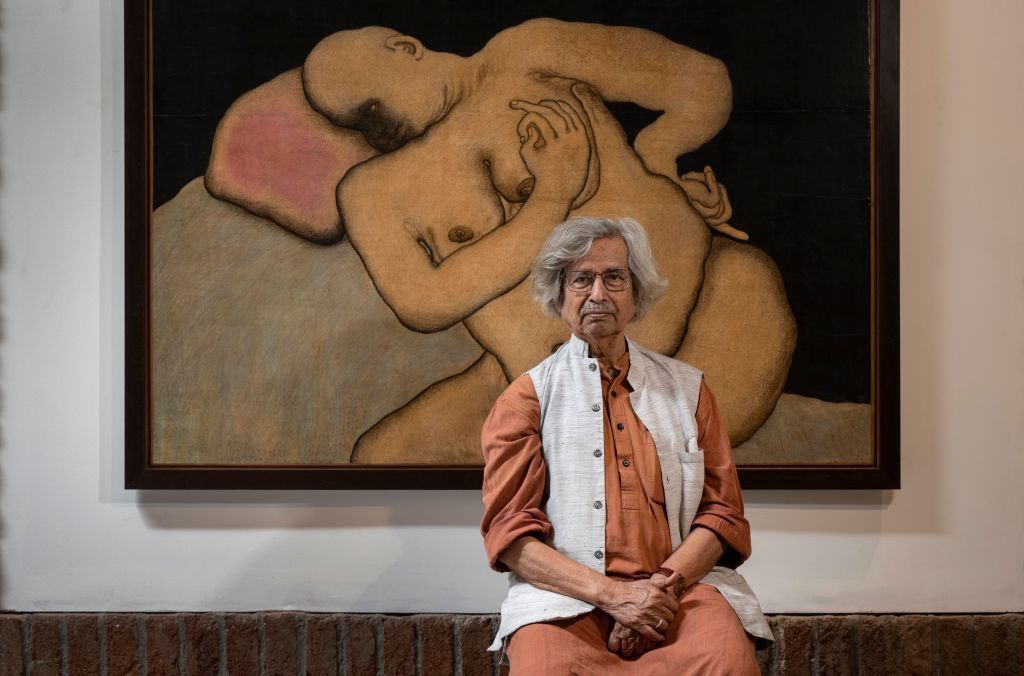
Jogen Chowdhury, one India’s leading modern painters whose figurative oeuvre foregrounded humanity, died at a hospital in Kolkata on October 25. He was 87. Indian media reports that Chowdhury had been suffering from a rare blood cancer for more than a year.
Condolences have poured in on social media in the wake of his death. Writing on X, West Bengal chief minister Suvendu Adhikari praised Chowdhury as a “a towering pillar of our cultural world,” whose artistic legacy would be “immortal through the ages.” Likewise Samir Aich, a prominent painter based in Kolkata, mourned his death as “personal loss” and representative of a chapter closing on the Bengal School of Art, an early 20th-century art movement that originated in Kolkatta (formerly Calcutta) and Shantiniketan during the British Raj, and then flourished across the Indian subcontinent, buoyed by the Indian Independence Movement.
Reacting in part against the dominance of Western realism in Indian art eduction at the time, the Bengal School of Art drew on Indian traditional art forms, such as Mughal miniatures, pastoral themes, and the intermingling of history and mythology. The distinctive red earth landscape of Santiniketan, where Chowdhury had a home, was a particular inspiration. Elements of Cubism and Japanese modern art sensibilities were threaded throughout the movement, owing to a thriving cultural exchange between India, Japan, and Europe.
Chowdhury was renowned for his line work, which excelled in the tactile, expressionistic quality unique to Indian art. He often used a cross-hatching technique to delicately distort the human figure, pushing them to caricature not as a mockery, but as a means of visualizing psychic interiors.
“The figures are wrought by a combination of decorative wilfulness and expressive distortion and are imbued with an effusive sensuality,” Indian art critic R. Siva Kumar once wrote. “Chowdhury’s art is rich in suggestions; it is to be apprehended without bracketing our fund of knowledge, experience or memories, but also cannot be narrativised without trivialising it, without depleting its sensory particularities.”
Jogen Chowdhury was born on February 16, 1939, in Daharpara village in Faridpur, then a region in undivided Bengal. (British occupying forces partitioned Bengal along religious lines for the second time in 1947, after a failed attempt in 1905.) He described a creative, aristocratic upbringing: His mother was renowned for her skill in Alpana drawings, and his father was a painter and sculptor.
He enrolled in to the Government College of Art & Craft, Kolkata in 1955. He also trained at the Government College of Art & Craft from 1955 to 1960 and later at the École Nationale Supérieure des Beaux-Arts in Paris in the 1960s, returning to India in 1968.
In 1972, Chowdhury served as a curator at the Art Gallery of Rashtrapati Bhavan, the official residence of India’s president. In April 2014, he entered politics, winning election to the Rajya Sabha, India’s upper house of Parliament, as a member of West Bengal’s Trinamool Congress. He served until April 2020.
Chowdhury’s art accolades include the Prix de la Jeune Peinture in Paris in 1966 and recognition at the Second Havana Biennial in Cuba in 1986. In 2001, he received the Kalidas Samman from the government of Madhya Pradesh in recognition of his artistic contributions. In 2012, he was awarded the Banga Bibhushan, the highest civilian honor conferred by the government of West Bengal.