


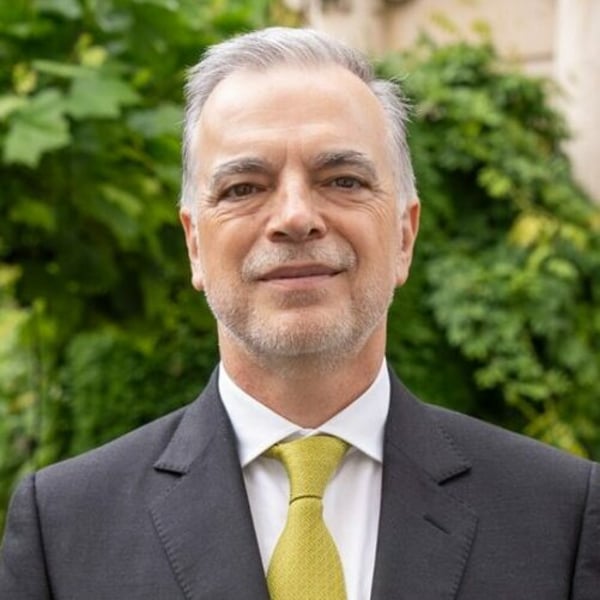
On Friday in Brussels, the General Assembly of the European Apparel and Textile Confederation (Euratex) voted to re-elect Mario Jorge Machado as its president. He begins his second term in an industry context where rising production costs, intensifying international competition, and the ecological and digital transitions are weighing on companies.
An engineer specialising in polymer production, the new Euratex president has previously served with the Portuguese Textile and Clothing Association (ATP) and the Portuguese Business Confederation (CIP). As head of the printed fabrics manufacturer Adalberto, Mario Jorge Machado spoke to FashionNetwork.com last September about the 10% job loss the sector experienced in just 18 months.
“My priority for this new term is clear,” Mario Jorge Machado states today. “To strengthen the competitiveness of our industry, ensure that the same rules apply to all products sold in Europe, and support our companies in the ecological and digital transition. Europe must decarbonise its industry, not deindustrialise it.”
To underpin this strategy, the organisation sets competitiveness as the foundation of all industrial policy, directly shaping the continent’s capacity for investment, innovation, and strategic autonomy. This new mandate therefore aims to promote a favourable business environment, notably by supporting small and medium-sized enterprises in their efforts towards automation, digitalisation, and the integration of artificial intelligence.
The issue of regulatory fairness, particularly in relation to Chinese competitors and online platforms, is the second priority announced for this new mandate.
Euratex intends to advocate for all goods sold in Europe to be subject to the same legal requirements as those manufactured there. The confederation is calling for increased market surveillance and strengthened border controls, particularly targeting import flows generated by e-commerce platforms. The goal is to prevent manufacturers from being placed at a disadvantage by goods that circumvent the European Union’s environmental and safety standards.
Regarding sector-specific support, Mario Jorge Machado states his intention to make sustainability a driver of growth rather than a financial burden. The executive advocates the implementation of realistic regulations, backed by affordable energy and targeted support mechanisms. He also emphasises the need to stimulate demand for responsible European textiles through public procurement and transparency tools adapted to companies’ constraints.
In implementing this roadmap, the re-elected president will be supported by a presidential team confirmed by the General Assembly, comprising Franz-Peter Falke for Germany, Barbara Cimmino for Italy, Ismail Kolunsag for Turkey, and Grégory Marchand for France. The employers’ association currently represents an industry accounting for more than €61 billion in exports, spanning the European continent with approximately 200,000 companies generating 1.2 million jobs.
Copyright © 2026 FashionNetwork.com All rights reserved.