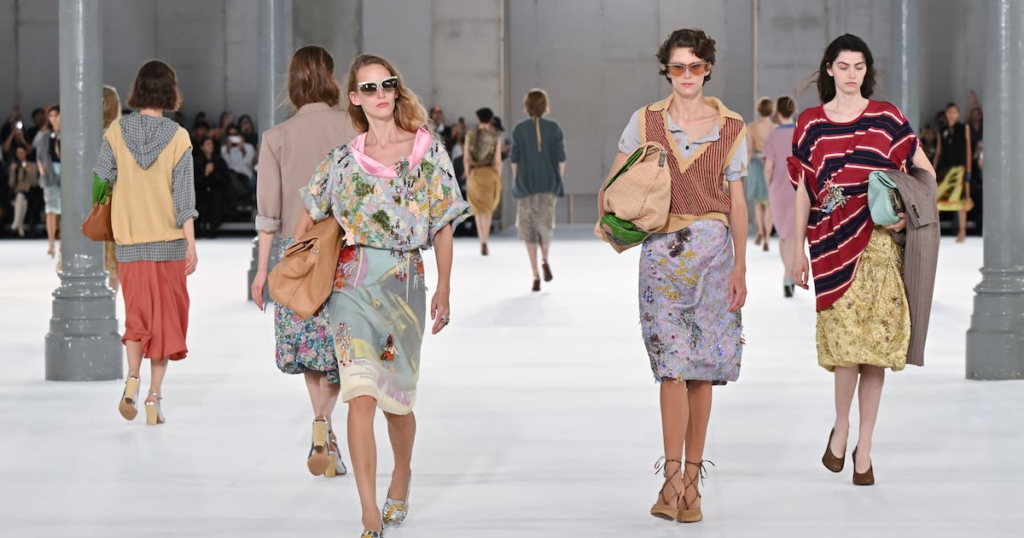



Between trips to Riyadh, Sarah Maj took part in the second edition of Destination Créative Marrakech in mid-June. The founder of the eponymous women’s ready-to-wear brand is one of the inspiring stories behind this event dedicated to fashion, beauty, and lifestyle. Since her first appearance at the Moroccan event, she has been expanding her international network.
Having previously done very little wholesale business and never having considered Saudi Arabia as a market, she has seen her brand’s appeal grow significantly. The designer, who divides her time between Milan- where she sources her fabrics- and Marrakech- where her workshops are located- has seen opportunities blossom. After making initial contacts, she participated in the Tranoï Paris and Tranoï Tokyo trade shows, which enabled her to secure international accounts, particularly in Japan, and saw her collection gain traction in the Middle East through several pop-up events at concept stores in Saudi Arabia. As a result, the designer has begun creating a few pieces specifically for this market and must scale up her production capacity.
The independent label’s journey exemplifies what the founders of Audace set out to achieve with their hybrid initiative, supported from the outset by Nathalie Dufour, the founder of ANDAM. This season, the concept showcased the work of some 15 brands and designers in the worlds of ready-to-wear and accessories, as well as beauty, design, and tableware.

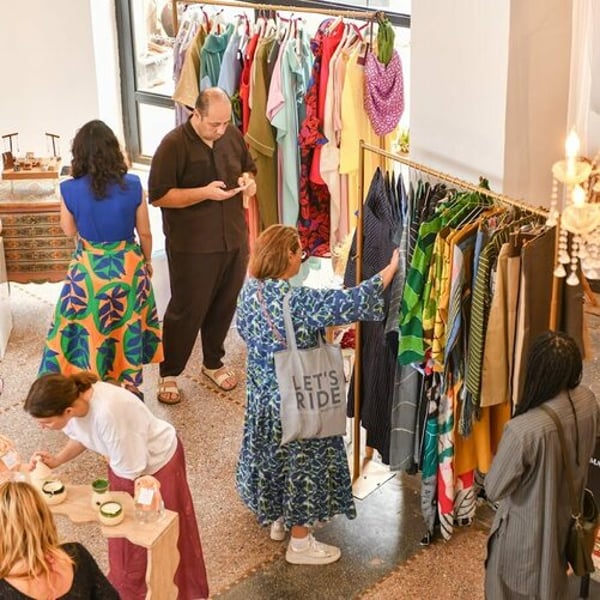
In a modern showroom connected to La Rôtisserie de La Paix in the Guéliz neighbourhood, these labels showcased their vision and products to representatives from department stores such as Bloomingdale’s, Tryano (part of the Chalhoub Group), and Le Bon Marché; buyers from concept stores in Europe and the Middle East; representatives from international trade shows such as Tranoï and Precious Room; and journalists from international media outlets.
“For each project, we receive about a hundred applications,” explains Youness Bouchida, who co-founded Audace with the goal of providing the tools to structure Morocco’s cultural and creative industries. “We aim to give designers access to international markets, but also to expose them to the demands of international buyers and industry experts such as Nathalie Dufour and Muriel Piaser, who heads the Precious Room trade show. We select about 15 projects that have the potential to showcase their work. It’s also a way to inspire them and expose them to international standards.”
The event thus drew on several local highlights, such as the well-established Chic Design, which has been working with local artisans since 2013 to develop a sustainable range of high-end Moroccan crafts, as well as the wellness offerings of Leïn Marrakech, which features rituals and handcrafted items, and the jewellery made from precious metals and semi-precious stones by the Casablanca-based brand Vendredi.

But far more than a trade show or a traditional showroom, Audace aims to showcase the country’s rich craftsmanship and dynamism as a creative hub, while also offering designers the opportunity to engage with different perspectives.
This time for connection is enhanced by informal exchanges, which foster a dialogue that goes beyond sales pitches and conventional brand messaging. This informal aspect can make all the difference for participants like Sarah Maj, who traditionally lack access to international contacts. Yet, as exemplified by Fadila el Gadi, who has been dressing women in positions of power around the world for years, the potential is there- and there is a drive to harness it.
“Morocco was a bit behind in the field of cultural and creative industries, but that’s changing, particularly thanks to efforts to raise Morocco’s international profile. Our soccer team is also helping to make the country known around the world. This opens up new opportunities that are necessary because the country faces the pressure of having several hundred thousand young people entering the job market each year. This is an ambitious and connected generation, with the same expectations as a young Australian or Swede. We must meet these expectations,” says Younes Boumehdi, vice president of the Federation of Cultural and Creative Industries (FICC).
“For a long time, we were a country that relied on subcontracting, but today we’re also committed to retaining value. Many of our mid-range ready-to-wear clients have disappeared. Faced with this reality, we had a choice: either let players from Asia enter the market, or try to bring that value back home, particularly by supporting niche or ultra-luxury brands. Morocco is set to become a major tourist destination and will serve as a showcase; as we increasingly embrace our African roots, we will see more and more Moroccan, sub-Saharan, Arab, and European designers presenting their work to this global audience. Audace highlights that there is tremendous potential. But this requires investment.”
The country, which will co-host the World Cup with Portugal and Spain in 2034, is investing in infrastructure and capitalising on its growing international appeal to nurture and attract talent.

“We have talented people with high-quality training programs. The idea is also to showcase diversity. Creativity is multifaceted, which is why we welcome brands like Wuman, which comes from Lagos, and the beauty and skincare brand Lady Octopus, which is from South Korea,” explains Youness Bouchida. “Marrakech, particularly through its art festival, is becoming a showcase for creatives from other African countries as well as from the diaspora.”
Like Sarah Maj, several designers infuse their collections with elements of their dual cultural backgrounds, living between Switzerland, Italy, France, and Morocco. Samia Garet, an engineer based in Paris, founded her brand Thïab in 2020. “I wanted to offer a comfortable yet modern wardrobe rooted in Moroccan craftsmanship,” explains the entrepreneur, who works with a workshop in Marrakech to produce her elegant tunics and caftans, crafted from silk and a linen-poplin blend.
With Le Fen Project, Kamil Hajji combines 3D object modelling with software designed to apply Moroccan-inspired graphic patterns to objects, which are then brought to life by artisans. He offers a modular and modern home decor collection that draws inspiration from the Maghreb. Anne-Sophie Cicile, a French native who has lived in Morocco for many years, founded Cols Porteurs last year, featuring a concept of removable collars- whether Claudine-style or pleated- with original prints sourced from dormant stock and garment scraps. Her original pieces, made in Marrakech, were spotted by American concept stores at the Oasiria market.
Léa Ihssane Chabaa has a different story. The Moroccan designer, who lives in Paris, launched ADN Paris in 2019 and focuses on production in the French capital. But for the designer, whose company has reached a certain level of maturity and is showcasing its collection in a showroom during Paris Fashion Week, the connection to Morocco could open up new opportunities, both in distribution and in terms of cultural relations.
“This bridge between France and Morocco has long existed on both the creative and industrial levels,” says Serge Haouzi of Teintures de France, who works for numerous luxury houses- both those part of major groups and independent ones. “When I first started out, we would come to Morocco for inspiration. And the best example is that a genius like Yves Saint Laurent drew a great deal of inspiration from here. There are many innovations, particularly in denim. Admittedly, the approach is different, and luxury brands haven’t yet taken the plunge to come here, but something is happening. These major players and independent brands can look to the country.”

Opportunities that Stella Cadente seized back in her day. The French designer and interior decorator has been based in Marrakech for about 15 years. She recalls seeing French artisans and industrial craftsmanship gradually dwindle or become inaccessible to an affordable independent brand. “I moved to Morocco for the country itself, but also to have access to fine craftsmanship and expertise. Unfortunately, there’s a lack of self-confidence when it comes to championing our exceptional craftsmanship. For example, we work with five workshops that support 60 families. I don’t want the same thing to happen here as it did in France. Brands have everything to gain by discovering Morocco’s potential.”
This approach applies not only to production but also to design, and it has a direct impact. “We’re fortunate to have a millennia-old heritage whose full diversity hasn’t yet been tapped. And these creators- in fashion and design- will reinterpret it. Morocco can serve as a springboard for European brands looking to reinvent themselves or bounce back,” explains Younes Boumehdi, citing the Korean cultural wave- which spans numerous creative sectors- as an example. “Korean brands are partnering with French players to offer the best of both worlds. There’s an opportunity to create niche brands with global potential.”

Nevertheless, the ecosystem, which has long been fragmented, is taking shape. Incubators are springing up, and the search for talent is helping to bring emerging profiles to the forefront in different regions of Morocco. Above all, the country is discovering its own potential, which advocates for the creative industries would like to see supported more strongly.
“Until now, institutions and bankers have argued that the creative industries were a small sector,” said Boumehdi. “But a recent World Bank study showed that the 13 sectors of the creative industries account for 2.7% of Morocco’s GDP. That’s more than logistics, which has benefited from heavy investment. And we’re betting on doubling that share within five years. To me, this is the only sector with this kind of potential. Even without support, the fashion and design sector grew by an average of 16% per year between 2022 and 2024, with exports accounting for only 8%. This creates local value, but it also fosters co-development. Much of this growth is driven by international designers who bring their expertise and funding and help advance the national ecosystem. I believe in this win-win potential between Europeans and Africans, with Morocco serving as the platform.”
However, there is still a long way to go. To make this dream a reality, representatives from the kingdom’s fashion and textile industries will need to convince policymakers to fund these developments and train the talent of tomorrow- the people who will help structure and grow these brands. These future leaders could then reach customers on both continents, as well as African diasporas around the world.
Copyright © 2026 FashionNetwork.com All rights reserved.