



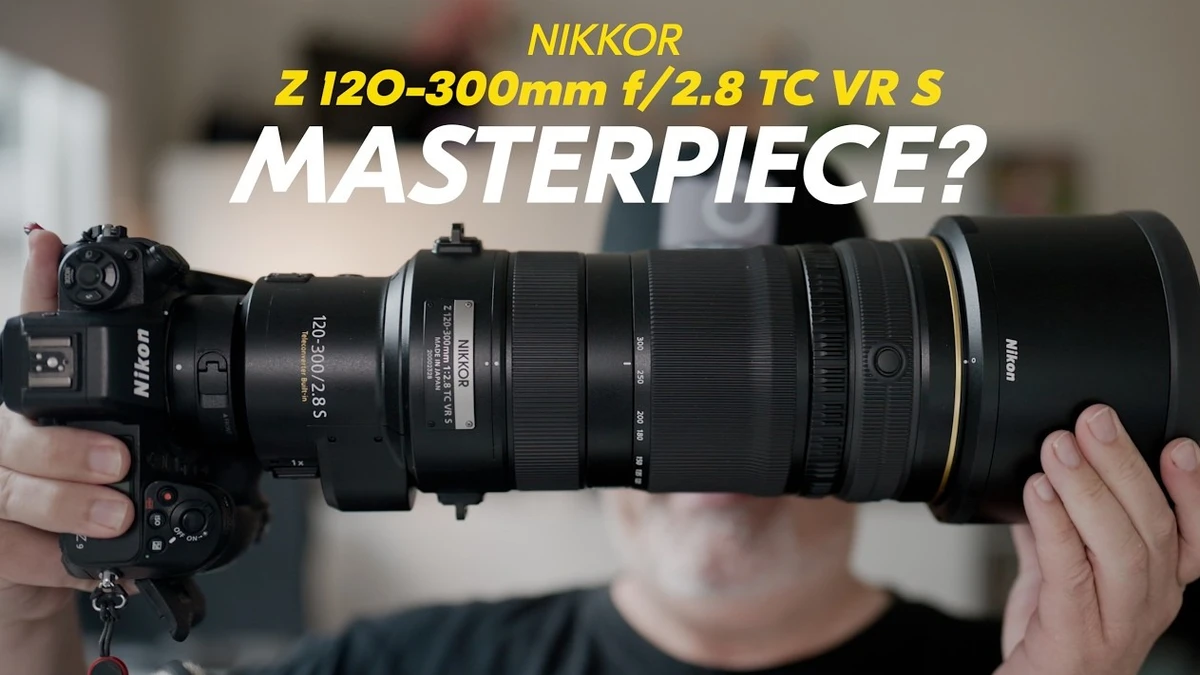
Nikon’s Z 120-300mm f/2.8 TC VR S is up for preorder at $13,996, and for that money, you get a constant f/2.8 zoom with a 1.4x teleconverter built into the barrel. If you shoot sports, wildlife, events, or anything else where you can’t simply walk closer, one lens that covers the territory of several fast primes changes what you pack and how quickly you can respond to what’s in front of you.
Every frame in the first-look footage was shot handheld, after just one day with the lens. Matt Irwin spent that day zipping around a city on an electric scooter with the 120-300mm hanging off his backpack, grabbing shots as fast as he could. Flip the internal converter on, and you’re at 168-420mm at f/4, still full frame. Add an external teleconverter and use the crop modes on a Nikon Z8 or Z9, and Irwin works out an equivalent field of view approaching 2,000mm. Nikon rates the stabilization at up to 6.5 stops, and it says the autofocus keeps pace with the Nikon Z 400mm f/2.8 TC VR S and may even beat it. Irwin describes focus as an instant snap, with stabilization he calls “unsettlingly perfect.”
Irwin’s most useful framing treats the zoom as a stack of primes sharing one barrel. At 120mm, he puts it next to the Nikon Z 135mm f/1.8 S Plena and finds the rendering at least as good. At 200mm, it sits one stop behind a 200mm f/2, and at 300mm, it matches a 300mm f/2.8 outright. With the converter engaged, 420mm at f/4 lands a single stop shy of a 400mm f/2.8, and Irwin says image quality holds steady whether the converter is in or out. You give up a stop in a few places, and you never pull the lens off the camera to move between those looks.
The obvious buyers shoot birds, sports, and news, though Irwin spends much of his time with it on cityscapes and cinematic street scenes. He likes compression, shallow depth of field, low light, and shooting without a tripod, and this lens lets him do all four at once. At 120mm and f/2.8, it sits close to where a 135mm portrait lens lives, with 200mm and 300mm a twist of the ring away. Landscapes compressed from a distance are just as natural a fit.
Nikon bought RED Digital Cinema in 2024, and the Z mount has been turning into a shared platform for stills and cinema ever since. RED now sells Z-mount versions of cameras such as the RED Komodo-X and RED V-Raptor. The Nikon ZR arrived in 2025 as a compact full frame body that records RED’s R3D NE raw format. A telephoto zoom bought for football or wildlife can now sit on a cinema rig the next day, so the cost gets spread across more kinds of paid work. If you shoot both stills and video, judge any long lens with video in mind too. A zoom that extends as you zoom shifts a gimbal’s balance, and focus breathing becomes obvious in a focus pull even though it never shows up in a still frame.
At about 2.7 kg, or roughly 6 pounds, the new lens is around half a kilogram lighter than Nikon’s F-mount AF-S Nikkor 120-300mm f/2.8E FL ED SR VR, which had no built-in converter. It measures about 35 cm long, zooms internally so nothing extends from the barrel, takes drop-in filters, and ships with an Arca-Swiss-compatible foot. Irwin handheld it for hours without trouble, though he points to the Nikon Z 70-200mm f/2.8 VR S II paired with a Nikon Z TC-1.4x as a route to much of the same reach at less than half the weight and a far smaller price.
If you’re weighing the lens for cinema work, the handheld city footage Irwin shot in his one day with it is the part of the video to watch.