



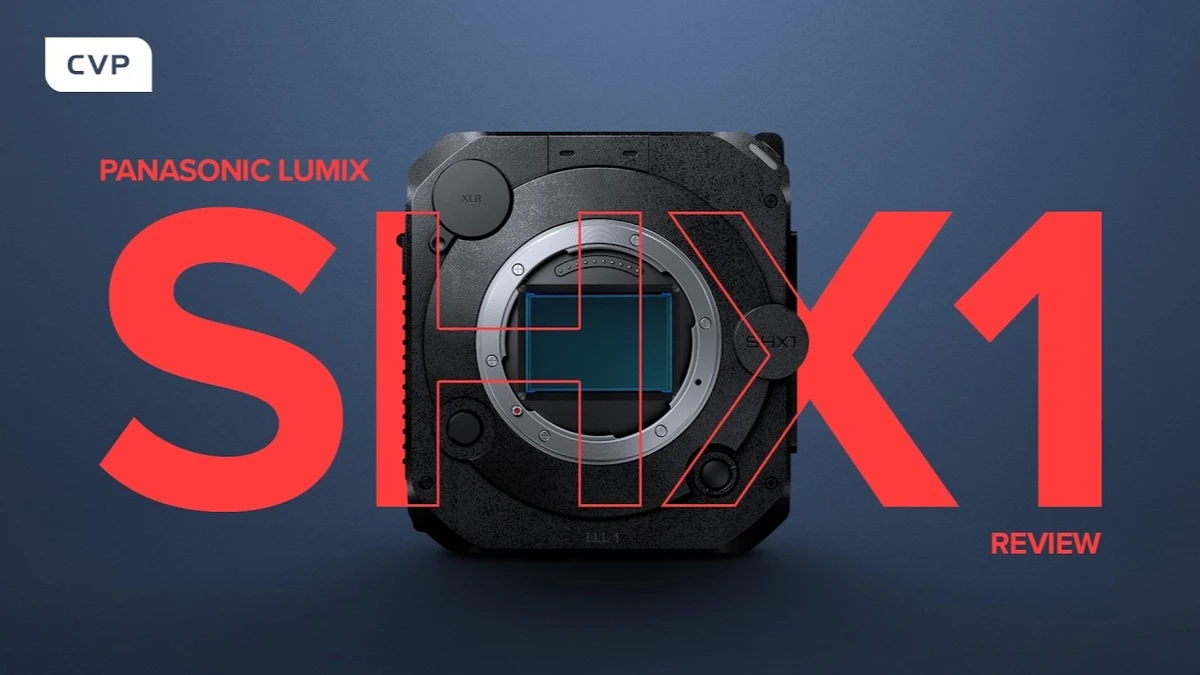
Panasonic’s Lumix SHX1 is the company’s first dedicated box-style cinema camera since the BS1H in 2021, and it records Blackmagic RAW without an external recorder, a first for a camera maker other than Blackmagic. If you keep bolting cages, handles, and V-mount batteries onto a mirrorless body until it behaves like a cinema camera, a body designed that way from the start changes how you build a rig and how long you can shoot.
Jake Ratcliffe of CVP ran an early sample of the Panasonic Lumix SHX1 on beta firmware through the same lab tests the team uses on other cameras, with the Panasonic Lumix S1II as the obvious reference point. Panasonic flew him to Japan to try the camera and give feedback to its engineers, and he says the company had no input on the video. The SHX1 and S1II share a 24.1-megapixel, partially stacked full frame sensor, so you get 6K open gate capture with pixels large enough to hold up in low light and in the highlights. The difference sits in front of that sensor. The S1II has no optical low-pass filter, which gives you crisp stills but can make video look too sharp. It also leaves the S1II prone to moiré on patterned shirts, brick, and LED walls, which are the subjects that wreck a take on set. The SHX1 adds a bespoke filter, the first on a Lumix since the Panasonic Lumix S1H in 2019. On a test chart built to break an image, the S1II shows obvious aliasing while the SHX1 keeps it under control, at the cost of a very slight softening in fine texture like beard hair.
The bigger choice you’ll make on this camera is whether to turn on dynamic range boost. The mode reads each pixel through a low and a high circuit and merges the two. Panasonic rates the result at 15 stops, roughly a stop more than standard mode. You give up dual base ISO for a fixed base of 1,000, so bright exteriors call for an 8- to 10-stop ND if you want to keep a wide aperture. Readout slows a lot, too. In 6K open gate, the sensor reads out in just under 16 milliseconds with boost off and around 29 milliseconds with it on, which will show as skew on fast pans or a quick handheld move. For a seated interview or slow documentary work, the extra highlight room is easy to take. In CVP’s latitude tests, the boost holds skin to about five stops over, against roughly 4 1/3 in standard mode at either base, and gives the cleanest shadows of the three modes, good down to four stops under, while the S1II performs almost identically. Blackmagic’s PYXIS 12K keeps highlights intact up to five stops over once highlight recovery is enabled, though skin goes yellow, and looks bad from about three stops under. The standout underexposed is the Sony FX5, which keeps excellent noise, color, and detail at five stops under in its dual gain mode.
For color, the SHX1 offers V-Log and ARRI LogC3, which comes preinstalled, and Blackmagic RAW can also be shot in Blackmagic’s own gamma and color space. Next to the S1II, a basic headshot looks nearly identical. ProRes RAW needs Panasonic’s V-Log RAW conversion LUT, since straight into Resolve it looks unsaturated and pink. For Blackmagic RAW, Ratcliffe suggests shooting V-Log, and in that mode you can’t load your own LUTs, only the built-in View Assist. Noise reduction and sharpening are adjustable from zero to 10 in every profile, and even at zero, the compressed formats clean up noise that raw shows plainly. At ISO 25,600 with noise reduction, he considers the footage usable for plenty of situations.
Internal Blackmagic RAW comes with conditions in the current firmware. It only records over USB-C to an external SSD, not to the CFexpress Type B or SD UHS-II slots, and Panasonic says that limit is on its end rather than Blackmagic’s. The USB-C port is threaded for a locking cable, which helps when a drive is hanging off the back of the rig. Open gate Blackmagic RAW only runs at 23.98p, so 25p means dropping to the 5.8K mode, and higher frame rates crop in further. The 32-bit float audio doesn’t work while recording Blackmagic RAW, and in-camera playback only shows proxies, so you need proxy recording turned on to review takes. A Blackmagic Video Assist still works with the camera and gets you higher raw frame rates than recording to the SSD.
Ratcliffe calls the stabilization class-leading. In side-by-side tests, the SHX1 and S1II perform equally well, and he credits the SHX1’s slightly steadier feel to its extra heft. Anamorphic shooters get the usual desqueeze options plus new vertical squeeze modes at 1.3x, 1.6x, and 2x, though oddly not 1.5x, and the in-body stabilization can be tuned specifically for anamorphic lenses. Power comes through a V-mount plate sized for mini V-mount batteries, and on a stripped-down rig, a 98 Wh battery lasted roughly four to five hours, while a locking USB-C port doubles as a DC input for a 100 W PD supply. The body alone weighs about 984 g, and that climbs once you fit a battery, a lens, and media, plus the top handle, XLR unit, and side grip, the last of which he considers pretty much essential. The camera records 32-bit float audio through the XLR unit or the body’s 3.5 mm input, and the outputs include full-size HDMI, 12G-SDI, and BNC timecode, with a live production module adding IP control and genlock due in the first half of 2027. There’s no internal ND, no stills mode, and no weather-sealing, though the camera can control Tilta’s Mirage electronic ND matte box.
He calls the SHX1 a fantastic step for Lumix and the closest any Lumix camera has come to the look of S1H footage, which he loved. It builds on the S1II but puts that performance in a body designed for video, and it’s arriving in a very competitive part of the market.
Ratcliffe’s footage from a few extra days of shooting around Japan opens the video, much of it in dynamic range boost mode or Blackmagic RAW.


