


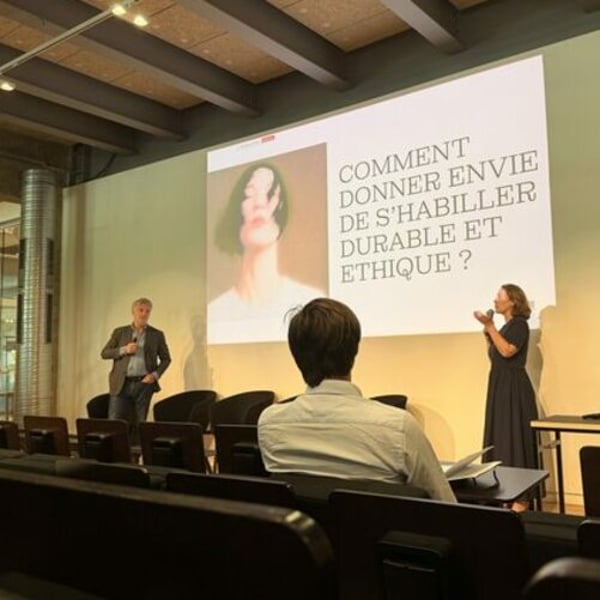
Should we talk about quality fashion rather than sustainable fashion? This simple question could well sum up the findings of the Paris Good Fashion public consultation, the results of which were unveiled on June 10 at the Institut Français de la Mode (in Paris’s 13th arrondissement). The association launched this consultation a few months ago with the support of several fashion industry players, including Galeries Lafayette, Etam Group, the Eram Group, Karla Otto, Kiabi, Lacoste, Printemps, SMCP, and Le Bon Marché Rive Gauche.
This public consultation, which follows an initial one held in 2021, brought together a total of 168,000 participants, including 107,000 in France, 32,000 in Italy, 17,700 in the United States, and 11,500 in the United Kingdom over a two-month period, resulting in 480,000 votes on 1,449 validated proposals. As a reminder, each participant could submit multiple proposals for measures to make fashion more sustainable and vote for or against other participants’ proposals. A roadmap developed by Paris Good Fashion based on these responses will be unveiled to fashion companies on July 9.
Health, an emerging concern among fashion consumers
The conclusion is clear, according to the various speakers at the results presentation: consumers who participated in the consultation have become significantly more mature regarding environmental issues in fashion. Issues related to packaging or unsold inventory no longer appear. This consultation generated half as many proposals as five years ago, but they are more focused and more mature, according to Isabelle Lefort, director of Paris Good Fashion.
According to Lefort, several points highlight this growing maturity among participants, 82% of whom are women: the call for government involvement in sustainable fashion issues came up frequently, as did health concerns related to clothing (skin allergies, endocrine disruptors, cancers, PFAS). Environmentalism is now embraced through the lens of health: consumers want fashion that is good for the planet, for others, but above all, for themselves. Isabelle Lefort then poses a question: should we stop talking about sustainable fashion and start talking about quality fashion?
A lack of clear and reliable information
Conversely, other topics are surprisingly absent from the proposals, such as purchasing power and ultra-fast fashion. The latter suffers from a significant lack of public understanding, according to Isabelle Lefort, who argues that without definitions of the terms used in fashion, sustainability issues will not be able to make clear headway with consumers.

And, as if to confirm this argument, participants in the public consultation indicated that they were primarily concerned about the lack of clear and reliable information regarding sustainable fashion. Among the themes in proposals that garnered over 70% support, “Information, transparency, and education” leads the way at 31%. What to buy? How? Where? Everything seems unclear to consumers, especially since, without clear definitions and regulations, brands are developing internal interpretive tools that differ from one another. This is compounded by the greenwashing still practiced by many brands, which exacerbates the climate of suspicion surrounding information in which France is mired, according to Axel Dauchez, CEO of Make.org.
Mixed results for environmental labeling
The idea of making information simpler and more intuitive, while adapting it to the cognitive load consumers are willing to devote to it, is also gaining traction in brands’ thinking. As Axel Dauchez points out, transparency without efforts to ensure customers can understand it is not true transparency. For brands, these efforts toward communication and understanding are gradually being integrated into their strategies.
Informing customers about alterations, repair, or product rental services, as Bocage does within the Eram Group, is one example. This transparency applies to internal initiatives as well as regulatory obligations. The SMCP Group, which implemented the French environmental labelling system before it went into effect, reports a lack of interest among its customers in the displayed data. Its CSR manager, Lucie Guillory-Nicot, highlights two major issues with the system, both in terms of content (lack of data on certain materials) and form (readability).
Refocusing sustainability on the concepts of pleasure and quality
We must therefore continue this informational work but change the way it is presented, according to Isabelle Lefort and Karine Viel, sustainability director at Galeries Lafayette. “This is an educational effort we all need to make,” she explains. At Galeries Lafayette, the Go For Good selection of sustainable products now accounts for 23% of the group’s non-luxury revenue, up from 3% in 2020. But the executive notes that the selection is losing momentum and that the initial energy behind the project has waned. To win back customers, Karine Viel advocates putting desirability and pleasure back at the heart of the narrative- a pleasure centred on the beauty and quality of the products.

To raise consumer awareness of sustainable fashion, several solutions are possible beyond traditional communication. During the presentation, some were proposed: while in many countries people are taught how to sew on a button, this is not the case in France. Reconnecting with customers through experience and creativity (customization and DIY repair workshops) would allow brands to give them a glimpse of the value of the clothes they buy, according to Andrée-Anne Lemieux, director of the IFM-Kering Sustainability Chair and professor at the Institut Français de la Mode.
Building a mental framework among future citizens and consumers
Together with her team, the researcher goes even further and proposes integrating education on the value of creation, repair, health, and clothing into the school curriculum. Initially proposed as a bill, this idea has taken the form of an amendment to the anti-fast-fashion law, which is expected to go before a joint committee in the coming weeks. In the form of fun activities and exercises integrated into traditional subjects, this program could be provided as a turnkey solution to teachers with the goal of building a mental framework around these crucial issues among the citizens and consumers of tomorrow.
The informational aspect is obviously not the only topic addressed by participants in the public consultation, who also raised the issues of “Circular Economy” (23.9%), “Slowing the Pace of Fashion” (13.9%), “Quality, natural materials, and desirability” (12.6%), “Reshoring production” (12.5%), “Affordability of sustainable fashion” (5%- fair value for money), and “Adapting clothing to body types” (1%). This provided an opportunity for Kiabi to highlight the success of its Made in France jeans manufactured by the Fashion Cube Denim Factory and the limitations that industrial reshoring still faces in France, and for Le Bon Marché to emphasise its efforts in the repair sector, which it hopes to make profitable.
This article is an automatic translation.
Click here to read the original article.
Copyright © 2026 FashionNetwork.com All rights reserved.