



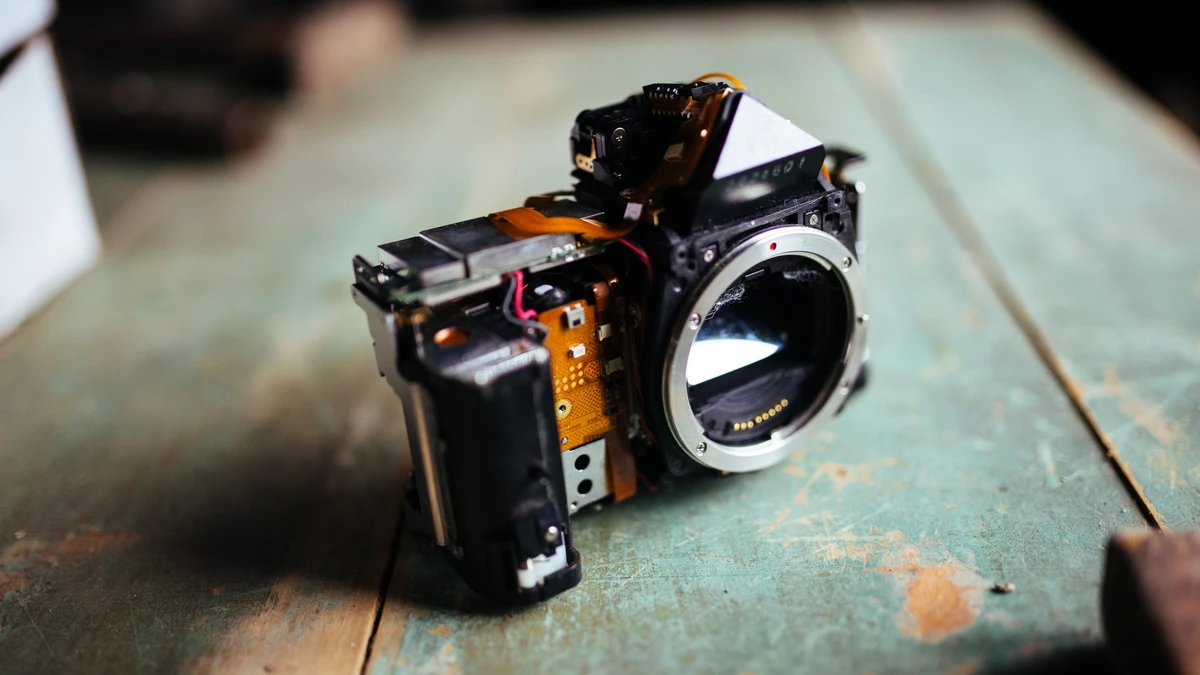
At $1,998, its price in early November, a Sony a7 IV drew a checkout offer at a major camera retailer: three years of protection for $119.99. Most buyers should decline it. The breakdown coverage largely repeats what the manufacturer and a good credit card already provide, and the one part worth paying for, accidental damage, only earns its price if your camera lives a rough life.
None of the big camera makers’ standard US warranties covers a drop. Fujifilm’s, for example, covers defects in workmanship and materials and says it may be voided by accident, impact, or exposure to liquid, and the Canon, Nikon, and Sony warranties are likewise written around defects in materials or workmanship. Accident coverage is the piece the checkout plans add, and the plan in that offer covers nothing but accidents until the maker’s warranty runs out.
What You Already Get for Free
Canon, Nikon, Sony, Fujifilm, and OM System cover a new camera or lens bought from an authorized US dealer for one year. Fujifilm’s US warranty spells out “one (1) full year” for cameras and lenses, Sony’s covers interchangeable-lens cameras and lenses for one year from purchase, and Canon’s covers EOS cameras for a year against defects in materials or workmanship. Fujifilm’s warranty does not apply to gear from unauthorized sellers, and Sigma won’t service gray-market lenses under warranty at all.
Panasonic is the outlier. Lumix cameras and lenses bought new from an authorized US dealer qualify for a three-year warranty once you register them with Panasonic, and purchases from Panasonic’s own store get four years. The free membership that comes with registration adds a loaner, when one is available, for repairs that run past seven business days, but nothing on Panasonic’s page mentions accidental damage.
Sigma covers registered new lenses from authorized US dealers for four years, and Tamron Americas covers its lenses for six. Since January 1, 2026, Tamron has also offered accidental damage coverage on new lenses: half off the repair bill for impact, liquid, or sand damage within the first six months, as long as you register the lens and opt in to Tamron’s email. On a Sigma or Tamron lens, the breakdown half of a four-year retailer plan duplicates the warranty you already have, so you would mostly be paying for accident coverage.
What the Checkout Plans Actually Sell
The retailer’s own plan, offered alongside the camera makers’ plans on Sony, Canon, and Nikon gear alike, is an accident plan run by a third-party administrator, sold in two-, three-, and four-year terms with no deductible, and you have 30 days from purchase to add it. In early November, it listed at $95.99, $119.99, and $155.99 on both the $1,998 Sony a7 IV and the $1,999 Canon EOS R6 Mark II, or 4.8%, 6%, and 7.8% of the camera’s price. The term starts the day you buy, and while the maker’s warranty lasts, the retailer says, the plan pays only for accidents. A two-year plan buys two years of drop coverage but just one extra year of breakdown coverage.
On the $996.95 Nikon Z 24-120mm f/4 S, the same plan was $71.99 for two years and $95.99 for three, or 7.2% and 9.6% of the lens price, so a lens pays a larger share of its price than a body does. Across those three items, a two-year accident plan ran 4.8% to 7.2% of the purchase price, and a three-year plan ran 6% to 9.6%. Total payouts are capped at what you paid for the item, and the plan ends once it replaces the item. It excludes loss, theft, and cosmetic damage, and its published terms also exclude gear put to heavy commercial, rental, school, or industrial use, so a camera that earns its keep may not qualify.
Camera Makers’ Plans Add Service, Not Just Coverage
One camera maker’s accident plan, which you can add up to 90 days after buying the camera, covers drops, spills, and power surges from the purchase date and breakdowns, including normal wear and tear, once the one-year warranty ends, with no deductible. Each year of coverage also includes one factory maintenance service, and the maker estimates its 18-point camera maintenance at $139. In early November, the same retailer listed that plan at $110.99 for two years and $219.99 for four on a $1,999 full frame body, and at $61.99 and $119.99 on a $1,399 zoom.
Two of those services at the maker’s estimate come to $278, more than the two-year plan costs, if you would have paid for them anyway. The plan is for personal use only, though, and its terms define commercial use as any non-residential use, including business, rental, and educational work. Coverage ends after one replacement for an accident claim, while a replacement for a breakdown or power surge keeps the plan running, up to a limit of two.
A second maker’s accident plan bundles one clean-and-check service a year, covering the sensor, viewfinder, focus, exposure, and shutter, with no deductible, while its breakdown-only version simply extends the warranty. For cameras and lenses, the maker’s FAQ allows up to 365 days after purchase to buy either one, but accident coverage waits 30 days unless you buy the plan with the camera. On a $1,998 body, the retailer listed the accident plan at $132.99, $170.99, and $211.99 for two, three, and four years.
A third maker’s plans run two or three years alongside its one-year warranty, must be bought within 30 days under its terms, and transfer to a new owner at no cost. Its accident version listed at $69.99 for two years and $79.99 for three on a $996.95 zoom, slightly less than the retailer plan charged on a lens at that price. Its terms exclude products used for rentals, and its accident coverage excludes theft and loss.
Your Credit Card May Already Double the Warranty
Many credit cards add a year to a manufacturer’s warranty at no cost. In the current guides from two large card issuers, the benefit adds up to one year and caps claims at $10,000 per item, but the details differ. One issuer’s guides, for both its travel and cash-back cards, apply it to warranties of three years or less and exclude items bought for resale, professional, or commercial use. The other issuer accepts warranties of up to five years and covers items bought for personal or business use, including a camera you use for paid work.
Both guides pay only for what the original warranty would have covered, so a dropped camera is out. They also limit how the benefit stacks with a plan you buy. The first issuer starts its extra year only after any store warranty or service contract ends, and it pays nothing if the manufacturer’s warranty and the contract together exceed three years. Its guides give a six-month warranty paired with a 36-month contract no extension at all. The second issuer starts its year after the longer of the warranty and any service contract, and its cutoff is five years.
Card purchase protection does cover accidental damage and theft, but only briefly. In the same two issuers’ guides, it runs 90 or 120 days from purchase, with per-item caps that range from $500 on some cards to $10,000 on others. If the a7 IV hits the pavement in its first three months on the right card, the card may cover it. After that, only an accident plan or insurance will.
What Repairs Cost When Nothing Covers Them
Nikon’s basic factory maintenance package, which includes a sensor cleaning, starts at $56.99. Independent repair shops charge about $50 to clean a full frame sensor. Cleaning is maintenance rather than a defect repair, so a plan that only extends the warranty won’t pay for it, while the two maker plans above with bundled services do.
One large independent repair shop starts any mirrorless body repair at $545 and any DSLR at $440, finishes standard repairs at that rate, and re-quotes if a major part is needed. Thom Hogan, who has long covered Nikon gear, wrote in a 2024 column that most repairs beyond the superficial cost $300 to $600 at Nikon USA, with image sensors and main boards pushing the bill higher. One EOS R6 owner posted a Canon estimate on Canon’s community forum in November 2025: $779 in labor plus $1,200 for a new sensor, or $1,979, close to the $1,999 an R6 Mark II cost in early November.
The same shop starts zoom repairs at $370 for lenses that top out below 70mm and $440 for those reaching 70mm to 199mm, then adds 40% when it diagnoses impact damage. That puts a dropped 24-120mm zoom at about $616 before any major parts. Shutter wear rarely enters the picture for hobbyists. Panasonic says the Lumix S1II shutter passed a 400,000-release durability test, and a Photo Review guide puts typical enthusiast DSLR ratings at 150,000 to 250,000 actuations. At 10,000 frames a year, even 150,000 takes 15 years.
The Break-Even Math on a $2,000 Body and a $1,000 Lens
A plan pays off when the odds of a covered claim, multiplied by the repair bill, exceed the plan price, so dividing the price by the bill gives you the odds you need. The retailer’s three-year plan costs $119.99 on the $1,998 a7 IV. Against that shop’s $545 starting rate for a mirrorless body, it breaks even if your odds of a drop or failure over three years top 22%. Against the $300 low end of Hogan’s Nikon USA range, you need 40%. Only a total loss brings the threshold down, to 6% if the plan’s like-kind replacement is worth the full $1,998.
The same retailer’s $95.99 three-year plan on the $996.95 Nikon Z 24-120mm f/4 S breaks even at 16% odds of a $616 impact repair, or 10% odds of an accident that destroys the lens outright. If you would put the chance of a serious drop over three years at one in five or higher, the plans are close to a fair bet. If you have owned cameras for a decade without one, they are not.
Without a plan, a card that adds a year gives the a7 IV two years of defect coverage for nothing. With a three-year plan, the first issuer’s three-year cutoff may wipe out its free year, while the second issuer’s guide would add a fourth year of breakdown coverage after the plan ends. With a four-year plan, the first issuer’s benefit is gone. Before counting on both, call the card’s benefit administrator and ask how it treats a plan that runs alongside the manufacturer’s warranty.
The Case for Buying One
The best argument for a plan is variance: a freelancer with one body can’t easily absorb a $1,979 sensor quote the week before a wedding, and a no-deductible plan turns that risk into a fixed $120. Heavy use changes the odds, too. Photo Review notes that a wedding or commercial photographer shooting 2,000 frames a week passes 100,000 actuations a year, so wear a hobbyist never reaches can arrive inside a three-year term. Even for hobbyists, the first maker’s plan includes factory maintenance worth more than its price if you would book it anyway.
Several of these plans exclude the buyers who need accident coverage most. The first maker’s plan bars all commercial use, the retailer plan excludes heavy commercial and rental use, the third maker’s plan excludes rentals, and the first card issuer excludes items bought for professional use. If you earn money with the camera, look for a plan written for commercial use, or price an equipment insurance policy. Insurance can also cover theft and loss, which the retailer plan and at least two of the maker plans exclude. SLR Lounge’s Photography Business Training System covers insurance and contracts in its first workshop, on building a photography business plan.
Who Should Buy, and Who Should Skip
Buy accident coverage if you shoot for pay, travel with your camera every month, or keep a body rigged on a gimbal, car mount, or slider, where a single $545 body repair costs more than four times the plan. Prefer a maker plan when you would use the annual cleaning, check the commercial-use clause before you pay, and match the term to how long you actually keep a body.
Skip it if you are a careful hobbyist, especially with a card that already turns a one-year warranty into two. On Panasonic bodies registered for the three-year warranty and on Sigma and Tamron lenses, whose warranties match or outlast most plan terms, a plan buys little beyond accident coverage. Be wary of breakdown-only plans when a card already adds a year, since they mostly pay for defect coverage you already have. Put the $120 in a repair fund instead, and it stays yours if nothing breaks.
The retailer plan above can be added within 30 days, and the three maker plans allow 30 days, 90 days, or a full year, depending on the brand, so you don’t have to decide at the register. The retailer’s plan terms do allow a waiting period of up to 30 days between buying a plan and the start of coverage. Put the Sony a7 IV or Canon EOS R6 Mark II on a card with extended warranty, and revisit accident coverage once you know how often the camera leaves the house.
Lead image by Shixart1985, CC BY 2.0. Source.


