



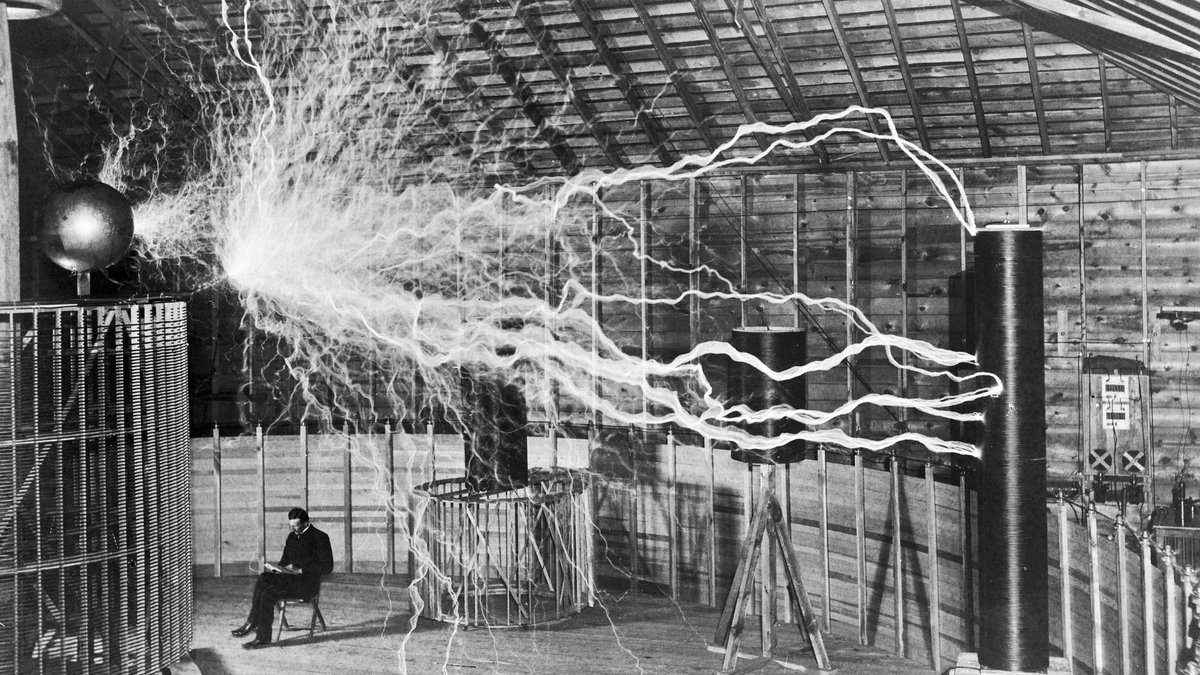
The print Nikola Tesla signed for the British scientist William Crookes on June 17, 1901, shows Tesla in a wooden chair in his Colorado Springs laboratory, reading. Above him, streamers of artificial lightning burst from the top of a huge cage-like coil and pour across the room to a tall coil on a stand. In handwriting across the floor of the picture, Tesla wrote, “To my illustrious friend Sir William Crookes of whom I always think and whose kind letters I never answer!”
Tesla was not in that chair while the sparks were flying. In his laboratory diary, published in 1978 as the Colorado Springs Notes, the picture is plate XII in a series made with a photographer named Alley in the last two weeks of December 1899. The discharge went onto the glass plate first, in the dark. Then Tesla took the chair, and flash powder was fired “to bring out my features.” On the plate made just before it, the man in the chair is Alley, and when the Century magazine printed that plate in June 1900, it ran with Alley removed.
Plates for ‘My Friends of the Century’
Tesla arrived in Colorado Springs in May 1899 to study wireless telegraphy and the upper atmosphere. The Colorado Springs Notes run from June 1, 1899, to January 7, 1900, and the entries from December 31 to January 7 are devoted almost entirely to the photographs. The Nikola Tesla Museum in Belgrade prepared the manuscript for publication, and Aleksandar Marinčić, who wrote its commentaries, counted 63 photographs described in the diary, most of which show the oscillator running.
The photographer appears in the diary only as Mr. Alley, and the Wellcome Collection in London catalogs him as Dickenson V. Alley. Tesla’s entry for December 31, 1899, lists 14 of the plates Alley made between December 17 and 31 and says they “were forwarded through him to my friends of the Century,” meaning The Century Illustrated Monthly Magazine in New York. The list under that heading runs through plate XIV, so it includes both XI and XII.
The Century was waiting on an article from Tesla. In 1902 testimony for a Patent Office interference proceeding, Tesla said the Century “began to press me very hard for completing the article which I have promised to them.” One of his friends there was Robert Underwood Johnson, the associate editor. In his 1923 memoir, Johnson wrote that they met in 1893 and “soon became intimate friends,” and he listed himself, Mark Twain, and others among the visitors photographed by the light of Tesla’s tubes in his New York laboratory.
Alley worked on 11-by-14-inch isochromatic plates, according to Tesla’s notes on the first plates in his list. A moonlit view of the back of the laboratory took an exposure of 1 hour 20 minutes. Of a daylight view of the building, Tesla wrote, “I conclude that the high quality of photographs obtainable in these parts is not so much due to the skill of the professionals as to the pure atmosphere and abundance of light.”
How Plates XI and XII Were Made
Plate XI shows sparks crossing the laboratory from the central coil to a second coil on a stand, and Tesla estimated their length at about 15 feet, possibly more. “The discharge was produced by 50 successive short closures of the switch, the experiment being, of course, performed in the dark,” Tesla wrote. Then the room was exposed for 10 minutes under an arc lamp, with the lens nearly wide open, while Alley sat in the chair.
“The picture of a human figure was introduced to give an idea of the magnitude of the discharge,” Tesla wrote of plate XI. For plate XII, the coil on the stand was moved farther from the central coil, and Tesla put the sparks at about 20 feet in a straight line. The switch was thrown 50 times again, and this time Tesla took the chair himself. “The procedure was slightly modified by setting off about 1/3 of an Eastman flash powder to bring out my features,” he wrote. The XII entry does not mention the arc lamp. Tesla wrote that the next two plates, XIII and XIV, followed the procedure used for XII, and a note after them reads, “open lens, arc light 5 min.”
The 1978 edition reproduces both plates. Its caption for XII calls it a repeat of XI “but with Tesla sitting in the chair,” and the plate matches the print Tesla later signed for Crookes, down to the looping streamer that arcs across the top of the frame to the coil on the stand. In plate XI, the seated man beside the central coil is Alley, in the same chair, with a different tangle of sparks above him.
Tesla preferred the arc lamp to flash powder for recording the room, writing that with it “the time can be closely determined in each case.” In his January 3, 1900, entry on plate XL, another picture made the same way, he explained why the sitter had to stay in the chair through the whole arc-light exposure, which ran five minutes in that case. Without that, he wrote, “the structure of the chair would show through the body of the person, if the same were exposed merely to the light of the flash powder.”
Tesla ruled out lighting the whole scene with flash. The large ball on the coil, he wrote, would have called for so much powder that using it was dangerous and would have hurt the quality of the photographs. The sessions ran late at night, when the weather was “most generally far below zero,” and neither Tesla nor Alley found a way to spare the sitter the cold wait in the chair.
Fifty Throws of the Switch
Tesla built the lightning on most of the discharge plates from many short bursts, closing and opening the circuit by hand while the lens stayed open: 50 closures for plates XI and XII, 100 each for plates VII through IX, and 200 for plate X. In the entry on plate XL, he put each closure at “approximately one half of one second, possibly less.” The web of streamers above the chair in the famous picture consists of those bursts, recorded one on top of another on a single plate.
Tesla worked the switch while Alley handled the camera. On plate IX, the longest streamers ran all the way to the walls. “One of them reached the photographer Mr. Alley in the corner of the building, while another one struck me as I was operating the switch in another corner,” Tesla wrote, adding that both were too weak at that distance to cause injury or pain. Of a third, he wrote, “Another one struck the camera but, as subsequently found, did not spoil the plate.”
Tesla put those longest streamers at 31 to 32 feet in a straight line and reckoned that their winding paths were probably more than twice as long. Streamers from pointed terminals had a reddish or purple tint, and he noted that “owing to their color and small luminosity they do not impress themselves upon the plate as powerfully” as the brighter discharges from larger surfaces. On plate XL, he wrote that the weakness of some streamers was “probably due to their red color.”
For plates of coils lighting lamps out in the field, made after sunset, the lamp was lit by about 100 throws of the switch while daylight was still reaching the plate. When the daylight was too strong, Tesla wrote, “Mr. Alley helped himself by covering the lens during the short interval when the lamp was not lighted.” One of those dusk plates, a coil in the field with the mountains behind it, ran in the Century as Figure 4, and the 1978 edition reproduces it from there.
What the Century Printed
The June 1900 Century, Vol. LX, No. 2, cost 35 cents and carried one line above its title on the cover: “Recent Discoveries by Nikola Tesla.” Tesla’s article, “The Problem of Increasing Human Energy,” began on page 175 under the line “Illustrated by the writer’s electrical experiments, now first published.” Its 10 figures show parts of the oscillator, coils responding to it, lamps lit at a distance, a boat steered without wires, and several big discharges. None of them shows a person, and no caption says how the plates were exposed.
Tesla’s December 31 list says plates XI and XII, with Alley and Tesla in the chair, went to the Century. Plate XII is not in the article. Figure 8, titled “Experiment to illustrate the capacity of the oscillator for producing electrical explosions of great power,” has the coil on the stand at plate XI’s distance, closer than in the signed print, and its streamers follow the same paths as those on plate XI, down to the kinked strands that reach the floor, so the figure is plate XI. Where Alley sat, the floor is a flat gray patch with no chair and no boards.
Captions on the famous picture often describe its arcs as 22 feet long. In the Century, the number belongs to Figure 8. The note under it says the discharge “escapes with a deafening noise, striking an unconnected coil twenty-two feet away,” and that sparks an inch long could be drawn from a water main 300 feet from the laboratory. In his diary, Tesla estimated the sparks on plate XI at about 15 feet, “possibly more,” and those on plate XII at about 20 feet in a straight line.
Tesla said little about the pictures in the article itself. The photographs in Figures 7 through 10, he wrote, “may serve to illustrate some of these features and convey an idea of the magnitude of the effects actually produced,” and he added, “The completeness of the titles of the figures referred to makes a further description of them unnecessary.” An unsigned editorial note in the same issue told readers that parts of his account were “little short of the incredible.”
What Tesla Wrote About the Posed Pictures
The line usually quoted as Tesla’s admission comes from his January 3, 1900, entry on plate XL, a different picture made the same way, with the sitter slightly behind the central coil. “I did not like this idea but some people find such photographs interesting,” Tesla wrote. “Of course, the discharge was not playing when the experimenter was photographed, as might be imagined!” His entry for January 4 records two more plates with Alley in the chair.
“The streamers were first impressed upon the plate in dark or feeble light, then the experimenter placed himself on the chair and an exposure to arc light was made and, finally, to bring out the features and other detail, a small flash powder was set off,” Tesla wrote of plate XL. For that plate, he recorded 50 closures of the circuit, five minutes of arc light at about half the full lens opening, and about a third of a large Eastman flash powder.
On June 17, 1901, a year and a half after he wrote that he did not like the idea, Tesla signed a print of plate XII for Crookes. The Wellcome Collection in London holds a glass-plate copy negative of that print, which its catalog dates to June 1956. Its catalog record credits the photograph to Dickenson V. Alley, the man who had sat in the same chair one plate earlier.
Lead image by Dickenson V. Alley, public domain. Source.


