



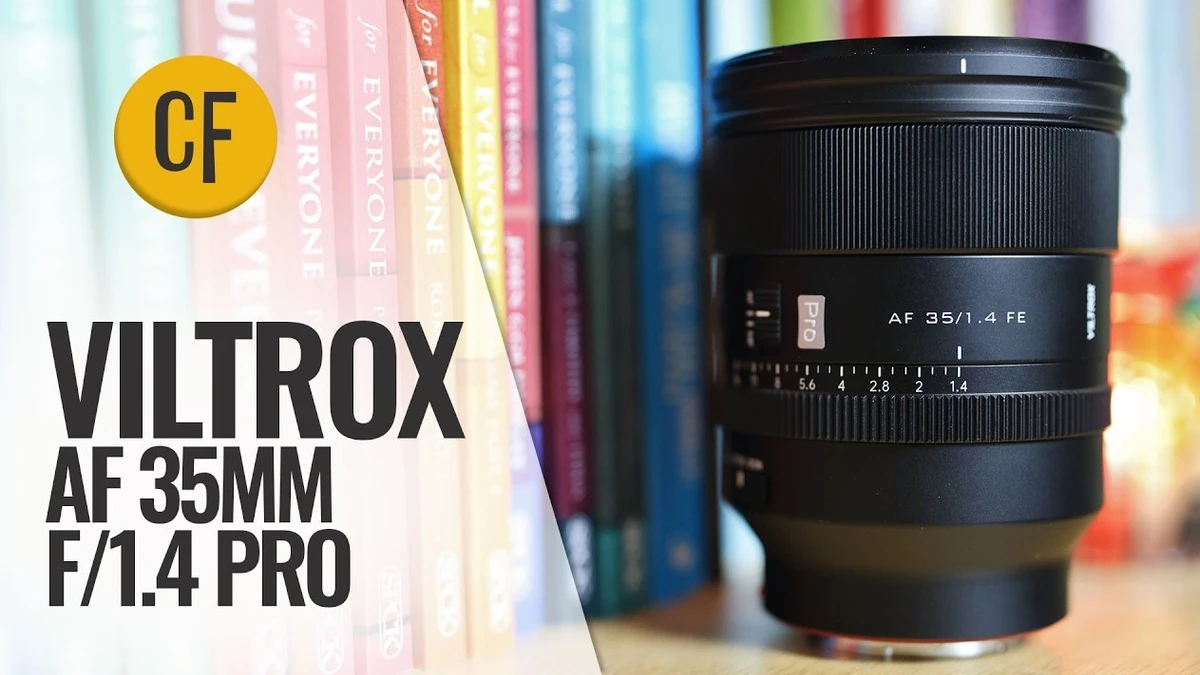
Viltrox’s new AF 35mm f/1.4 Pro costs $829 for Sony E and Nikon Z, which puts it below Sony’s own 35mm f/1.4 GM and above Nikon’s NIKKOR Z 35mm f/1.4. It’s big and heavy for a 35mm f/1.4, with a metal body, weather-sealing, and an aperture ring that switches between clicked and smooth.
Christopher Frost weighs the Viltrox AF 35mm f/1.4 Pro at 780 g for the Sony E version and 830 g for the Nikon Z version, which is heavy for a 35mm f/1.4. In return, you get a metal body with a smooth finish, a metal mount with weather-sealing around its edge, and a USB-C port built into the mount for firmware updates. The aperture ring clicks in third stops and can be switched to turn smoothly for video. The detent that moves it in and out of the “A” position is stiff, so you’re unlikely to bump it to f/16 by accident. Frost also notes that you can feel glass elements shifting slightly inside when you tilt the lens, a trait that’s become common enough that some Sony and Fujifilm lenses share it.
Optically, the headline results come from a punishing test body, the 61-megapixel Sony a7CR. At f/1.4, the center already shows very good sharpness and contrast. Stop down to f/2 and it turns razor sharp. Corners hold up well wide open, though they’re noticeably dark, and by f/2.8 they’re essentially as crisp as the center. Things change in the camera’s 26-megapixel APS-C crop mode, where the center is only okay at f/1.4 and the corners go soft until you stop down a few steps. Frost’s conclusion is that the lens is much more at home on full frame.
Viltrox built its name on affordable autofocus primes, many of them for APS-C cameras, and a metal-bodied full frame f/1.4 at this price shows how far the company has moved. The comparison points are no longer other budget brands. The Sony FE 35mm f/1.4 GM costs $1,498, and the Sigma 35mm f/1.4 DG DN Art has long been the default third-party pick on E mount. On Nikon Z, where outside autofocus options have arrived more slowly, a lens like this fills a bigger gap. A lens that’s sharp at f/2 on a 61-megapixel sensor will look even cleaner on a 24- or 33-megapixel body, because lower resolution hides small softness. Vignetting is a different story, since it shows up the same way at any resolution, so pay attention to that number regardless of your camera.
Autofocus is silent and accurate. In single-shot mode, it’s only average in speed, and continuous mode makes it a bit smoother and more decisive, though rival lenses focus faster. Manual focus through the metal ring is precise but a little slow to respond. Focus breathing is nearly absent, which is a real advantage for video. There’s no stabilization, the filter thread is 77mm, and a fairly deep plastic hood comes in the box. With corrections switched off, distortion is limited to mild pincushion, but the corners at f/1.4 are very dark and never fully brighten even at f/2.8, so leave peripheral illumination correction on. Minimum focus distance is 30 cm, and the aperture uses 11 blades. Frost runs both of those through dedicated tests, along with flare, coma, and bokeh.
Frost’s full test results are in the video above.