

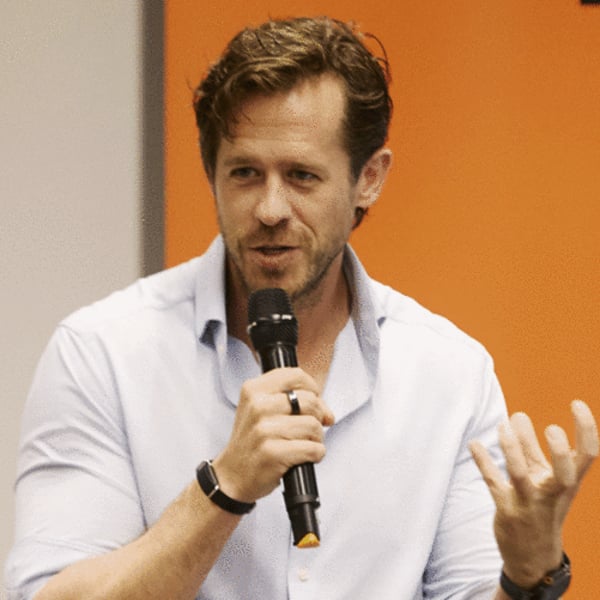
Zalando is currently celebrating the tenth anniversary of its Dublin ‘Tech Hub,’ an outpost dedicated to developing new technological solutions to enhance the platform experience. A decade later, this Irish initiative has been replicated in Helsinki, Zurich, and Stockholm. It is an opportunity for Robert Gentz, co-founder and co-CEO of the group, to discuss the potential of European innovation and the new capabilities unlocked by AI.
It was also a chance for the executive to revisit the reasons that led Zalando to establish a technical team in Dublin in 2015, three years before Zalando started selling in the country. “Our idea has always been to democratise fashion, to give equal access to it from southern Italy to northern Finland,” said Gentz. “But as we grew, our challenges became technological. At the time, we had around 200 engineers. We had to move up a gear to make an impact. And it also became clear to us that, to create a European solution, we couldn’t do everything from Berlin. And these hubs enable us to attract local talent who bring us more varied solutions for different challenges in different markets.”
With around a hundred employees, Zalando’s Tech Hub sits between Dublin’s old town and its port, on Windmill Lane, where industrial heritage and artistic creation mingle: it was on the very street Zalando chose that local rock band U2 recorded their first albums. The foundations of the windmill that gave the street its name still emerge from the ground at the heart of an atrium around which Zalando has recreated the ambience of its Berlin headquarters. Surrounding it are the offices of other major players such as Google, Meta, Airbnb, X (formerly Twitter), and Microsoft, attracted in particular by the low corporate tax rate (12.5%), substantial tax credits for research and development, and an extensive network of tax treaties with over 70 countries.
“Ireland, as you know, has faced difficulties at times, but has managed to recover with growth and a positive mindset,” said Gentz, speaking to a handful of European journalists, as he addressed the proliferation of regulations governing the activities of large companies, particularly in online retail. “I think we probably need a bit more of that Irish spirit across the European Union. We create a lot of regulation here in Europe. And, to a certain extent, regulation is necessary. But to what end? What Europe needs most is a positive vision of why we’re creating this innovation.”
For the co-CEO of Zalando, who recalled starting out selling flip-flops from a basement, the emergence of other big companies like the German group should be at the heart of the European regulatory project. “We simply have to create more globally competitive European companies. This mentality of creating regulations to strengthen Europe’s competitiveness is, in my opinion, essential. We have everything we need in Europe for very strong growth. But I think that regulation should rather support the development of European competitiveness and help companies to be more competitive, not the other way round.” Without naming them, Gentz alluded to competition from major non-European players, notably Chinese firms, in response to which the European Commission is currently working on the Digital Fairness Act, expected by the end of the year. But for the Zalando co-CEO, beyond the simplification of rules pursued by Brussels over the past two years, the question of enforcement already arises.
“The same rules should apply to everyone operating in Europe, but in practice they are not always applied uniformly,” lamented Gentz. “In practice, it can be more difficult for European companies to scale than for companies coming from outside and operating in the European market, because of differences in how the rules are applied and enforced. This mentality needs to change. For example, imagine if China created regulations designed to make it harder for Chinese companies, but not for companies operating from outside China. A mentality that creates competitive advantages for European companies and makes them competitive on the global stage is my wish for the future.”
AI and agentic commerce
This future will largely be shaped by artificial intelligence, and the agentic commerce it enables. For Zalando, this revolution is embodied mainly in the personal assistant integrated into the platform and its mobile app, enabling the company to offer ever more finely tuned recommendations. AI also makes it possible to tailor suggestions for related products to each customer and to the most popular trends.

But what are the system’s limits today? Can you set a price cap, specify certain materials, exclude particular sizes or request the highest-rated items? “The assistant applies some of the filters you set on the platform, but not all the things you mention are possible yet,” Shauna Moggan, lead designer for Zalando Assistant, told FashionNetwork.com. “There are things we can’t talk about yet, but you can imagine them,” smiled Mike Mulligan, product director responsible for the e-commerce platform.
For Robert Gentz, it’s about adapting to every customer journey. “If you have a pair of brown trousers and you want to find an item that matches perfectly, it’s very difficult to do so in traditional e-commerce, because it’s an atypical request. An agentic approach, on the other hand, offers easy access to all matching trousers and shoes,” noted the executive.
“So for us, the ultimate goal is to create this system to make it, in a way, your own life companion, with whom you’re prepared to share a lot of information, because you know it will really help you in a positive and relevant way,” he continued. “As a European company, we really have the opportunity to create such an experience here at the heart of Europe, because we actually have a lot of data that customers have shared- if we harness the data flows correctly.”
Returns, sizes, and fits
These data flows are used in particular to tackle one of the bugbears of online retail: returns. This is particularly true for a platform founded in Germany, where the cost of returns has historically been borne by online retailers. For Zalando’s co-CEO, questions of size and fit are “the Holy Grail” of fashion retailing.

“Nobody likes returns: neither the customer, who has to go back to the post office to have a return processed, nor us, because it’s expensive and increases environmental impact,” stressed Gentz. “But some of the causes are solvable, including size and fit. A product isn’t always as you imagine it, and that’s where technology can help. When a customer makes a return, they give us their reasons, and over time this creates a dataset which makes it possible, for example, to determine that two customers have a similar body shape. And so, if one of these customers kept a given size (i.e., did not return it), we know we can suggest the same size to the other. This dataset, built up over time, has- particularly over the past 18 months- really helped to bring down return rates.”
In terms of fit, Zalando can rely on Fision, the Swiss body-scanning specialist acquired by the Berlin-based group in autumn 2020. This solution allows customers to create a body profile from photos to refine sizing and carry out virtual try-ons.
“It’s another way of limiting returns, and around one million have already done so, with around 20,000 new users doing so each week,” said Gentz, who is otherwise tight-lipped on figures ahead of the publication of first-quarter results on Wednesday. After returning to growth in 2024, Zalando recorded turnover of 12.3 billion euros in 2025, up 16.8%, compared with 14.7% for sales volume, which reached 17.6 billion euros.
This article is an automatic translation.
Copyright © 2026 FashionNetwork.com All rights reserved.
