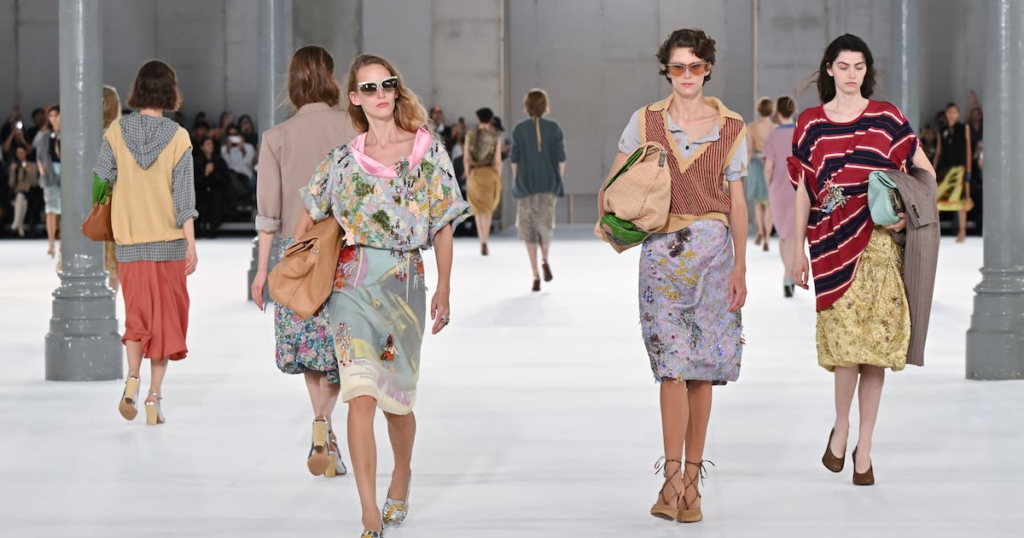




US company Marquee Brands stepped into the European spotlight last week by acquiring a majority stake in Roberto Cavalli. It marks a major coup for one of the industry’s rising players specialising in the acquisition and management of intellectual property. Founded in 2014 by asset management giant Neuberger Berman, which manages no less than $560 billion globally, Marquee Brands today manages a portfolio of 22 brands (including BCBGMaxAzria, Bruno Magli, Ben Sherman, Anti Social Social Club, and Laura Ashley), generating around $5 billion in retail sales. To relaunch the Florentine house, the American group has assembled a strategic tripartite structure: Dubai-based developer Damac, which retains a significant stake to develop the lifestyle and hospitality space, and Milan-based specialist The Level Group (TLG), responsible for fashion operations and distribution. CEO of Marquee Brands since 2024, Heath Golden answered FashionNetwork.com’s questions to shed light on this acquisition and the realities of their fast-growing business model.
FashionNetwork.com: Marquee Brands recently acquired a majority stake in Roberto Cavalli alongside Damac Group and operator The Level Group (TLG). While the amount of the transaction remains confidential, how is the governance of this partnership between New York, Dubai, and Milan structured in practical terms?
Heath Golden: Marquee Brands steers the brand’s global strategy and ensures its expression is consistent across all categories and consumer touchpoints. TLG manages the core fashion business thanks to its deep expertise in design, production, distribution and retail, while DAMAC brings its know-how in prime real estate and luxury hospitality experiences. All initiatives are underpinned by the creative ethos and design DNA that have defined Roberto Cavalli for over 50 years, ensuring total cohesion from catwalk shows to lifestyle categories and residential or hotel projects.
FNW: Roberto Cavalli has experienced a fragile financial trajectory and several changes of ownership over the last 10 years. What do you think was lacking in the strategies applied to Cavalli, and how is your brand management model better equipped to relaunch this house?
HG: We chose Roberto Cavalli because the brand’s fundamentals are exceptionally strong: an iconic visual identity, a genuine luxury heritage and global recognition that very few brands possess. The issue was never brand desirability, but the traditional operating model that surrounded it. Previous strategies relied on a vertically integrated approach, which can be capital-intensive and less flexible in today’s luxury environment. Marquee’s model is designed precisely to address that. We bring rigorous management, a global licensing and distribution platform, and the ability to align the brand with the best operational partners by category and region. This enables Cavalli to pursue a more focused, strategic and asset-light path, protecting its luxury positioning while fostering long-term global growth.

FNW: Your business model is largely based on delegating operations. What exactly is the role of your in-house teams on a day-to-day basis? Are they just contract managers?
HG: Our role goes far beyond mere brand stewardship on paper. Marquee actively drives global strategy, including positioning, category expansion, distribution, partner selection, 360-degree marketing across all channels, and digital optimisation. We collaborate closely with our operational partners and remain deeply involved in product direction, brand expression and the overall customer experience.
FNW: By entrusting manufacturing and distribution to third parties, how do you ensure the uncompromising quality inherent in luxury? Additionally, how are operational and legal responsibilities divided, and what happens if a partner underperforms?
HG: We work exclusively with best-in-class partners; in the case of Cavalli, we have built a network of recognised experts in luxury design, manufacturing and distribution. Quality and brand standards are embedded in every partnership, with clear parameters and expectations covering product and distribution strategy. In this model, responsibilities are clearly delineated rather than diffuse: operational partners assume responsibility for manufacturing and execution, while Marquee oversees brand standards and quality requirements. If a regional partner falls short of commercial or operational targets, we have clear governance rules and contractual remedies to step in early, correct course and protect the brand with rigour so that its integrity is never compromised.
FNW: The brand management sector is dominated by major players such as Authentic Brands Group (ABG) and WHP Global. Beyond your current size (22 brands and around $5 billion in retail sales), how does Marquee Brands differ from its competitors?
HG: We share a similar model, but Marquee’s DNA is unique. We operate with a highly disciplined, brand-centric approach, prioritising long-term brand value over rapid, large-scale expansion. We drive global strategy in-house, with dedicated design, creative, marketing, and public relations teams that lead positioning and storytelling to ensure consistency in every market and category. The partnership with Cavalli is a perfect embodiment of this model: bringing together the sector’s leading operators under a unified strategy to support thoughtful, long-term growth. We are seeing strong momentum across the portfolio thanks to this approach, notably the exceptional growth of heritage brands like Laura Ashley since our acquisition in January 2025.
No standard playbook for acquisitions
FNW: What are your specific development objectives for Roberto Cavalli over the next three years? Does this acquisition presage a broader buying cycle targeting other independent European luxury houses?
HG: Cavalli will grow by combining Marquee’s business model with Damac’s expertise in luxury real estate and hospitality, extending the Cavalli experience in key markets around the world in a considered and exclusive way. Luxury has long been a strategic focus for Marquee; the acquisition of Cavalli is a continuation of this strategy, not a pivot. However, this transaction reflects our internal discipline rather than signalling a generalised buying cycle. It underlines our confidence in seizing growth opportunities when iconic brands align perfectly with our platform.
FNW: Do you intend to finance your next acquisitions independently, or is the joint venture model with regional giants like Damac your preferred approach? What role does Neuberger Berman play in financing the next phases?
HG: With Cavalli, the combination of Marquee and Damac made perfect sense, given the brand’s positioning and potential. We do not approach every acquisition from a single angle; we structure transactions in the way that best serves the brand, and this deal is an example of that agility in action. In terms of our financial structure, Neuberger Berman is Marquee’s financial sponsor, providing robust, long-term support for our growth. We adopt a rigorous, opportunity-specific approach. More broadly, we remain focused on long-term value creation and do not comment on future plans for fundraising, recapitalisation or an IPO until they are publicly announced.
This article is an automatic translation.
Click here to read the original article.
Copyright © 2026 FashionNetwork.com All rights reserved.