


b. 1946, Los Angeles; lives and works in Los Angeles
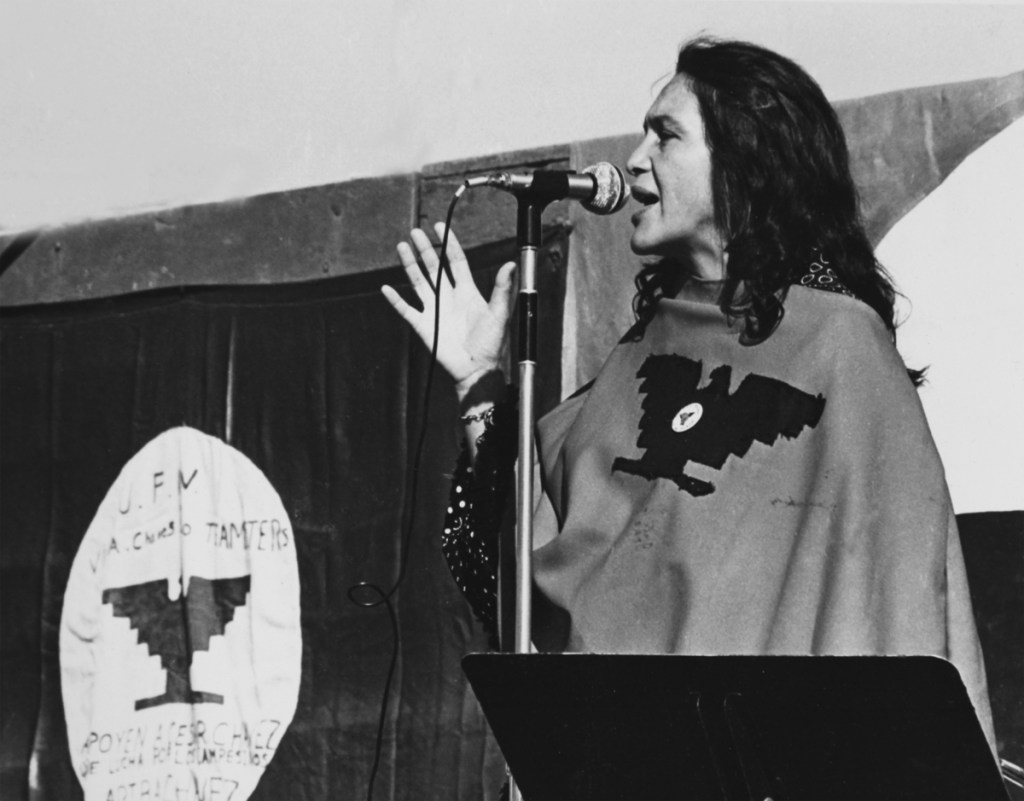
Early on in the movement, Dolores and I would have been present at similar things, marches and organizing events in support of the United Farm Workers. I was also at La Paz working at one point [around 1974] to produce a big mural that Carlos Almaraz had designed. I remember painting a section that said, “No More Sweetheart Contacts,” and that piece was used for a march to Sacramento. The making of that giant canvas was the first time I went to La Paz. I might have met her then, but I knew her from a distance for a while. I can’t quite remember when I started to have more personal contact with her.
At a certain point, I had a chance to speak with Dolores at length, and she told me that she was not given the credit that she was due as a cofounder of the United Farm Workers and for the work that she had done. Of course, I understood that because I had struggled myself with the dominance of men within the mural movement and the Chicano movement, and in the art world as well. So, when I started working on Arch of Dignity, Equality and Justice (2005–08), which is a 25-foot arch on the campus of San Jose State University, I decided when I was going to put Dolores in the front of the monument—that she would be the dominant figure, not Chavez. I depicted her in a thoughtful way: One of her hands is outstretched, saying, “Join me,” and is welcoming, and the other hand is a fist. In other words, she was both those things simultaneously. It is a depiction of her in leadership role, coming up out of the fields. From that point on, when I was making something historical, I looked to Dolores as a way to represent the power of a Chicana organizer and a model for us in social activism. In a sense, she was a hero for me over and over again.
She had the most amazing energy I ever experienced—never tiring. Not only that, but you could end up dancing all night with her. I remember staying up until three in the morning with her listening to music at Burning Man in the tent. I have a fabulous image of her in a dust storm there. I couldn’t even get out of the car; it was so horrible. I put my head out and I was choking, and there she was standing there laughing. I thought, How did she get that tenacity, that resilience? It must have been from being out in the Central Valley and having dealt with bad conditions like that in the field. So that to me was a real image of her resilience and her capacity to withstand any storm.
In Gente del Maíz (2012) for the Miguel Contreras Learning Center, you see Dolores in the fields [on the left] with a bullhorn. That comes from a story that Maria Elena Durazo [then executive vice president of the national AFL-CIO Executive Council] told me about how Dolores had called Miguel Contreras to join the United Farm Workers. Later, of course, he joined the United Farm Workers and led the Delano Grape Boycott in Canada. I wanted to indicate that here was this young man, Miguel, who didn’t have a plan to become an activist. It was through Dolores’s encouragement that he joined the movement, and he became a critical figure in it. The central image is an ear of corn with three figures: a young Miguel drops soil, another drops kernels in the soil, and the other is watering the soil. Out of these planted corn kernels come community organizers. I was talking about how there’s the planting of people, the nurturing of souls that become engaged in in a passionate commitment to social justice. I think that’s what Dolores models for us repeatedly: a lifelong commitment to social justice. That’s something important for young people to learn, because they often don’t have an understanding of what it takes to commit a life to creating change. I think more young people need to learn activism is something that you put your body on the line. Dolores was arrested around 25 times, and she was beaten almost to death in San Francisco by the police and they ruptured her spleen. Dolores put her body, her heart, and her spirit into the movement.
In Seeing Through Others’ Eyes (2010), she is there between Chavez and Robert F. Kennedy leading the crowd, while these two men break bread. It’s important to say that we can’t let the discussion of Dolores Huerta focus on her being victimized by Cesar Chavez. It cannot be about that because that’s a diminishment of her character. She was much larger and much more powerful than simply a rape victim.
Dolores was a model, not only training young people to become activists but also she’s a model for standing up against the most powerful forces. I don’t think I can think of a person who can replace her or that can equal her contributions. She’s the Chicana icon, and she will be sorely missed. She was one of the greatest leaders we’ve had.