


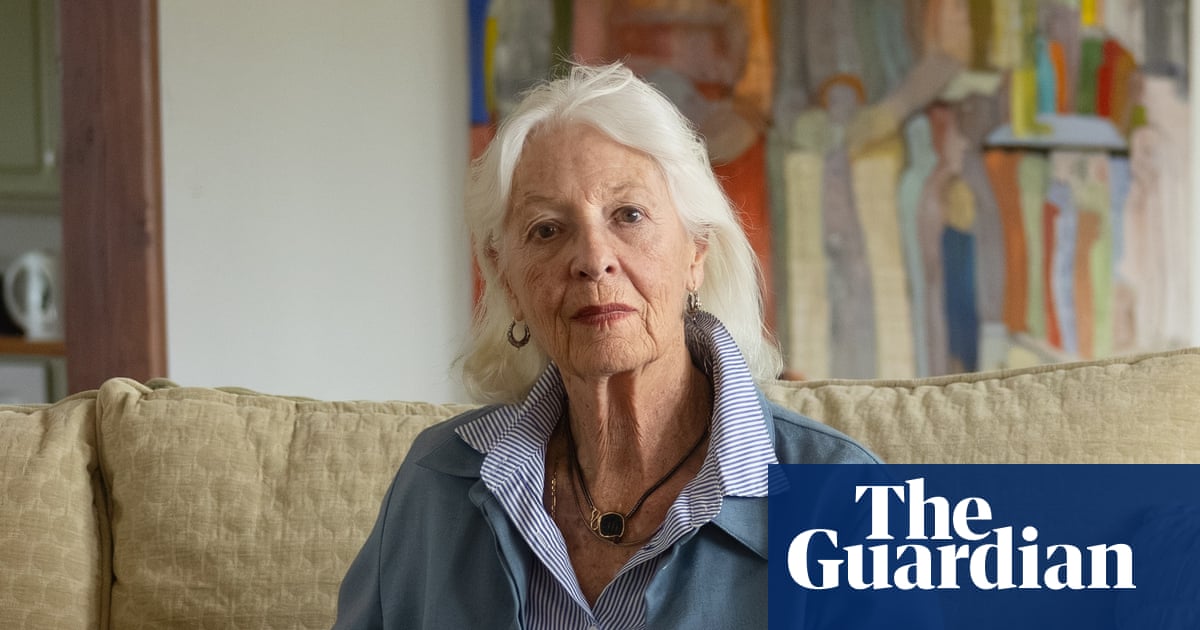
Jane Alexander will never forget the play that won her a Tony award, a husband and her first film role. The Great White Hope, which ran on Broadway from 1968 to 1970, was based on the life of Black boxer Jack Johnson, who in 1908 became world heavyweight champion in segregated America. Alexander played Eleanor, a white woman married to an African American boxer also called Jack, at a time when interracial marriages were still illegal in many states.
Decades later, when the play opened, the US supreme court had only recently struck down all remaining bans – and Alexander received hate mail and death threats for the role.
The play also attracted a famous fan: the boxer Muhammad Ali. He came to watch it several times, says Alexander. “He said, ‘This is my story, all except that white chick,’ Alexander remembers. “And in many respects it was.”
The previous year, after refusing to be drafted to fight in the Vietnam war, Ali had been stripped of his world heavyweight boxing title and banned from boxing. The few times Alexander saw him, Ali seemed “hurt and angry – rightly so”. She remembers watching him once, unseen by Ali, after the show. Everyone else had left, except the stage doorman, and Ali wandered out on to the stage. He reprised the end of the second act, in which Johnson thunders “in a Hungarian train station thousands of miles from home, ‘You want me? You come and get me. Here I is. Here I is. Here I is.’ And that’s what Muhammad Ali did. ‘Here I is, here I is, here I is!’ to an empty house.” He walked off the stage but Alexander hadn’t “moved an inch. I was left stunned how much it meant to him. Beautiful.”
In 1970 a film adaptation of the play was released. The following year Alexander’s performance earned her an Oscar nomination and, although she lost to Glenda Jackson, her career was set.
The next 60-odd years saw a wealth of film roles: All the President’s Men, Kramer vs Kramer, Testament. Interesting modern TV roles: last year, she had a guest role in Apple TV’s dystopian thriller Severance. And a lot of theatre, still her passion. “I love being in a room with musicians or actors, the collective experience,” she says.
Now 87, Alexander is speaking via video from her home in Canada, where she has lived for nearly 30 years. She also spends half her time in an experimental retirement complex on a college campus in New York, where the residents can take courses and mentor students. “I’m the only actress, but there’s plenty of lawyers, doctors,” she says. It’s working so well, with “so many cognitive and physical experiences going on”. ”Hardly anybody’s died in three years,” she adds. “We have people going into their late 90s and 100s. We’ve filled up all the places, and nobody new’s coming in.”
When she’s in Canada, she is mostly outdoors. She walks her dog, sees friends. Birdwatching is her great love. “I’m out every single day birding,” she says. One of her current projects is working to prevent bird collisions, most of which are from striking windows and glass buildings. Such strikes may kill more than 1 billion birds in the US alone each year. But, she says, “it’s pretty exciting because it’s all human-made, and so we can fix this problem”.
Alexander has many good stories and is writing a memoir. But some of the best ones predate her. Her grandfather, Daniel Quigley, was a doctor whose patients included William Cody, the wild west showman known as Buffalo Bill. Quigley was interested in the use of radium to treat cancer, and established one of the first radium hospitals in the US. He obtained two chunks of the element from Marie Curie in Paris. “My grandmother had half of her brain removed in her late 40s – I think because they kept the radium in the icebox in the kitchen.” Quigley lost a finger to it.
When he died, Alexander inherited his unused radium. What did she do with it? “I buried it. I didn’t know what to do with it. I probably should have given it to the Soviet … Smithsonian,” she says, course-correcting her Freudian slip to refer to the US museum and research organisation rather than the Soviet Union.
We’d just been talking about Testament, the 1983 film in which she plays a mother dealing with the aftermath of a nuclear attack on the US. It was made at a time of prolonged cold war anxieties. More than 40 years on, the “Doomsday Clock”, set by the Bulletin of the Atomic Scientists, is set at closer to catastrophe than at any other time in its history, due not just to the nuclear risk; it also includes the huge threats of the climate crisis and AI. “I just know that the proliferation of [nuclear weapons] around the world isn’t a good thing,” says Alexander. “Somebody’s going to use it some time.”
Alexander was born as the second world war started, and grew up in a Boston suburb in a medical family. When her father, a surgeon who had been away treating wounded British soldiers, came back, he took her to the ballet. “I just sat there, gobsmacked, out of my mind. I didn’t even dare speak because it was all so new to me, and I said to myself, ‘I want to be there. I want to be up on that stage.’” It was the colour, the movement, she thinks. “We had nothing during the war. We didn’t go to the theatre. We made our own little things up, but it was nothing professional, and high professional art is something that gives me chills still to this day.”
By her 20s, Alexander was forging a steady stage career, until The Great White Hope sent it rocketing. Her next film was a western, A Gunfight, starring Johnny Cash. “My gosh, what a man!” says Alexander. She became close to Cash’s wife, June Carter, who would bring their baby son to the set.
Carter once asked Alexander to accompany them to one of Cash’s famous prison concerts. “She said as ‘eye candy’.” Carter “was nursing the baby and was wearing long dresses. She wanted me to wear a miniskirt that was in style for younger women, and at that time, we did not wear bras. Believe it or not, this was part of the feminist movement. Be liberated, take your bra off. What was that about? All it did was attract the guys more.” She laughs. Carter introduced Alexander on stage to 4,000 maximum security prisoners. “There was an incredible roar. I couldn’t wait to get off the stage,” she says. “Then out [Cash] came, and there was huge applause, cheers.”
It must have been tricky to be an actor in the 70s and 80s, when sexual harassment was blatant. Alexander was aware of it, but says she didn’t feel threatened. When she was about 12, she says, her father taught her how to knee men in the balls if they came on to her. Alexander only had to do it once, with someone backstage at a theatre. “It worked like gangbusters,” she says. But the “casting couch” was a fairly overt part of the industry. “I said no thanks. A couple of times, I just laughed at them. But other actresses had problems.” She says some made the decision to use what they had to “to get their career going, and that was OK with me too. For many of them it worked. For those who are more vulnerable, I understand it does not work, and I’m glad the #MeToo movement happened. It had to come out in the open.”
In 1993, Alexander became chair of the US’s National Endowment for the Arts, the organisation that provides federal arts funding, after being nominated by President Bill Clinton. This was a time when there was immense pressure from conservatives to shut the body down, amid controversy about what art its funds were supporting. “It was a very difficult time,” she says. A few years earlier, there had been protests against grants for exhibitions featuring work by the controversial photographer and artist Andres Serrano, and particularly his photograph Piss Christ, which appeared to show Jesus on a crucifix submerged in urine. Then there was controversy around an exhibition of work by photographer Robert Mapplethorpe: “homoerotic, for the most part, pictures”, says Alexander.
She was, she says, “inheriting a volatile situation. I wanted to reach the American people, so I went on the road.” In just over a year, she visited 200 towns and cities in all 50 states, reminding people that art was for them, not only for the elites, and “in their backyard”. The organisation was set up, she points out, “to create expansion of the arts away from the big urban centres. It was so that every place in the United States of America could have art, or exposure to art.”
Public arts funding is always under threat – certainly in the US, where in Trump’s first term he proposed cutting all funding. Since last year, executive orders have restricted the use of federal funding for art that promotes diversity, equity and inclusion. Losing money, says Alexander, means “we lose a lot of people able to be exposed to art, and do their art”.
Individual artists, she says, “can’t be kept down. They will find a way to do art.” But the big arts companies, the symphony orchestras, “the more complex art, the individual art that needs help, those will be very tough to bring back. They should be part of a civil society everywhere in the world. But of course they’re not.” The arts will become only accessible to the wealthy. “That’s exactly what’s happened. Look at the price of things, the price of theatre tickets.” She gives the example of Broadway theatre: “It’s profit-making and tickets have gone absolutely bananas.”
No long, rich life is without grief, and Alexander has survived some crises. She and her husband, the director Ed Sherin, were married for more than 40 years and had four sons between them, until his death in 2017. In the early 90s, they were embezzled out of most of their money by their accountant. Then to lose Ed after decades together was, she says, “very, very hard. But he’s still very much right here. We talk about him almost every day in my family.” He was, she says, “a huge, generous soul,” and she misses him all the time. “But you just get on with life. Everybody tried to set me up with other people, but you can’t follow an act like that. I will be single the rest of my life.”
In 2015, her son Jace Alexander was arrested for possessing images of child sexual abuse; he was convicted the following year. The family got through it – including his wife Maddie Corman, an actor, who created a one-woman play about surviving betrayal and shame – by prioritising “support, and love”. Alexander took the view that her son was “sick”. She adds: “I’m not for one minute condoning it.”
This year, Alexander played the leads in two films – as a former CIA agent who spies on her neighbours in the comedy drama Lillian, Next Door, and in a Canadian film, Clara and Vanessa, as a woman married to a retired concert pianist who has dementia. “I loved it because it is so beautifully written,” she says. It was a change from most of the roles she started being offered once she turned 60. “You play judges, you play Alzheimer’s victims,” she says.
Alexander has no plans to retire, but she regrets that work cuts into her birdwatching. “There are two things that are incontrovertible to my mind: one is art, the other is nature,” she says. Both need our protection. “Those two things we can collectively praise and adore, and ask for in our lives. All people, everywhere.”