



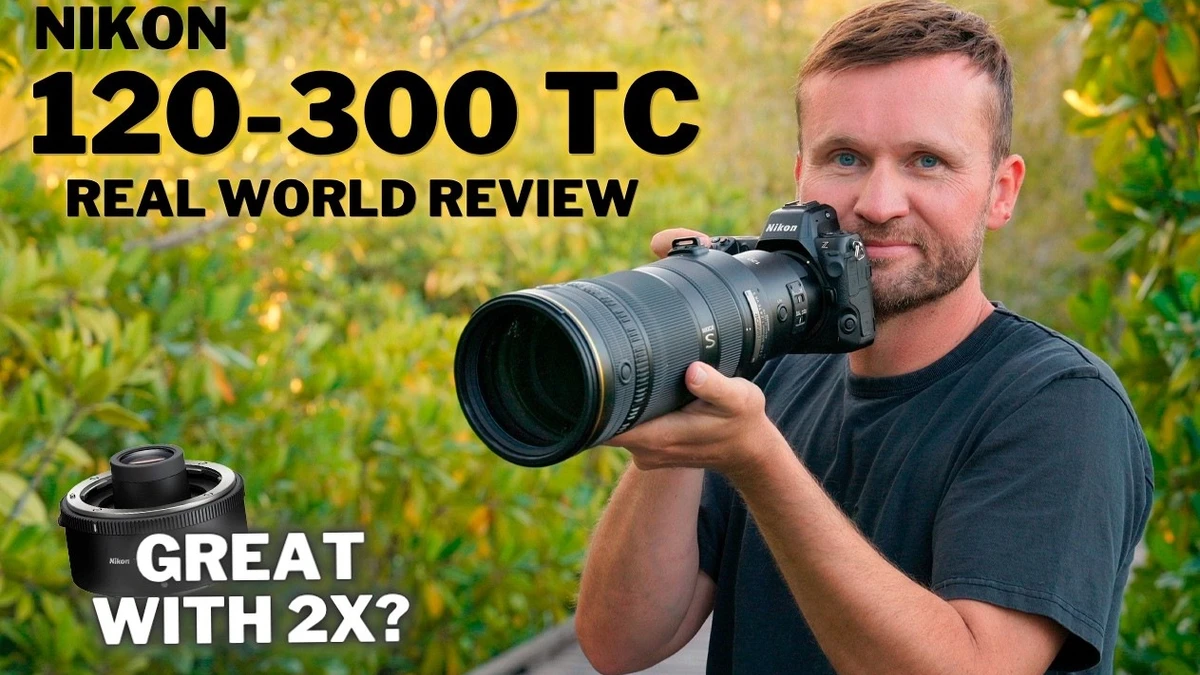
Nikon’s NIKKOR Z 120-300mm f/2.8 TC VR S costs almost $14,000 and weighs more than 6 pounds, which puts it much closer to a big telephoto prime than a handy second zoom. With an f/2.8 aperture and a built-in 1.4x teleconverter, it’s built to cover low-light wildlife, sports, and safaris with one lens.
Jan Wegener mounted the NIKKOR Z 120-300mm f/2.8 TC VR S with a Nikon Z Teleconverter TC-2.0x on a Nikon Z8, turning it into a 240-600mm f/5.6, and spent time with bee-eaters digging nest holes. The stabilization stood out immediately, and Wegener ranks the pairing among the best he has used. Focus stayed quick with the 2x attached, and wide open at f/5.6, the files held detail on perched birds and in flight. In his testing, that gives it an edge over the Canon RF 100-300mm f/2.8L IS USM, which needs to be stopped down at least a stop with a 2x to match. Flicking in the built-in 1.4x on top of the external converter pushes the reach to 840mm. Image quality takes a hit there, yet a white-headed pigeon against a black background still came out with surprisingly crisp feathers.
Plenty of lenses look good in bright sun, so the harder test happened in a dim Australian rainforest. Wegener was there for bowerbirds, but a noisy pitta showed up first, hopping onto a log right in front of him while he was nursing a sting from a stinging tree he hadn’t noticed he was sitting beside. The background was close and cluttered, and f/2.8 still pushed it into soft blur. More useful was the ISO: he stayed between 3,200 and 6,400, where other lenses in the same spot usually force him to 6,400 to 12,800 or higher. A satin bowerbird surrounded by the blue plastic it had collected proved far tougher, with the Z8’s autofocus repeatedly jumping past the bird onto the high-contrast bower behind it. Wegener is clear that the lens wasn’t the problem, and he only got the shot hours later.
Built-in teleconverters began as a specialist feature for working pros, first on Canon’s EF 200-400mm f/4L IS USM Extender 1.4x in 2013 and then on Nikon’s AF-S NIKKOR 180-400mm f/4E TC1.4 FL ED VR in 2018. Both were built for shooters who couldn’t stop to swap glass mid-play. Nikon has since made the feature standard on its biggest Z telephotos, including the NIKKOR Z 400mm f/2.8 TC VR S and NIKKOR Z 600mm f/4 TC VR S, and this zoom moves the idea down to a range that starts at 120mm. One extra stop of aperture lets you halve your ISO at the same shutter speed, and in the shadows of a forest, the jump from ISO 6,400 to 12,800 is often where fine feather texture starts turning to mush and noise reduction starts smearing detail. Wegener’s bowerbird flight shots show it plainly: freezing wings at 1/4,000 s in that light usually means ISO 25,600 or higher, and he mostly stayed at 6,400. When you weigh any fast telephoto, ask how often you shoot where that stop decides whether you get a usable file.
Size is where the lens asks the most of you. At 2.75 kg, it weighs only about 200 g less than the 400mm f/2.8, so handholding it for long stretches will wear on most people, though the Arca-Swiss style foot makes tripod work easy. The built-in converter also creates a decision you may never have faced. Between 168mm and 300mm, you can reach the same focal length two ways: at f/2.8 with the converter out, or at f/4 with it engaged. Each time a subject moves closer, you have to choose between zooming back, flicking the converter out, or doing both. Leaving it in and zooming back is quicker for fast action in good light, at the cost of the extra stop the lens is built around. Wegener also argues that if you plan to keep a converter on all the time, the NIKKOR Z 400mm f/4.5 VR S gives similar reach and aperture for a fraction of the cost and size.
Wegener’s verdict on whether he’d buy one is in the video above.