

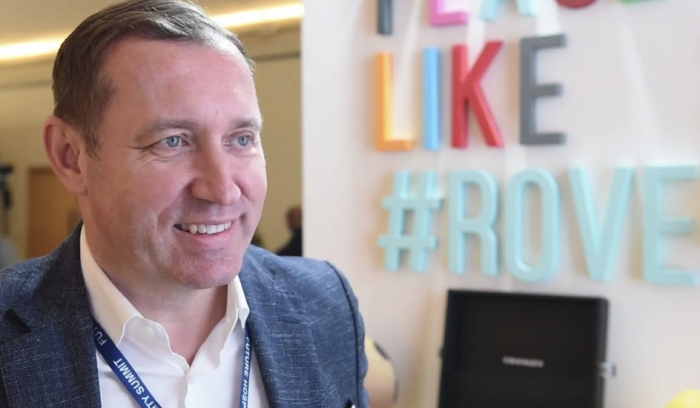
Rove Hotels was created to fill a gap between conventional budget accommodation and design-led lifestyle hotels. The rooms were efficient, the public spaces social and the tone informal. Paul Bridger has been closely involved in translating that concept from one Dubai opening into a growing regional business.
Bridger joined Rove in 2016 and became chief operating officer in 2021. He brought more than two decades of hospitality experience across the Middle East, Asia, the UK and Ireland. That career gave him exposure to both international brands and the operational realities of building a new proposition from the ground up.
He joined shortly after the first Rove properties began operating, when the brand still needed to prove that its informal tone and compact design could generate repeat demand. Bridger helped turn the founding concept into routines that teams could reproduce across locations: simplified food and beverage, communal work areas, technology-enabled service and a staffing model intended to remain efficient without feeling impersonal.
The operating model has continued to evolve. Rove JBR added a beachfront location, while the Rove Home developments moved the brand into ownership and longer-term service. HQ by Rove tests whether its social, flexible approach can work in offices. Each extension carries a risk of dilution, so Bridger must define the non-negotiable qualities of Rove more precisely than when it was simply a hotel brand.
Rove is a joint venture between Emaar Properties and Dubai Holding. By 2026, Bridger oversaw 11 open hotels, eight owned assets, four properties under construction, six branded residence projects and an office concept. The mix shows how the brand has expanded beyond transient hotel stays into living and working.
During 2025 and 2026, Rove announced entry into Egypt, Oman and Saudi Arabia. It also launched Rove Al Marjan Island, HQ by Rove at Marasi Bay and Rove Home Meydan Horizon. These projects place the brand in resort, residential and workplace settings rather than one repeatable urban format.
The strategy responds to changing traveller behaviour. Guests increasingly combine work, leisure and longer stays. Residents want flexible services and social spaces without the cost structure of traditional luxury. Owners are attracted to efficient design and a brand that can operate in mixed-use developments.
Bridger must protect the operational simplicity that makes the model work. Lifestyle hotels can become expensive if public spaces, food concepts and programming are added without enough revenue. Rove’s success depends on using design intelligently, keeping rooms functional and allowing technology to remove friction rather than human service.
International expansion creates another challenge. The brand’s playful Dubai identity cannot simply be exported unchanged. A Rove in Cairo, Muscat or Riyadh must reflect its surroundings while retaining recognisable values around accessibility, energy and community. Recruitment and local partnerships will matter as much as interior design.
Sustainability is embedded in the operating proposition through measures including Green Key certification and efforts to reduce waste and environmental impact. Bridger also sits on the senior advisory council of the World Sustainable Hospitality Alliance, connecting the brand with wider industry work on responsible operations.
Branded residences will provide a particularly exacting test. Hotel guests leave after a short stay, while homeowners continue to judge maintenance, service fees and community management. Bridger must ensure that Rove Home translates the brand’s accessible personality into dependable long-term operations. If the residential product disappoints, it can damage trust in the hotels as well as the property developments.
Rove’s development is significant for the region because it shows that Gulf hospitality can create exportable brands rather than only import them. Bridger has helped build the systems, culture and product discipline behind that possibility. The next test is whether Rove can become regional without becoming generic.
