

Finding the perfect camera that will fit every job is the dream. But sometimes, it’s more effective to build a team than rely on the power of one.
Okay, I have a problem. Year after year after year, I come to the same realization. Then, just as fast, year after year after year, I somehow continue to con myself into thinking I can somehow beat the system. What is the conclusion I come to? That there is no such thing as one perfect camera that’s right for every job. Yet, despite years of evidence to the contrary, I have spent an unreasonable amount of time over the years trying to prove myself wrong.
There’s a reasonable reason for this that goes beyond my own personal inability to let things go once I get an idea in my head. On a basic practical level, I function better with a more minimal approach. The more options I have, the more decision fatigue starts to set in and gets in the way of my artistic brain. So much of my desire to find one camera that suits all of my needs equally boils down to my mind trying to simplify the increasingly complex decision tree that one faces when the scope of their jobs continues to get equally more complex.
The other part is most likely a subconscious desire to get back to my early days in filmmaking and photography. Back when it was only a hobby and not a means of feeding myself. When only owning one body was fully practical since the work I was creating was only for me and the consequences of failure, artistic or equipment-related, were limited to my own level of embarrassment. Where all I needed was my Nikon D200 and a few spare batteries and off I went. But, of course, a funny thing happens when your passion becomes your profession. You suddenly find yourself beholden to dozens of stakeholders, and the choices you make suddenly need to be considered within a complex web of hundreds of decisions you haven’t yet made. And other decisions that have already been made for you.
I’m a professional filmmaker and a professional photographer. So my own decision tree is further complicated by the fact that both my jobs and my personal work can flip a switch from professional photo shoot to narrative film in a split second. Granted, I usually will know what I’m going to shoot long before I leave the house. But I like to have options. So it’s rare that I’ll want to go to set without the ability to change lanes if the mood or opportunity should strike. I don’t even like to go to the grocery store unprepared to make a film if the mood should sway me while meandering down the cereal aisle.
In many ways, we live in the perfect moment for such flexibility. Mirrorless cameras have made doing hybrid video and photo work easier than ever before. Essentially merging photo bodies with video cameras to provide impressive specs in both directions. I’ve shot a number of films on small mirrorless cameras that have played in theaters alongside films shot with much larger (and more expensive) dedicated cinema bodies. So, image quality is no longer the hurdle.
Workflow is really the determining factor in which tool is right for the job. And this is where my one perfect camera constantly runs into trouble. Tools designed for one-man-band operation aren’t always well suited for a professional team-based production approach. And, vice versa, large production tools with flawless image quality aren’t always practical when the day’s task is more travel vlog and less Academy Award-level ambitious.
So, try as I might to simplify my lineup, I’ve begrudgingly come to an obvious conclusion. Instead of looking for one perfect camera to rule all, I’ve shifted to taking more of a team-based approach when thinking about my approach to cameras.
Now, before I discuss the approach, allow me to recognize that such an approach does require a financial investment. This is not something that everyone is going to do on day one. And the current players on my roster, to be clear, have been accumulated over time rather than just as the result of my winning the lottery and dropping a wad of cash all at once. So think of this less as a rejection of one’s ability to make art with a single camera and more as a gradual process of filling potential gaps.
I’ve approached building this “team” as if I were the GM of the Chicago Bulls. Yes, you want to have Michael Jordan on your squad. But even Mike isn’t going to win the championship playing 1v5. Instead, he needed Bill Cartwright at center to play in the post. John Paxson at point guard to knock down a timely three-pointer. Scottie Pippen at small forward. Horace Grant at power forward to haul in rebounds. Instead of thinking of each player as an island, you think of each player in terms of their contribution to the team.
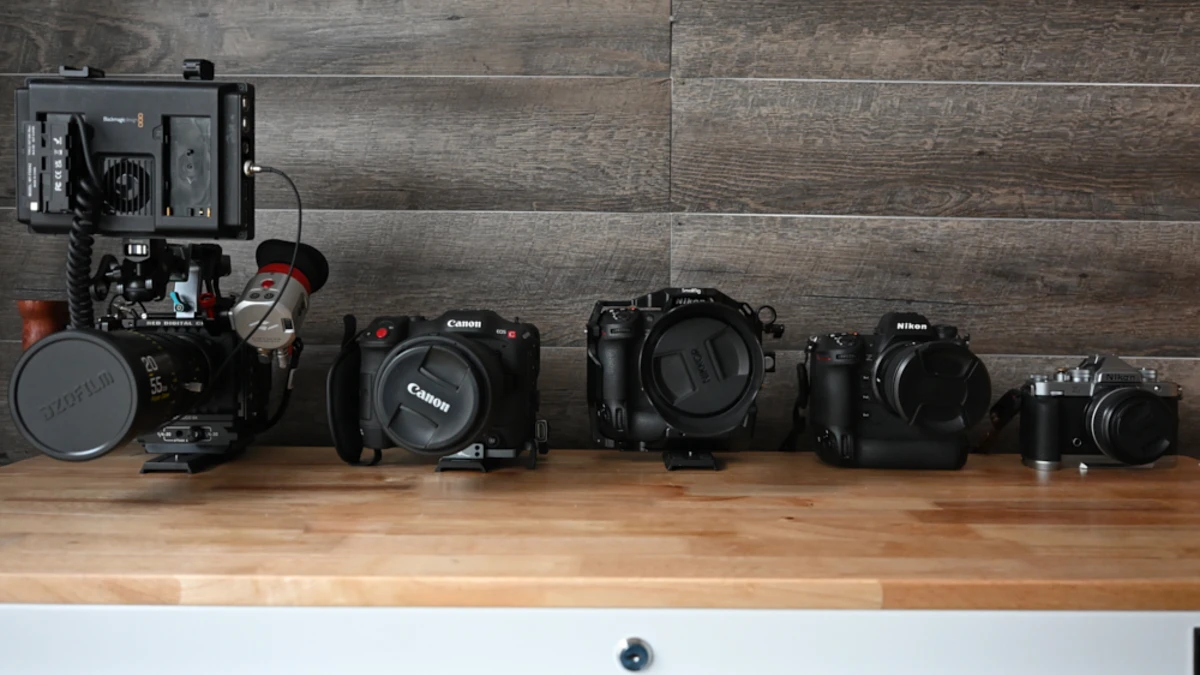
In my own personal lineup, the Nikon Z9 is the team captain. Why? Because the Z9 is the closest camera I’ve found to something that can do everything well. It’s my “desert island camera,” if you will. It is built like a tank, and I can take it to every job from shooting a commercial campaign to a feature film and know that it will do the job. This is why I have two of them. In professional work, you always need a backup. So, having two gives me protection if one should go down or provides a second angle if doing multicam work. For years, these two bodies were my entire camera lineup for both stills and video, and aside from some workflow issues, they could continue to be such now.
The RED KOMODO is my main tool for high-level commercial production. In my lineup, it is the camera with the absolute best video quality with its 16-bit R3D files. And, most importantly, it’s the camera in this lineup that my clients will accept with no questions asked. Note that I didn’t say the Z9 was incapable of these higher-end jobs. Simply that Nikon doesn’t carry the same weight with commercial producers as RED. And, unfortunately, brand names matter with certain clients. The KOMODO is the camera I bring out when I’m shooting for more traditional clients and agencies and they need to see a body they’ll feel more comfortable with. It is also the best camera in my lineup when working with larger team productions. Things like SDI outputs, hardwired timecode, genlock, and R3D’s workflow are less important when working as a one-man band. But when I’m only one part of a much larger crew, having tools that are purpose-built to work inside of a professional workflow when my crew (and the gear they bring) is all used to integrating with certain industry-standard tools is not only a plus. It’s a requirement. In fact, for some jobs, the KOMODO itself isn’t going to be enough, so I will still end up renting a higher-end camera like an ARRI ALEXA. But for my owned gear, the tools provided and budget required to acquire the KOMODO were a perfect fit for the role it was being asked to play.
Similarly, the Canon EOS C70 lands somewhere between a one-man-band camera and a more professional workflow. If you’ve used the C70, you already know about the unique image. Even at only 4K, the C70 just has something special. It also has the best native audio interface of any camera in my lineup. While I do normally record audio separately from image, there are jobs where being able to pack both a great image and multiple channels of high-quality audio into one physical device is the difference between success and failure. So, the C70 tends to be the camera that comes out when I’m doing audio-intensive projects that are below the budget level where a full audio team is an option. Interviews, direct-to-camera pieces, documentaries. Jobs where things like false color, lacking in my Z9 and slower to access in my KOMODO, or built-in NDs are going to save me time on set and make things more efficient.
The Nikon Z f serves the exact opposite end of the spectrum. Whereas the other team members are there to serve the professional end of the spectrum, none of them are particularly good at being incognito. All four scream “professional filmmaker/photographer.” If you live in a city like Los Angeles, which I do, where every security guard is trained to sniff out any hint of professional activity and treat it like a terrorist threat, being able to have a camera body that doesn’t immediately draw suspicion is a massive plus. Even if you aren’t trying to secretly sneak B-roll from a restricted area, sometimes you just want to go out and take some photos for fun without being hassled. The Z f’s retro style seems to put people at ease, while simultaneously, its internals still deliver excellent image quality.
Of course, the dream would be a small, inconspicuous camera that delivered Hollywood-level video quality and billboard-resolution stills, that had all the professional video scopes as well as built-in NDs, SDI, and XLR connections, but still came in an aesthetically pleasing body that somehow put strangers at ease but simultaneously impressed both high-end commercial clients and Hollywood crews and came at a reasonable price. But… since that camera doesn’t exist, at least to the best of my knowledge, there’s really only one answer for someone like me.
Instead of trying to find a camera that is one-size-fits-all, build a team of more affordable bodies that, when working together, can collectively build the platform that will allow you to serve all your client needs at a very high level. There’s no “I” in “team.” Build something that is greater than the sum of its parts.