



Few years have tested the hospitality industry in the Middle East as much as 2026. Commercial teams made decisions with limited visibility, rewrote their plans more than once and still produced results. Holding steady, adapting quickly and delivering under pressure are topics which will take centre stage at the HSMAI Commercial Strategy Conference MEA 2026 (CSC MEA 2026) under the theme “Resilience. Agility. Results. The spirit that defines MEA”.
In the lead-up to the event, Mona Faraj, President, HSMAI Middle East & Africa, asked six industry leaders how commercial strategy is changing, where the biggest challenges and opportunities lie over the next 12 months, and what the conference theme means in practice. Their insights reveal broad agreement on three priorities: bringing revenue, sales, marketing and distribution together as one commercial function, holding rate through discipline instead of discounting, and building longer-term guest relationships, with loyalty at the centre.
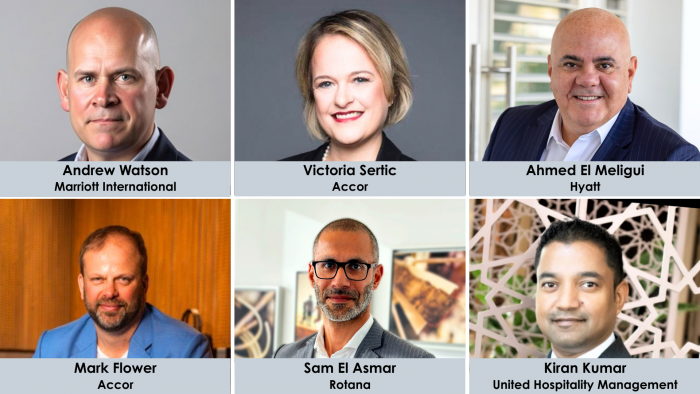
With inputs from: Sam El Asmar, Corporate Vice President – Revenue and Distribution, Rotana; Ahmed El Meligui, Regional Vice President, Sales, Revenue & Business Development Middle East & Africa, Hyatt; Mark Flower, VP Commercial Market Strategy, Middle East, Africa & Türkiye, Accor; Kiran Kumar, Regional Director of Marketing & Communications, ME & India, United Hospitality Management; Victoria Sertic, Senior Vice President, Brand, Marketing and Loyalty Middle East, Africa, Turkey & Asia Pacific Premium, Midscale & Economy, Accor and Andrew Watson, Chief Commercial Officer – EMEA, Marriott International.
What is the biggest transformation you are anticipating in commercial strategy in the next couple of years?
Sam El Asmar, Ahmed El Meligui and Kiran Kumar agree that the biggest transformation will be bringing revenue, sales, marketing and distribution together into one integrated, data-led commercial function, with AI speeding up the change. As Ahmed El Meligui puts it: “Sales, revenue, marketing, digital and distribution can no longer operate independently.”
Neither Sam El Asmar nor Kiran Kumar expects technology to make the final call. Sam El Asmar sees “technology supporting decisions while human judgement remains critical in interpreting market dynamics and defining strategy”. Kiran Kumar puts it more strongly: “I don’t believe AI is going to replace the commercial leader. If anything, I believe experience and judgement will become even more valuable.”
Kiran Kumar also wants commercial teams to move beyond room revenue. He argues the industry must “look at the total value of a guest and the total profitability of an asset”, from rooms and F&B to wellness and experiences.
Mark Flower goes further: “The shift from room-centric to total revenue management is now non-negotiable. The 2026 crisis proved room revenue alone is a vulnerability.” When occupancy across the GCC and UAE fell sharply, he says, “survival meant immediately monetising our physical footprint”. In his experience, “Properties that pivoted to ‘Asset Re-Imagined’ strategies, converting lobbies to co-working hubs and launching local lifestyle-led campaigns, stabilised fastest.”
Andrew Watson and Victoria Sertic both put the guest at the centre, moving away from broad, transactional approaches towards deeper and more personal relationships. Andrew Watson expects “the shift from broad, segment-based marketing to truly customer centric, insight-led demand generation”, with the aim “to reach the right customer, with the right offer, at the right moment”. For Victoria Sertic, the change is “the move from managing transactions to building guest lifetime value”, where “success will come from understanding the guest more deeply and creating personalised experiences across every touchpoint”.
What do you see as the single biggest commercial challenge and/or opportunity for hotels in the region over the next 12 months?
Kiran Kumar sets the tone: the next 12 months “will require us to be cautiously optimistic and commercially disciplined”. Despite the pressure to fill rooms and deliver the month, he believes the better question for commercial leaders is: “are we generating the right business at the right price and, importantly, at the right cost?”
For Mark Flower, the challenge is “resisting the urge to discount as we recover”. He says: “It is tempting to slash rates to chase occupancy, but price cuts do not create demand when safety concerns restrict travel; they only dilute value.” At Accor, he adds, combining pricing discipline with targeted loyalty offers, lifestyle-led packages and total revenue management contributed to “a 60% increase in weekend occupancy and 16.7% growth in domestic UAE demand during the crisis”.
Sam El Asmar also expects pressure on rate, driven by new supply: “The biggest challenge will be maintaining profitable growth as hotel supply continues to expand across key Middle East markets. Demand remains strong, but greater competition will put pressure on rate and market share.” His answer is to become “much more disciplined around segmentation, pricing, and channel mix”.
Victoria Sertic likewise weighs strong demand against rising competition: “The opportunity is clear: travel demand across MEA APAC remains incredibly strong, supported by growing middle classes, increased connectivity and major destination investments. The challenge is standing out in an increasingly competitive environment.” She sees loyalty as key, “helping hotels create lasting relationships rather than competing solely on price or promotion”.
Andrew Watson shows where that demand is growing. Across EMEA, he points to “strong growth in luxury travel, branded residences, safari experiences, domestic travel and midscale accommodation”. He adds: “At the same time, traveller expectations are becoming more diverse and experience driven. Hotels that can leverage customer insights, loyalty, localised commercial strategies and strong brand positioning will be best placed for success.”
Mark Flower and Ahmed El Meligui both point to shorter booking windows and increasingly regional demand. Mark Flower sees the greatest opportunity in capturing resilient regional and domestic demand, as travellers book later and expect more flexibility. Ahmed El Meligui says: “Across MEA, we have seen booking windows shorten significantly and demand become increasingly regional and market specific. Domestic and intra-regional travel, MICE, events and loyalty can create significant opportunities, while international demand can recover quickly. Hotels that understand their source markets, react quickly and combine sales, revenue, digital and marketing behind one strategy will be best positioned to capture that demand.”
The 2026 conference theme is “Resilience. Agility. Results.” What does this mean in practice for commercial leaders from your perspective?
Victoria Sertic and Andrew Watson agree that resilience is about the long term, building value and guest relationships that last through market volatility, while agility means responding quickly to changing customer behaviour. Victoria Sertic captures the balance: the most successful organisations will be “those that combine long-term brand and loyalty building with the ability to act quickly and decisively in the moment”.
Ahmed El Meligui defines all three words in one sentence: “For me, resilience is staying focused when conditions change; agility is having the courage and capability to change the plan quickly; and results come from disciplined execution.” In MEA, he says, the strongest response is “rarely blanket discounting”. Instead, it lies in understanding what demand is still available and creating relevant value.
Mark Flower makes the same point, warning against reactive discounting. For him, resilience means “protecting brand value and customer trust during disruption”, and agility means pivoting instantly, whether by reallocating investment to resilient markets, activating loyalty channels or launching targeted offers.
Sam El Asmar sees resilience as “building strategies that can survive rapid changes in demand” and results as “ensuring every commercial action delivers measurable value”. In practice, he says, “this requires strong forecasting, faster decision-making and close alignment across revenue, sales, marketing and distribution”. Victoria Sertic and Kiran Kumar agree that teams need to work as one. Victoria Sertic extends this to loyalty and operations, and Kiran Kumar believes the days of each department working to its own targets are disappearing.
Andrew Watson also holds results to a hard measure, looking for “measurable outcomes for owners through profitable revenue growth, stronger channel mix and increased loyalty engagement”. Kiran Kumar says: “Activity is not the same as impact. We need to ask whether what we are doing is actually driving profitable revenue, improving customer value and creating value for the owner.” He sums up the theme: “So, for me, Resilience is about staying the course, Agility is about knowing when to change course, and Results are about making sure the course is taking us close to our goals.”
These questions will be debated at Conrad Dubai on 17 and 18 November, when CSC MEA 2026 brings together the region’s leading hospitality experts in sales, marketing, revenue management and distribution. This year’s programme features 18 hours of learning and insights across 40 sessions, nine engaging content formats, 65+ expert speakers, seven ROCKSTAR award finalists, and four hours of networking to turn conversations into connections. For full details of the conference, click here.